[ Retro Scan of the Week ] Corvus Apple II Hard Drive
November 16th, 2009 by Benj Edwards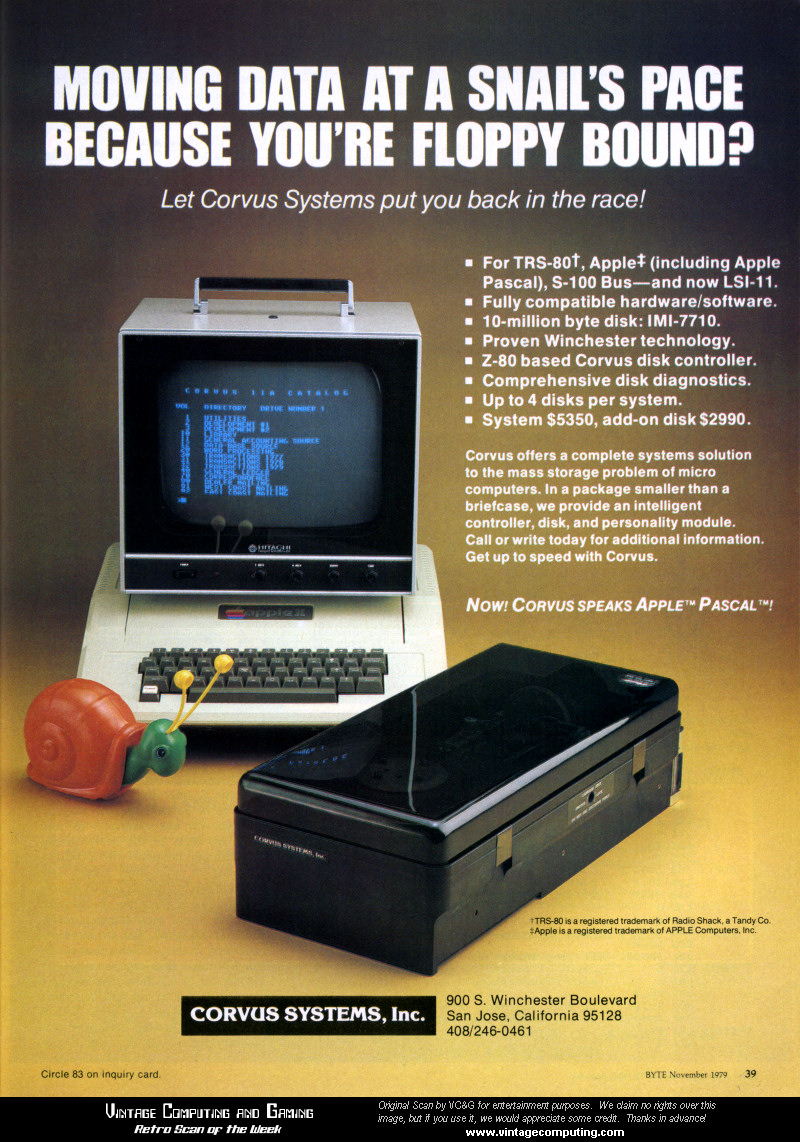 The snail was not amused.
Wow. $5,350 for a 10 megabyte hard drive system that’s almost as big as your computer. What a bargain! It’s like a tiny coffin for your data.
In case you’re taking notes, this Corvus hard disk system sold for $15,915.07 in 2009 US dollars. Its retail price constituted a whopping 53% of the average American’s yearly income in 1979 (about $10,121). Yes, in 1979, you could spend half of your annual salary on a single 10MB hard drive setup.
Just out of curiosity, how many of you owned a hard disk for your PC before 1985? Raise your hand.
Not many, and now you see why. Even as prices dropped, most hard disks were well out of the realm of affordability for most home PC users in the 1970s and 80s. Even at 1/5th the cost, this hard drive would have still been beyond the reach of most US households.
Discussion Topic of the Week: What was the size (data capacity) of your first computer hard drive?


November 16th, 2009 at 1:54 pm
In 1991, we finally got a computer (286) with a hard drive. Actually, there were 2– a 20 MB and a 40 MB. I still remember what DOS “types” these hard drives were: types 2 and 44, respectively. This was back in the day when DOS knew about 46 different types of HDs, plus type 47 which was some emerging standard called IDE, per my recollection. 🙂
November 16th, 2009 at 3:39 pm
Early 90s, on a 286, a 10 meg hard drive. Yes, 10 megs. It made a distinctive sound compared to the standard Seagate drive. Managed to shoehorn Windows 3.0 on it.
November 16th, 2009 at 4:45 pm
My first computer was a Packard B(H)ell with a whopping 1GB hard drive. What did I do with all that space? I backed up an entire CD! (no compression) I could listen to all 15 songs without a disk! After three days I deleted the backup so I had room to load Flight Unlimited.
November 16th, 2009 at 4:48 pm
The first hard drive I owned was a 20MB Hardcard (ISA) in an Zenith Data Systems 8088 computer.
November 16th, 2009 at 5:59 pm
The first computer with a hard drive I (well, my parents) owned was a Packard Bell 486SX-50 with a 420 meg hard drive. I remembered about wo years later my parents spending about $200 to replace that hard drive with a 1.2 gigabyte one. Nowadays, people give away USB flash drives that are bigger. I’m not sure whether to be amazed, or to be depressed. I’m going to go with the former, I think.
November 17th, 2009 at 12:35 am
My first was a 40 MB quantum drive inside of an Amiga 3000 in 1991.
It’s hard to believe today that I have an SD card in my camcorder that holds 16 GB!!!
November 17th, 2009 at 3:57 am
Benj, something’s not right with the RSS feed: at least clicking from Google Reader on last two entries brings me to a 404. Used to work ok.
November 17th, 2009 at 11:14 am
Thanks for letting me know, svofski. I’ll look into it.
November 17th, 2009 at 11:35 am
In Jr. High, there was an old Apple II+ sitting unused amongst all the IIe’s and the then-new Mac LCs (and LCIIs a year later). Being the antisocial computer geek, I got to have this thing basically all to myself. The best part, there was also a Corvus hard drive with it! Excepth, it looked a lot different than this picture. The one I remember had 3 lights in fron (power, activity and something else- error maybe?), was approxiamately the same color as the II+, and I believe was a little wider. It had outputs on the back to hook up a VCR to store images of the drive for backup purposes!
Personally, the first computer I had with a hard drive is a still-running 8088 that had 1, then later 2, 20MB Seagate ST-225s. I remember being almost ashamed when I managed to fill one up.
November 17th, 2009 at 11:35 am
Ok, I think I fixed the RSS feed problem. Feedburner changed something about how they manage feeds and it screwed things up. Luckily, I managed to turn off those features and get things working again.
November 18th, 2009 at 1:17 am
I remember the Corvus hard drive. In fall 1983 I was taking a course on Pascal. ACC (Austin Community College) had a computer center with Apple IIe computers and we checked out the Apple Pascal disks and booted from the floppy drives.
In Spring 1984 I was taking a course on Linear Algebra and in my spare time (trying to avoid rush hour traffic so I stayed at the school) I went to the computer center when it was not busy and began writing some programs in Apple Pascal to manipulate matrices – those with integer elements. I wanted to be able to calculate determinants and other useful things, and keep my programming skills fresh. During that semester the center had gotten a Corvus Hard Drive and had networked all the Apple IIe computers to it. I have a vague recollection they also had a VCR for backup, but never saw it in operation.
I got an account on the hard drive and it was sure nice to be able to load programs and data from the hard drive and not floppy disks. But I managed to crash the hard drive one day.
My Apple Pascal programs had a lot of procedures and includes and when it came time to compile, the floppy drive would be accessed very often. So using the hard drive, even over a network, was much faster. The day the Corvus crashed, I realized that the Apple IIe did not have the entire compiled program in memory, most of the program was still on the Corvus. So every time a procedure was called the request would go over the network to the Corvus, and as other students would be in the center also accessing the drive, but not as much as my program, the Corvus got overwhelmed.
I had written a little procedure for validating every keystroke because I had to use strings, the Apple Pascal integer input routine would hang if a non-integer character was pressed. That little validation routine had to be called from the server for every key press, and so when entering a matrix, that’s a lot of network hits.
Once I had realized what a disaster the program was on the network, I quietly stopped my work that day and never wrote another program to run on the network. Also, my other schoolwork and job were loading me up so I did not have time for programming any longer. I also realized that microcomputer programming languages had a long way to go before they would be ready for bigger projects. Memory was so expensive that the small processors like the 6502 maxed out was still a whopping lot of money.
Four years later I bought a CompuAdd 286 computer with a 20 megabyte hard drive, 4 banks of 256K memory, an EGA monitor, and a printer for $2000. All that for less than that Corvus cost.
Electronic and mechanical technology still advances, more function for less money.
November 20th, 2009 at 3:46 am
My first drive was an 80 Mb Seagate? (I think) in a 386. My next was a 120 Mb drive in a Mac SE/30. I still have the latter, and it’s still functional 🙂
November 20th, 2009 at 8:19 am
The first harddrive I used was a 10MB 5.25” monster in a Commodore PC-20. It was a 8088 based machine in a desktop case. Had a clicky keyboard and Hercules monochrome display unit. I used to try programming dbase and gwbasic on that ‘puter.
I also had an Amiga 1000 at that time (I still have it by the way), and I thought I would never have used a PC, if it wasn’t for the harddisk.
Some weird thing about the early harddrives was that, you had to park their heads manually by running a command before you physically moved the computer. Else all your data could be toast.
November 20th, 2009 at 11:27 am
Bought a gateway 486sx25 with a 120mb HD in 1992. Upgraded from an atari800xl with 3 floppis but no HD. 80mb HDs were the norm it seemed, and my 120 seemed huge. I said it would last forever and never be filled.
December 8th, 2009 at 7:38 pm
My first hard drive was a Seagate 64MB RLL drive for my Hyundai XT compatible. I was the envy of all my friends who were stuck with a tiny 40MB hard drives. Now I have files bigger than that sitting on my desktop!!
February 3rd, 2010 at 4:04 pm
I am in possession of a Corvus hard drive. Is there any museum that may be interseted in it? Does it have any value today?
February 11th, 2010 at 3:38 pm
I kept my first system, a Heath/Zenith Z-90….10mb Corvus Model 10B Serial Number 482-bh0370, and a Corvus Multiplexer Model Hmux Serial Number 402-M0427 one of the worlds first routers. Both Units are Revision B. Make me an Offer………
June 6th, 2012 at 10:17 am
first hard drive i owned was back in 2001 when my siaster bought a computer for me for christmas and it was a hp running windows me and came with a 20gb drive funny how things change my current system has four drives totalling to 6tb of space and a laptop with 500gb and one old windows 98 machine for dos games with 40 gb drive i have other drives just sitting around most are not bigger than 1gb though and the first computer i used with a hard drive was a macintosh running system 7.5 but i dont know the size and cant remember when it was but using a computer before that was nothing but floppies all through grades 1-5 which was apple ii
April 21st, 2013 at 3:13 pm
The family’s first hard drive was a 10MB Seagate MFM in 1986. My first hard drive was a 40MB IDE (don’t even remember the brand!) in 1989.
February 7th, 2014 at 7:06 pm
had a corvus hard drive in 1979 10 MB. used it with a dc hayes modem at 30 baud. retro-fitted a plotter for a printer. i used those in my commodity trading.
September 17th, 2014 at 3:26 pm
I have that poster on my office wall! I worked at Corvus from 1979-1988. Despite the price, we couldn’t keep up with orders in the early days. What the picture doesn’t show is the power supply, which was about the same size as the drive but 1/2 as wide. The drive Ben remembers was a later model, where the drive & power supply were in a big old case. (3rd LED was “Fault”) They did have an optional board in there called the Mirror that would back up the drive to videotape. If you had a fancy Panasonic VCR, you could control it via the backup software. Took about 30 minutes to back up the full 10 mb, IIRC. I wish I still had one to connect to my Apple II+ which is sitting in storage.
August 22nd, 2015 at 10:47 pm
The company I worked for in ’79 had this drive on a TRS-80 model 1 with a couple of floppy disks. In its day it was amazing leading edge technology.