Archive for 2008

Simon Turns 30

Friday, July 25th, 2008
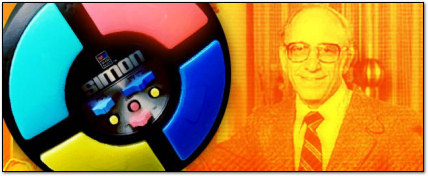
Milton Bradley SImon 30th Anniversary

Like an alien mothership come home, a small flying saucer surveyed the pulsing, Technicolor scenery of Manhattan’s trendy Studio 54 dance club. The saucer, a four-foot replica of a mysterious electronic toy, hung overhead in preparation for an unveiling later in the night. Yet the revelers below, entranced by thumping disco and free-flowing decadence, barely noticed the invasion in progress.

Further up, in the pitch black balcony, a 56 year-old engineer from New Hampshire fought off drowsiness and reminded himself why he had attended the deafening event: among the glamorous movie stars, the blasting music, and the swirling mirrored balls, it was his creation they were there to celebrate.

At approximately 3 AM on the morning of May 16th, 1978, the music stopped. The dazed crowd parted like the Red Sea, and a middle-aged man — the Vice President of Milton Bradley — took the stage to introduce the company’s latest toy, a curious wheel of blinking colored lights and musical tones called Simon that would soon become the must-buy gift of Christmas 1978.

In the balcony, the engineer smiled: he had reached the end of a story that had begun, surprisingly, six years earlier.
[ Read more about Simon’s creation at 1UP.com ]

[ Retro Scan of the Week ] Robots + Golf = Brilliant!

Monday, July 21st, 2008

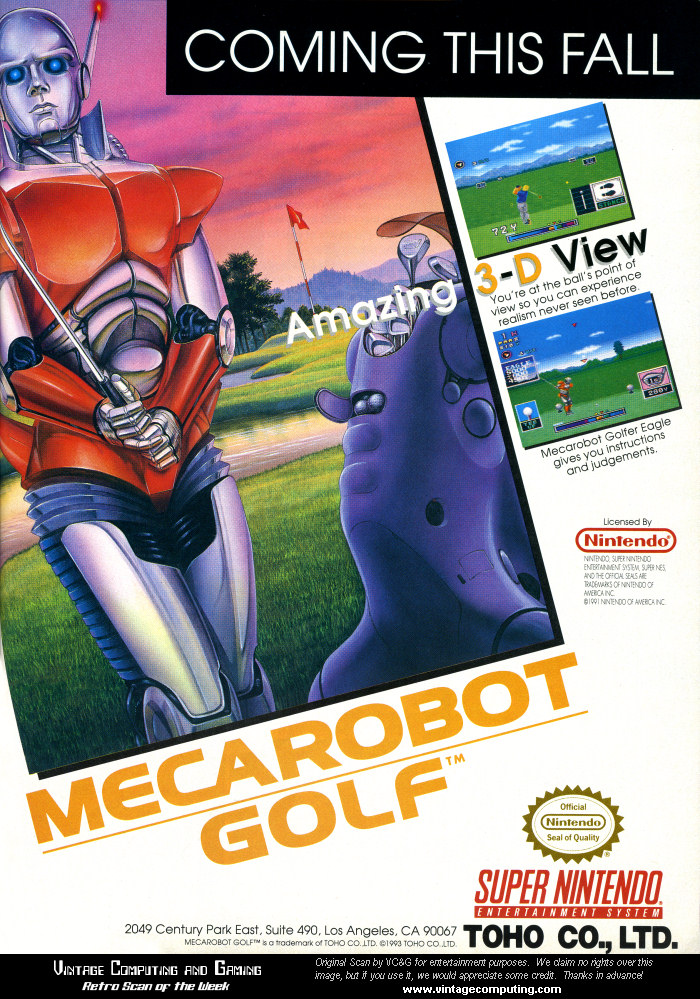
Mecarobot Golf Ad - SNES - 1993Something is crooked in the state of Denmark.

Leave it to the Japanese to create a fantasy golf game with androids, robotic caddies, and floating islands in the sky. As usual, they were quite forward-looking in 1993: they knew that some day, androids would be better at golf than humans.

I’ve actually tried my hand at this game a few times, and it’s weird. While the 3D engine is cool, it’s painfully slow; you can easily doze off while waiting for the screen to redraw.

[ Correction – 07/21/2008 ] I just played Mecarobot Golf again, and it seems that my memory was flawed. The whacked-out SNES Golf game I recalled above was actually Devil’s Course. Now that is a crazy golf game. Mecarobot Golf still contains robots, but it features a smooth Mode 7 engine.

[ From Electronic Gaming Monthly, June 1993 ]

Discussion topic of the week: What’s your favorite video or computer golf game?

If you use this image on your site, please support “Retro Scan of the Week” by giving us obvious credit for the original scan and entry. Thanks.

[ Retro Scan of the Week ] Floppy Girl Doesn’t Remember

Monday, July 14th, 2008

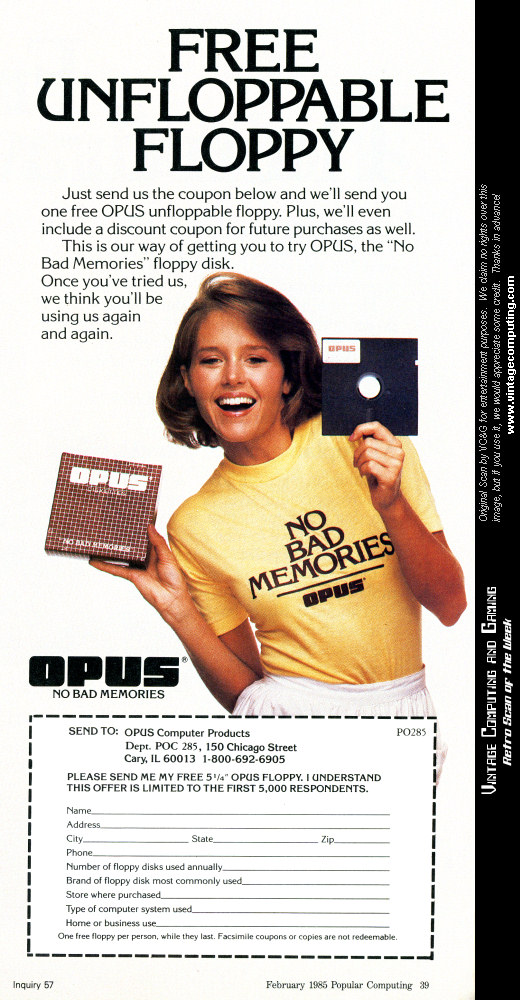
Floppy Girl - Opus Floppy Disk Ad - 1985Click above for full ad.

“No Bad Memories.”

That sounds more like a slogan from a denial-centric pop psychology movement or a dystopian memory-wiping company than from a maker of computer diskettes. It would be easy to dismiss this marketing tagline as absurd, were it not for the enthusiastic bearer of the message: a buoyant, bubbly woman cheerfully peddling OPUS-brand floppy disks. Indeed, she looks like her brain was totally wiped clean by OPUS’s technical staff some time in the early 1980s — a testament that their memory technology really works.

By the way, here’s a high-resolution scan of Floppy Girl in PNG format for those of you out there who might want to turn it into a desktop background. Or print it out and impress your nerd friends with vintage floppy pin-up art.

[ From Popular Computing, February 1985 ]

Discussion topic of the week: Have you ever lost important computer data to a hard drive or disk failure? Share your disaster stories below.

If you use this image on your site, please support “Retro Scan of the Week” by giving us obvious credit for the original scan and entry. Thanks.

Inside the World’s Greatest Keyboard

Wednesday, July 9th, 2008

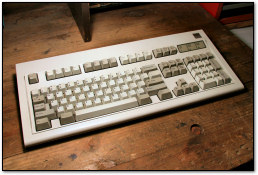
Inside the World\'s Greatest Keyboard - PC World

Today, PC World published the latest in my line of workbench tech autopsies. This time I dissected the venerable IBM Model M Keyboard, which some call the greatest keyboard of all time (obviously, I agree with them). While I took all the pictures as usual, the caption bubbles on a couple of the slides are courtesy of PC World’s art department. Here’s an excerpt from the introduction:

IBM’s Model 5150 PC, released in 1981, was a classic, perhaps the computer most responsible for launching the PC revolution. Sadly, however, its keyboard did not live up to that standard. This 83-key model was IBM’s first, and critics hated it, complaining about its awkward layout and nonstandard design. Stung by the criticism, IBM assembled a ten-person task force to craft a new keyboard, according to David Bradley, a member of that task force and of the 5150’s design team. Their resulting 101-key design, 1984’s Model M, became the undisputed bellwether for the computer industry, with a layout that dominates desktops to this day. As we peek under the hood of this legend, you’ll soon see why many consider the Model M to be the greatest keyboard of all time.

It’s no secret that the title “world’s greatest” ultimately comes down to a matter of opinion. Like the 10 Worst PC Keyboards of All Time, many people are bound to disagree. That’s OK. Feel free to share your picks for the greatest (or simply your favorite) keyboard of all time in the comments below.

(By the way, if you liked this piece, you might also enjoy checking out my previous teardowns of the Apple IIc and the TRS-80 Model 100.)

[ Retro Scan of the Week ] Blaster Master 2

Monday, July 7th, 2008

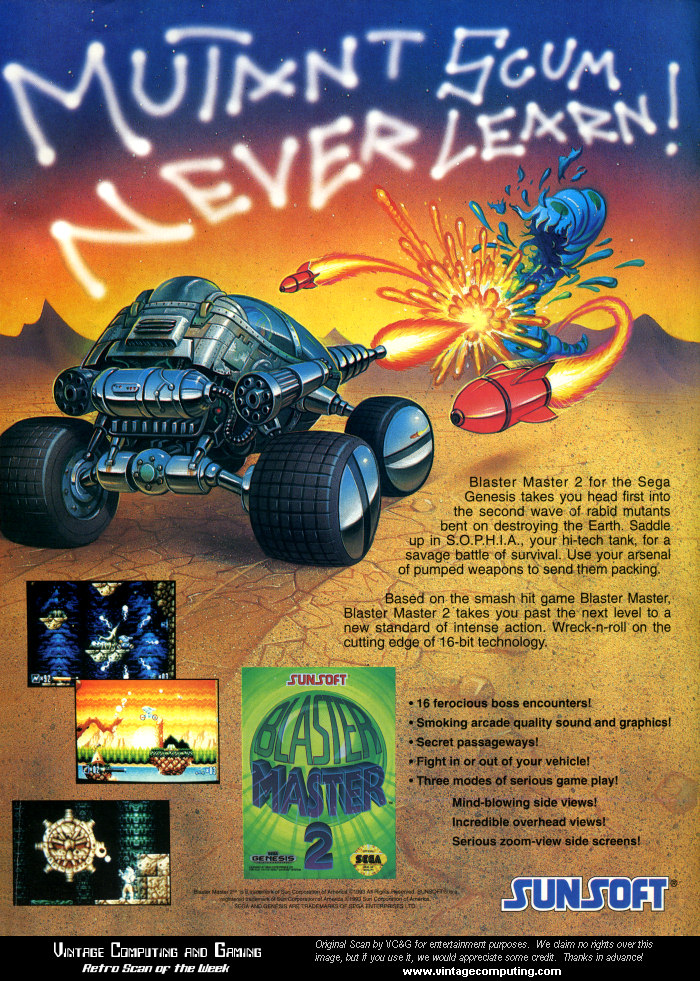
Blaster Master 2 Ad - 1993“Mutant scum never learn!”

Being a huge fan of the original Blaster Master for the NES, I went gaga when I first discovered that Sunsoft had developed (yes, I missed it at the time, along with everyone else) a Blaster Master 2 for the Sega Genesis. And so it was that BM2 became one of the first Genesis games I emulated on a PC in the mid-late 1990s. And I was disappointed.

If you get past Blaster Master 2’s horribly tinny FM-synthesis music, you’ll find a cartoonish technicolor imitation of the original. BM2 somehow lacks the epic feel of the original Blaster Master (maybe it’s the color palette), and instead resembles a straight-up Turrican-esque 16-bit platform shooter. Still, if I could get past the first stage (and turn down the volume), I feel like BM2 might be fun.

[ From Electronic Gaming Monthly, June 1993 ]

Discussion topic of the week: What’s your favorite Sega Genesis / Mega Drive game of all time?

If you use this image on your site, please support “Retro Scan of the Week” by giving us obvious credit for the original scan and entry. Thanks.

[ Retro Scan of the Week ] Where’s the Bits?

Monday, June 30th, 2008

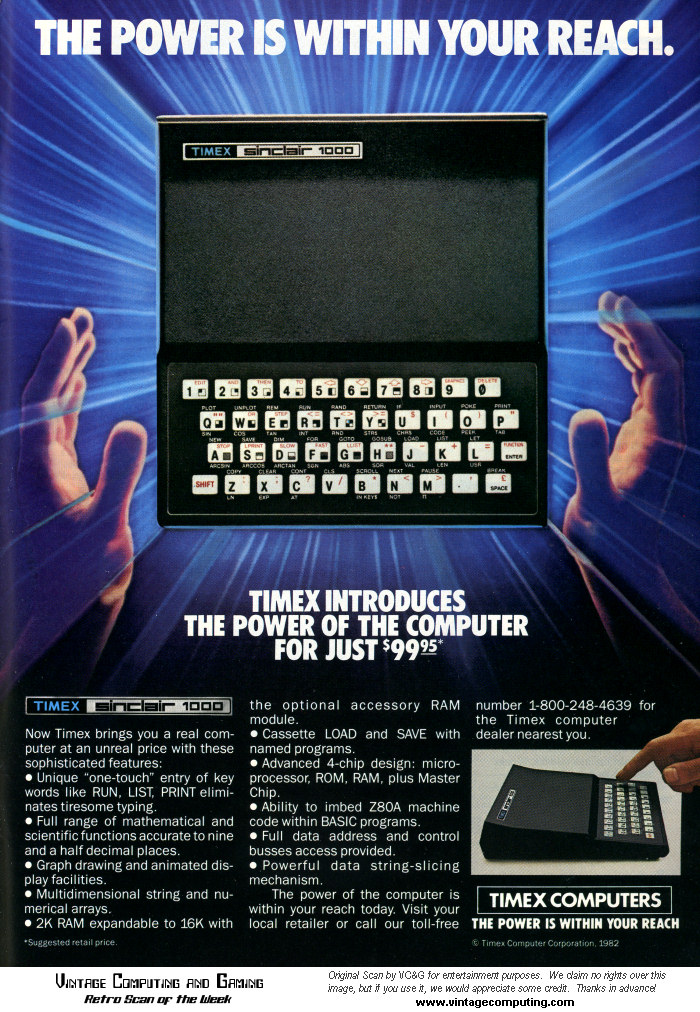
Timex-Sinclair 1000 Ad - 1982Fabulous secret powers were revealed to me the day I held aloft my magic computer….

The tiny computer you see above originated in the UK as the Sinclair ZX81, a wildly successful build-it-yourself kit computer. Due to strong sales, Timex struck a deal with Sinclair to market a fully assembled version of the ZX81 in the United States. They rechristened the unit “Timex-Sinclair 1000,” and the minuscule wedge became the first PC to sell for under $100 (US) fully assembled.

The diminutive, Z80-based 1000 was severely limited in function by its tiny membrane keyboard, its black & white display, no sound capabilities, and only 2K RAM. Despite that, it sold well in the US thanks to an incredibly low price. These days, Timex-Sinclair 1000s are relatively easy to find, and thanks to their nice shape, they make great doorstops.

[ From Personal Computing, 1982 ]

Discussion topic of the week: What’s the cheapest computer you’ve ever bought?

If you use this image on your site, please support “Retro Scan of the Week” by giving us obvious credit for the original scan and entry. Thanks.

Ten Things Everyone Should Know about Space Invaders

Thursday, June 26th, 2008

Space Invaders 30th Anniversary

Yep, it’s that time again: time to premiere a new Benj-crafted VC&G-related article from another site. Today we’re celebrating the 30th anniversary of Space Invaders, and my ode to the seminal space shooter can be found on 1UP.com. I think the piece turned out well — 1UP did an especially good job with the illustrations. Here’s a blurb from the introduction:

Thirty years ago this month, Taito released Space Invaders, one of the most important and influential videogames of all time, to Japanese arcades. You might know that it set its native Japan ablaze and drove America crazy, but have you ever wondered why? Well, you’re about to find out. Here are 10 things everyone should know about Space Invaders.

Feel free to check out the article; I think you’ll enjoy it. When you’re done, tell us some of your Space Invaders memories. When was the first time you played it? What did you think of it at the time?

[ Retro Scan of the Week ] Virtual Reality, Real Carpal Tunnel Syndrome

Monday, June 23rd, 2008

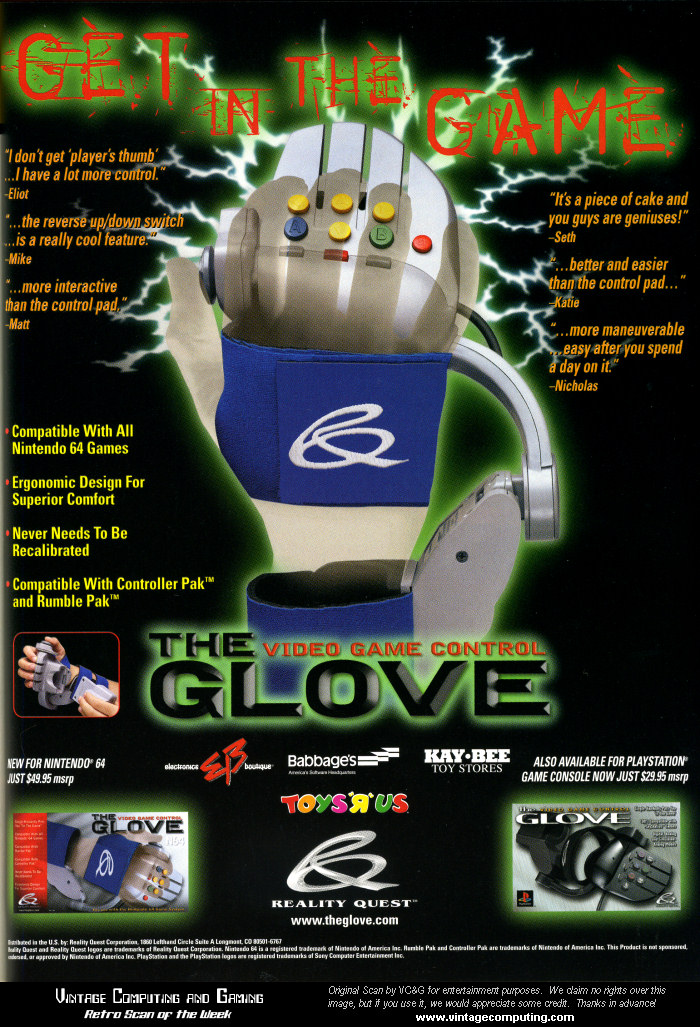
Video Game Glove Controller Ad - 1998“…easy after you spend a day on it.” Then your hand snaps off.

Of all the weird contraptions pitched by obscure third-party controller manufacturers, the Video Game Control Glove ranks among the worst. I have but a simple question: in what way was the regular Nintendo 64 controller bad enough to inspire someone to redesign it into an impractical novelty shape that likely promotes wrist injury? Better yet, why does anybody do anything stupid?

Because somebody, somewhere, thought it was a good idea at the time. (And someone else gave them money.)

Image DescUpon closer inspection of this ad, you’ll notice that the company behind this needless exercise in hand strain called itself “Reality Quest.” That explains a lot: exactly 83% of the dumbest video game peripherals ever made were ill-conceived attempts to capitalize on the early 1990s media hype around “virtual reality” (case in point, the StuntMaster headset). At the time, virtual reality was always just around the corner, courtesy of strap-on goggles and gangly game gauntlets that engulfed your hand in gaudy gadgetry.

I’ve never used the Glove; my guess is that it falls somewhat short of turning Mario 64 into an immersive virtual reality experience. But the next time I need a controller whose function requires rapid, repetitive contortions of one of weakest and least durable joints in the human body, I’ll keep it in mind.

[ From Electronic Gaming Monthly, November 1998 ]

Discussion topic of the week: What’s the worst video game peripheral you’ve ever bought?

If you use this image on your site, please support “Retro Scan of the Week” by giving us obvious credit for the original scan and entry. Thanks.

2008 VC&G Forum Contest Winners

Sunday, June 22nd, 2008

Vintage Computing and Gaming Forum ContestWell, our first forum contest was a spirited one. Its goal was to stimulate activity on our previously stagnant forum, and it succeeded. We saw many new members arrive and many interesting discussions held.

After a month of battling it out for post supremacy, I’m sure our contestants are anxious to hear the results. So without much further ado, I’m proud to announce the winners of our 2008 VC&G forum contest.

[ Continue reading 2008 VC&G Forum Contest Winners » ]

30 Years of x86 on PC World

Tuesday, June 17th, 2008

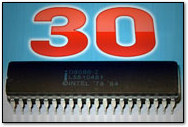
30th Anniversary of 8086 / x86 StandardThirty years ago this month, Intel released the 8086 microprocessor, the originator of the now-famous x86 standard and the ultimate progenitor of most modern consumer CPUs.

But what, exactly, does all that mean? Well, think of it this way: any assembly language program written as far back as 1978 for the Intel 8086 will run, unmodified, on Intel’s latest Core 2 Extreme released in 2008 — only 180,000 times faster.

The thirty-year tale of x86 began when an Intel engineer named Stephen P. Morse defined the 8086 instruction set (the core group of instructions that define what a microprocessor can do) while working at Intel in the late 1970s. That same instruction set would go on to form the basis of the world’s most popular personal computer architecture. Even the once-insular Macintosh platform, the last mainstream bastion of the non-Intel world, now runs on x86 processors.

Stephen P. MorseWhat’s going on here, and how did it get that way?


PC World recently published a feature I wrote on the anniversary that answers those questions, along with an in-depth interview I conducted with Stephen P. Morse, designer of the 8086 and the original x86 instruction set.

Anyone interested in PC history, or how this standard came to be, should check them out. For better or for worse, x86 is what we’re stuck with, so I feel that it is important for computer users to understand it.

I hope you enjoy the article.