<?xml version="1.0" encoding="UTF-8"?><!-- generator="wordpress/1.5.2" -->
<rss version="2.0" 
	xmlns:content="http://purl.org/rss/1.0/modules/content/">
<channel>
	<title>Comments on: [ Retro Scan of the Week ] Sharp Retro Scanner</title>
	<link>http://www.vintagecomputing.com/index.php/archives/377</link>
	<description>The Retrogaming and Retrocomputing Blogazine</description>
	<pubDate>Wed, 08 Sep 2010 20:34:49 +0000</pubDate>
	<generator>http://wordpress.org/?v=1.5.2</generator>

	<item>
 		<title>Comment on [ Retro Scan of the Week ] Sharp Retro Scanner by: Benj Edwards</title>
		<link>http://www.vintagecomputing.com/index.php/archives/377#comment-14444</link>
		<pubDate>Sun, 21 Oct 2007 16:01:01 +0000</pubDate>
		<guid>http://www.vintagecomputing.com/index.php/archives/377#comment-14444</guid>
					<description>zoyous, I believe that the neat rainbow effect on certain Atari 2600 games is due to an &quot;undocumented feature&quot; (flaw in the TIA chip) that allows the programmer to change colors mid-scan line as it draws the screen.  That's why the rainbow effects were usually limited to the background or simple shapes.  Feel free to clarify this, anyone.  I'm just going by what I remember reading recently.

And Moondog, the Macs of the time all had SCSI interfaces, so I'm not sure what the scanner's native interface was.  Maybe a parallel port?  That's what my old PC scanners used to use.</description>
		<content:encoded><![CDATA[	<p>zoyous, I believe that the neat rainbow effect on certain Atari 2600 games is due to an &#8220;undocumented feature&#8221; (flaw in the TIA chip) that allows the programmer to change colors mid-scan line as it draws the screen.  That&#8217;s why the rainbow effects were usually limited to the background or simple shapes.  Feel free to clarify this, anyone.  I&#8217;m just going by what I remember reading recently.</p>
	<p>And Moondog, the Macs of the time all had SCSI interfaces, so I&#8217;m not sure what the scanner&#8217;s native interface was.  Maybe a parallel port?  That&#8217;s what my old PC scanners used to use.
</p>
]]></content:encoded>
				</item>
	<item>
 		<title>Comment on [ Retro Scan of the Week ] Sharp Retro Scanner by: Moondog</title>
		<link>http://www.vintagecomputing.com/index.php/archives/377#comment-14443</link>
		<pubDate>Sun, 21 Oct 2007 04:57:24 +0000</pubDate>
		<guid>http://www.vintagecomputing.com/index.php/archives/377#comment-14443</guid>
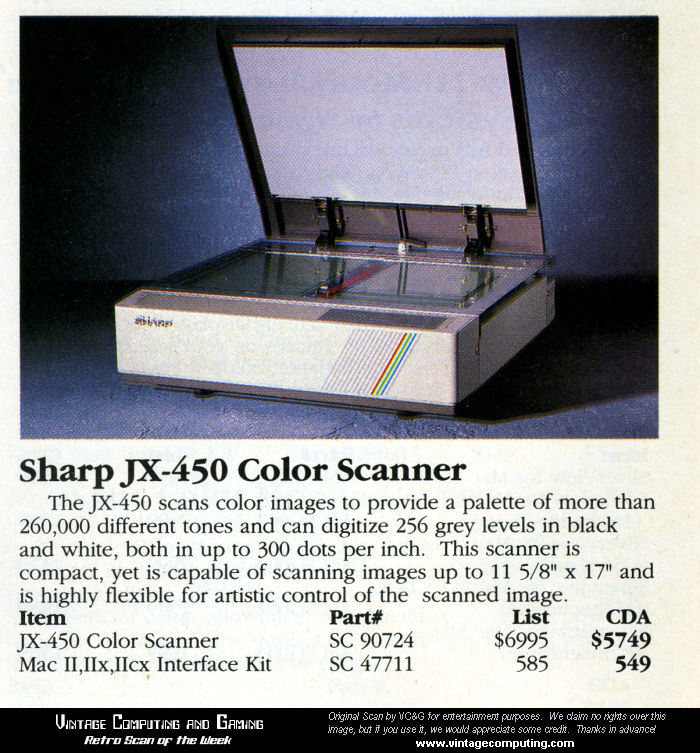
					<description>Wow, $549 extra to hook it to a Mac!  I wonder what type of interface it natively came with?  Some flavor of SCSI?  Makes me thankful for standardized interfaces.</description>
		<content:encoded><![CDATA[	<p>Wow, $549 extra to hook it to a Mac!  I wonder what type of interface it natively came with?  Some flavor of SCSI?  Makes me thankful for standardized interfaces.
</p>
]]></content:encoded>
				</item>
	<item>
 		<title>Comment on [ Retro Scan of the Week ] Sharp Retro Scanner by: zoyous</title>
		<link>http://www.vintagecomputing.com/index.php/archives/377#comment-14442</link>
		<pubDate>Sat, 20 Oct 2007 18:20:49 +0000</pubDate>
		<guid>http://www.vintagecomputing.com/index.php/archives/377#comment-14442</guid>
					<description>Thanks Mike.  I'd like to see some screenshots of those hacks!  

I always thought it was interesting that there was so much debate among me and my friends about which of the 8-bit systems had &quot;better graphics&quot; and could display more colors, when the Atari 2600 could actually display more colors than either the SMS or the NES... an ability which Activision often utilized for their beautiful background sunsets in many of their titles.</description>
		<content:encoded><![CDATA[	<p>Thanks Mike.  I&#8217;d like to see some screenshots of those hacks!  </p>
	<p>I always thought it was interesting that there was so much debate among me and my friends about which of the 8-bit systems had &#8220;better graphics&#8221; and could display more colors, when the Atari 2600 could actually display more colors than either the SMS or the NES&#8230; an ability which Activision often utilized for their beautiful background sunsets in many of their titles.
</p>
]]></content:encoded>
				</item>
	<item>
 		<title>Comment on [ Retro Scan of the Week ] Sharp Retro Scanner by: Multimedia Mike</title>
		<link>http://www.vintagecomputing.com/index.php/archives/377#comment-14434</link>
		<pubDate>Tue, 16 Oct 2007 20:48:43 +0000</pubDate>
		<guid>http://www.vintagecomputing.com/index.php/archives/377#comment-14434</guid>
					<description>@zoyous: I don't remember exactly, but the NES' palette specs have to do with some electrical engineering details. Wikipedia currently reports that the hardware had 48 RGB colors and 5 grey levels (so 53 colors total). However, I remember that some NES hackers have put together some custom ROMs which do special timing tricks, the upshot of which are to display many more colors (10s, maybe 100s of thousands) on screen at once. So the 52 or whatever limitation was not absolute.</description>
		<content:encoded><![CDATA[	<p>@zoyous: I don&#8217;t remember exactly, but the NES&#8217; palette specs have to do with some electrical engineering details. Wikipedia currently reports that the hardware had 48 RGB colors and 5 grey levels (so 53 colors total). However, I remember that some NES hackers have put together some custom ROMs which do special timing tricks, the upshot of which are to display many more colors (10s, maybe 100s of thousands) on screen at once. So the 52 or whatever limitation was not absolute.
</p>
]]></content:encoded>
				</item>
	<item>
 		<title>Comment on [ Retro Scan of the Week ] Sharp Retro Scanner by: zoyous</title>
		<link>http://www.vintagecomputing.com/index.php/archives/377#comment-14433</link>
		<pubDate>Tue, 16 Oct 2007 19:12:26 +0000</pubDate>
		<guid>http://www.vintagecomputing.com/index.php/archives/377#comment-14433</guid>
					<description>Speaking of powers of two and odd color palettes, does anyone know why the NES had a palette of 52 colors?</description>
		<content:encoded><![CDATA[	<p>Speaking of powers of two and odd color palettes, does anyone know why the NES had a palette of 52 colors?
</p>
]]></content:encoded>
				</item>
	<item>
 		<title>Comment on [ Retro Scan of the Week ] Sharp Retro Scanner by: Benj Edwards</title>
		<link>http://www.vintagecomputing.com/index.php/archives/377#comment-14432</link>
		<pubDate>Tue, 16 Oct 2007 18:28:56 +0000</pubDate>
		<guid>http://www.vintagecomputing.com/index.php/archives/377#comment-14432</guid>
					<description>I don't remember it by name, but I'm glad that you do.  64 hues per color is an interesting choice.  It seemed arbitrary to me, but I guess it's just as arbitrary as any other color depth.</description>
		<content:encoded><![CDATA[	<p>I don&#8217;t remember it by name, but I&#8217;m glad that you do.  64 hues per color is an interesting choice.  It seemed arbitrary to me, but I guess it&#8217;s just as arbitrary as any other color depth.
</p>
]]></content:encoded>
				</item>
	<item>
 		<title>Comment on [ Retro Scan of the Week ] Sharp Retro Scanner by: Multimedia Mike</title>
		<link>http://www.vintagecomputing.com/index.php/archives/377#comment-14431</link>
		<pubDate>Tue, 16 Oct 2007 03:50:51 +0000</pubDate>
		<guid>http://www.vintagecomputing.com/index.php/archives/377#comment-14431</guid>
					<description>No weirder than the original IBM VGA. Remember mode 13h: 320x200x256 colors? Each of the 256 possible colors indexed into a table of RGB values, where each component was 6 bits. Thus, the IBM VGA had a total palette of 262,144 colors.</description>
		<content:encoded><![CDATA[	<p>No weirder than the original IBM VGA. Remember mode 13h: 320&#215;200x256 colors? Each of the 256 possible colors indexed into a table of RGB values, where each component was 6 bits. Thus, the IBM VGA had a total palette of 262,144 colors.
</p>
]]></content:encoded>
				</item>
	<item>
 		<title>Comment on [ Retro Scan of the Week ] Sharp Retro Scanner by: Benj Edwards</title>
		<link>http://www.vintagecomputing.com/index.php/archives/377#comment-14430</link>
		<pubDate>Tue, 16 Oct 2007 03:38:52 +0000</pubDate>
		<guid>http://www.vintagecomputing.com/index.php/archives/377#comment-14430</guid>
					<description>I suspected it was a roughly power-of-two thing, but I wanted to leave it to you guys to figure it out for me. :)  Still, 6 bits for each color is kinda weird, don't you think?</description>
		<content:encoded><![CDATA[	<p>I suspected it was a roughly power-of-two thing, but I wanted to leave it to you guys to figure it out for me. <img src='http://www.vintagecomputing.com/wp-images/smilies/icon_smile.gif' alt=':)' class='wp-smiley' />   Still, 6 bits for each color is kinda weird, don&#8217;t you think?
</p>
]]></content:encoded>
				</item>
	<item>
 		<title>Comment on [ Retro Scan of the Week ] Sharp Retro Scanner by: Multimedia Mike</title>
		<link>http://www.vintagecomputing.com/index.php/archives/377#comment-14429</link>
		<pubDate>Tue, 16 Oct 2007 02:54:49 +0000</pubDate>
		<guid>http://www.vintagecomputing.com/index.php/archives/377#comment-14429</guid>
					<description>260,000 colors? That probably means that the actual count is 262,144, which is 2^18. Thus, probably 6 bits allocated for each color component, red - green - blue. The exact color count probably looked too technical to the folks in marketing.

Computer geeks just recognize powers of 2 like that.</description>
		<content:encoded><![CDATA[	<p>260,000 colors? That probably means that the actual count is 262,144, which is 2^18. Thus, probably 6 bits allocated for each color component, red - green - blue. The exact color count probably looked too technical to the folks in marketing.</p>
	<p>Computer geeks just recognize powers of 2 like that.
</p>
]]></content:encoded>
				</item>
</channel>
</rss>