Vintage Computing and Gaming is 20
November 2nd, 2025 by Benj Edwards Greetings, fellow retro tech fans. 20 years ago today, I launched Vintage Computing and Gaming. The origins of the site have been well-covered elsewhere, so I’ll spare you the rehash.
Just kidding, that was a rehash. I copied and pasted that first paragraph from my 15th anniversary post and changed the number. 🙂
But seriously, 20 years is a long time. Looking back, it’s hard to fathom the scope of it. It’s true that I have not updated this blog much since I started freelancing back in 2007, and even less over the past decade. But I still feel it’s an important archive of observations about computer and video game history that generally spans the 1960s-1990s, the era of myself and my father.
In my initial 2005 post, I think I laid out the mission statement for the site when I wrote, “I believe we are in the middle of the most important and exciting transition in human history, where humans fully embrace and integrate computers into their lives, changing the way we live, work, and play forever. So it will be important in the future to be able to look back and see how we got there. And I, in my own small way, want to contribute to that effort.”
Looking at that statement all these years later, I find that I am very happy with my contribution that happens to span dozens of interviews, thousands of blog posts, hundreds of freelance works, even more posts on sites like How-To Geek and Ars Technica, and one book. All that started here on VC&G.
In general, I am not as worried about the preservation of tech history today as I was in 2005. I can’t claim full credit for that achievement, of course, and the best part is that many people who have never read this blog respect tech history now and put great effort into preserving it. So that part is covered, and I think we’ve seen a broad victory for cultural tech preservation. But regarding the “transition” itself — well, there’s a lot more to be said.
The Uneasy Sweep of History
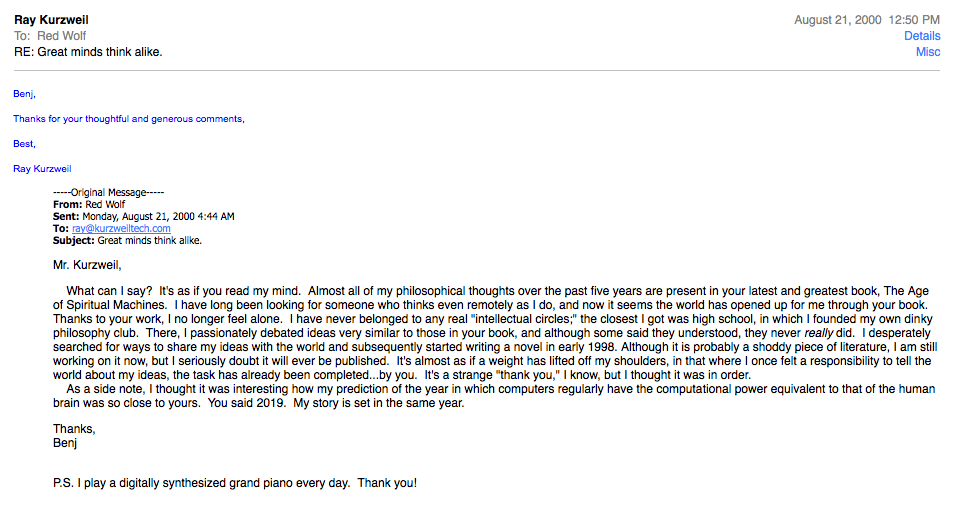
I first read Ray Kurzweil’s The Age of Spiritual Machines upon its release in 1999. I was 18 years old, a senior in high school. It had a profound impact on me. Prior to reading, I had already been writing a sci-fi story about a man who uploaded his dying wife’s brain into a computer, so I thought, “Wow, here’s a guy who thinks like me!” A year later, I sent Kurzweil an email full of over-eager teenage praise and he replied! It was a thrill.
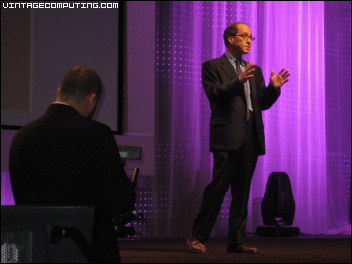 Forget the brain uploading stuff for a moment, since that is still wild sci-fi. Instead, a key premise of Kurzweil’s work that I believe is his most important is his “Law of Accelerating Returns” that posits that technological improvements compound on themselves exponentially over time. I believe this is clearly true, and once you accept this and “draw a line” on a graph, so to speak, you start asking yourself profound questions about the future.
So when I wrote about “the most important and exciting transition in human history” back in 2005, I was thinking mostly of a Kurzweil-like transition where humans and technology figuratively merge together amid what he forecast as the “singularity” where computers themselves became vastly more intelligent than humans.
While those things have not (yet?) come to pass, and perhaps they never will in the sense that Kurzweil projected, I stand by my 20-year-old assessment that we’re still in the middle of an important transition. I knew then that we were looking at an inevitable collision course between information technology and human society in a way that would be explosive. But a key point here: At the time, I tended to view that upcoming collision as generally positive. Abundance, capability, longevity.
In the intervening years, though, computer technology has become a political force in a manner I didn’t fully anticipate, and the effects of the latest obsessions of the tech industry have become highly contentious and controversial, tied up with generally unpopular people (such as billionaires and political figures) during a time of vast income inequality and very extractive prevailing tech business models. Even with the amazing technology and general economic prosperity we have here in America, people are suffering when they don’t have to. Basic human dignity is not being respected.
You’ve probably read about that topic in one of my previous posts, which landed on this site several years after I first wrote it because no one else wanted to publish it. It was difficult to make a critical statement like that when my livelihood is so closely intertwined with the tech industry. But others like Ed Zitron and Cory Doctorow spoke out more during the past few years when I was afraid to and have done good things with that criticism, even though I don’t always agree with the details or scope of their critiques.
A Complicated Legacy
Writing this retrospective post is difficult because of those complications. I still love this site, I still love tech history. I still love Atari! I am proud of everything I have done on this blog and in my writing career. But there was a time when I was generally proud of what computers could achieve for mankind, as if it were an unqualified good. At that time, nerds did not yet rule the world, and computers were a fun hobby. Many people felt that computers would always be a force for positive change.
Positive things (like this blog!) have come from improvements in information technology. That part is easy to love. But as time has progressed, we’ve also seen the emergence of polarizing algorithms in social media that led to irrational social self-harm like Brexit in the UK and electing US leaders with nationalistic and self-destructive policies. We’ve also seen extractive business models that don’t offer proportionate value for what they increasingly demand from customers.
In my mind, those have definitely tarnished the reputation of the tech industry. And now we have “AI.” In my current job as Senior AI Reporter for Ars Technica, I am constantly torn between celebrating and criticizing a set of technologies that are potentially useful and very technically interesting but also politically divisive, ethically dubious on many levels, and widely unpopular.
So I did foresee some societal turmoil and upheaval back in 2005, but I don’t think I foresaw how conflicted that would make me feel, personally. It’s impossible for me to be an unconditional champion of technology when those products are being used to divide us and abuse others on a massive scale. I still have a conscience. You cannot be non-political about American technology at the moment because the stakes are too high; they literally affect the structure of governments and the fate of nations. To be “neutral” and ignore the problems would be to tacitly accept the damage some of that technology has dealt to all of us.
The funny thing is that it really doesn’t have to be this way. We have structured our society to make this runaway Gilded Age 2.0 possible. What’s missing is balance and nuance, what has been stripped away by polarizing communications technologies. There is always a middle ground. You can criticize capitalism and still appreciate its positive effects. You can enjoy, say, friendships on social media and still want to structurally improve it. In a similar way, there can be balance between encouraging innovation with responsible regulation and maintaining general prosperity for every American.
Capitalism is perhaps the original runaway AI; it’s an algorithm that runs on the platform of society. If left alone, it extracts value and turns it into capital at all cost, potentially harming people. Recently in America, the needs of money have won out above all other needs. Elected officials, driven by seeking money, have prioritized the lightly-regulated accumulation of capital by a wealthy set of individuals over more equitable regulatory measures that could spread the benefits of technology more evenly to everyone.
 But we can cage this capital tiger and still enjoy its benefits with proper regulation. Capitalism has dramatically raised the standard of living in the Western world and it has been successfully controlled in the past. Instead of letting tech companies consolidate and monopolize and extract, we could choose to more actively regulate and foster healthy competition, breaking trusts, and taxing the ultra-wealthy down to reasonable levels. The current system will eventually collapse in on itself, but I fear it may take the structure of our own federal government down with it. We are in for very rough times ahead, and I think things will have to get much worse before they get better.
So with stakes that high and that existential, why might a 20-year-old blog about old computers still matter? Did I just go on a wild tangent? Not at all. From that very first post in 2005, this blog has always been about the effects of computers on society, and it will always be that way.
Over time I have come to realize that all governments are information processing systems. All relationships (even among two people), cultures, and societies are bound together by communicated information, which makes the machines that process and transmit that information very important. That’s what this blog is all about. From that lens, technology is not just an important thing, it might be the most important thing.
And also, in a time when people don’t know what’s real or not due to AI fabrications, I want to maintain this site as an archive of human-curated knowledge about tech history. Let it be a curated guidepost to the past in a time of great uncertainty ahead.
Thanks to generous Patreon donors, this archive remains ad-free and independent, and all the original comments persist. Meanwhile, I still have this site as an outlet to post things here when necessary, though I apologize that I don’t do it more often. My daily job has me writing 1-2 posts a day so there’s not much mental bandwidth left to maintain a blog. But I feel like it’s never too late to rouse a renaissance of the site when the time comes, since it can still be a refuge for unvarnished human-created thought. From my brain to yours.
Thanks for reading over the years, and I’ll see you at 25? –RedWolf







November 2nd, 2025 at 6:19 pm
Thanks for keeping on keeping on!
November 2nd, 2025 at 8:23 pm
Congratulations on 20!
November 3rd, 2025 at 10:25 am
Congratulations on this 20th anniversary! I blog myself and I confirm 20 years is good and long!
November 8th, 2025 at 11:25 pm
Yay!
December 29th, 2025 at 3:13 pm
Congratulations on 20 years of Vintage Computing and Gaming (I know I’m a bit late to the celebrations). Although I haven’t visited this site since the beginning, I’ve stopped by periodically ever since 2015 when I began listening to Retronauts and learned about your work through the podcast. I’ve always been interested in your take on tech and retro gaming, and I’m glad this site exists.
You’ve written a vast amount of articles on various tech and tech-related topics, and each time I visit I’m always finding something new to read and learn about. It really is a great archive on topics that aren’t usually covered by mainstream tech sites, and hopefully in the future, enthusiasts and researchers can continue to visit the site for information they’re looking for. Your passion for tech definitely comes through in the work you’ve put into building VC&G, which I know many readers appreciate and respect.
I agree that tech has transitioned into something that many people could never have imagined. The capabilities of tech are tremendous when respected and applied responsibly, but unfortunately, it does seem like tech is now being used in ways to manipulate the masses and help those who already have a lot of resources and power maintain or expand it.
It will be interesting to see where we are at technologically in another 20 years. Based on advances in AI and robotics, as well as the continual fight for power, I don’t think we’ll be in a good place. However, to be somewhat optimistic, I do see drastic advances in medicine and otherbeays to help people. Having said that, I look forward to reading/hearing more of your thoughts on various tech topics.
January 27th, 2026 at 9:16 am
First came across you and this site via Harry McCracken and Technologizer (if memory serves). Scarcity of posts is disappointing, but I’ve learned to live with it (via RSS notifications).
I’ve been in the IT Field professionally for 30 years, but in the early 80s I was sucked into computers, BBS’s and the all the potential. Anything seemed possible.
Now, with all the cybersecurity problems, social media and AI slop, and the absurd hardware costs, the fun as been fully removed for me. I am looking forward to retirement, and will stay as far away from tech as I can.
August 14th, 2026 at 7:46 pm
I just came across this site from a google image search, browsing retro computing images, like magazine ads and such, mostly out of curiosity. I just wanted to say that I thoroughly enjoyed browsing your site, and thanks for archiving the history of computing.