VC&G Exclusive:
Secret Deadly Towers Maps Revealed!
Wednesday, January 11th, 2006
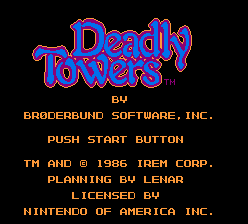 The game Deadly Towers for the NES has always held a special place of mystery and fascination in the minds of both myself and a close friend of mine. I remember playing it while I was sick from school long ago, and, believe it or not, being completely immersed in the atmosphere of the game. I now suspect that the game’s intriguing intro music had much to do with it, giving the game a much more epic feel in my mind than actually exists on cartridge. Also, I was always mystified by the myriad small black windows on the tower backgrounds, which always made want to peek inside and see what was in there.
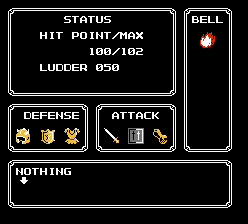
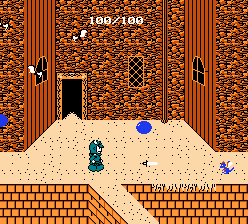 My overwhelming nostalgic love for the game is kinda funny because, years later, upon seeing if there were any fan sites for Deadly Towers, I realized that everyone other than me and my friend seems to utterly hate this game. In fact, the ever-colorful Seanbaby said it was the #1 worst NES game of all time on his site. Wow. I definitely wouldn’t go that far (but of course, Seanbaby always goes as far as he can — he probably wipes his butt with Deadly Towers cartridges…just because he can). But make no mistake: Deadly Towers is no gem, either. One of the reasons it is loathed by many is that it is insanely frustrating and difficult. Some of the first enemies you encounter in the game require you to stand in the same spot for a minute, hitting them about fifty times with your wimpy starting sword to kill them. Most of us who played it at all would have killed ourselves long ago if not for the famous “EF or FE Code” (thank you, Nintendo Power) that gives you one of the bells pre-burned and the best armor and weapons (To use the code, start the game, die, then add “EF” or “FE” to the start of your password). Using that trick, the game actually becomes bearable to play for someone who’s not swimming in mystical nostalgia.
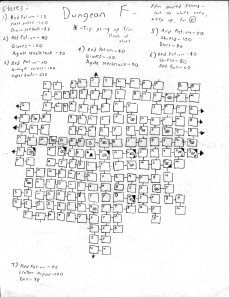
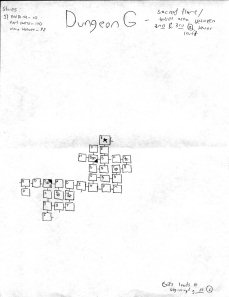
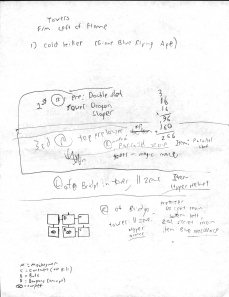
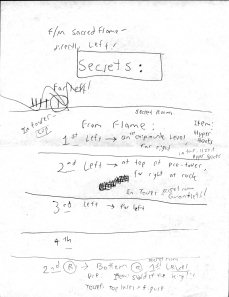
 So imagine my surprise when, back in 2003, my best friend called me up and announced that he was going to beat Deadly Towers — without cheating. “Gasp! Are you insane, man?!” I stumbled, almost dropping the phone as I fell from my chair. No, he replied…he took it as a challenge — a challenge to his gaming might, endurance, and ability. He wanted to be one of the twelve people in the world to actually complete the game as intended (ten of which are former Japanese grade-schoolers, no doubt, who seem to have a sadistic drive to consume even the most insanely difficult games). With no strategy guides or maps available to guide him, not even on our precious Internet (save for the 1st dungeon map in the manual), he set out on his mission. I set out along with him, playing it simultaneously as we talked on the phone, but I eventually gave up half-way through. It was just too tedious for me. Over the next month, he not only completed the game entirely, but mapped all of its completely useless dungeons (which you don’t even have to enter to beat the game), and found most, if not all, of the secret exits in the towers, which contain special weapon upgrades and the like.
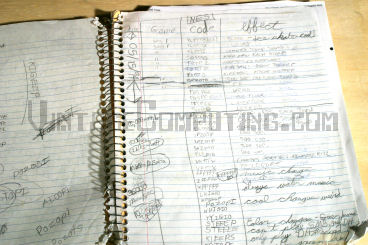
So without further delay, I present to you, published for the first time ever on the Internet (in English, anyway), The Secret Maps of Deadly Towers [cue mind-blowing music]. And what’s more, instead of spending countless hours transcribing them into some legible computerized format, I am presenting them in the artist’s original hand, for extra charm and authenticity. Their format might also give you more of an idea as to what an epic accomplishment this really is. The intrepid artist’s name? Ben Johnson. From now on, let these be known as The Johnson Maps.
Yep, those were the days: when we all had to make our game maps by hand.
How come there’s no “Dungeon A” map, you ask? Because it’s already mapped in the Deadly Towers manual. Oh, and the maps are in Adobe Acrobat PDF format for easy printing (didn’t want you to have to fiddle with printing letter-sized JPEGs, you know).
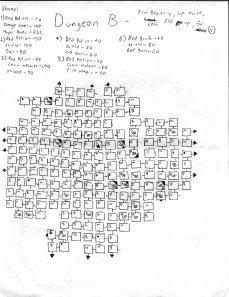
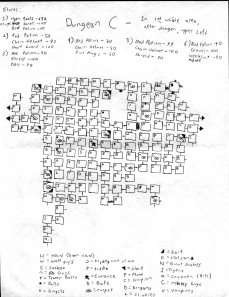
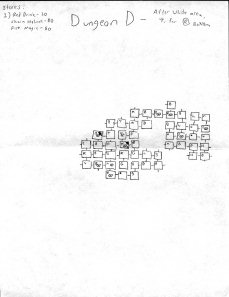
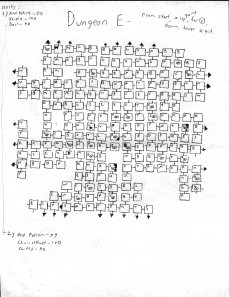
If anyone else actually likes this game, speak now, or forever will Deadly Towers roast in the pits of Internet game-punditry hell!
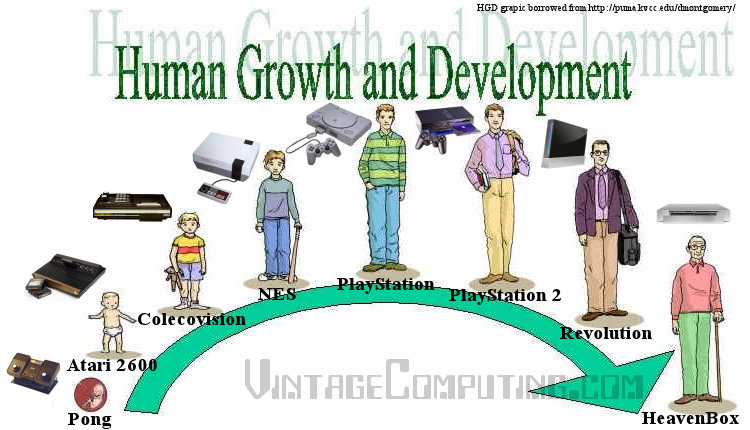
 Now, back to the present for a moment. At 30, Gamer X is currently enjoying PlayStation 2 games, with ever-growing depth and maturity. But soon (if he doesn’t already), he’ll have his own wife, kids, and family, and his priorities will change again. What happens when Gamer X reaches 40? At 40 years of age, I bet he’ll probably still want to play video games. But will Gamer X be content to run around and shoot hookers, kill virtual people, and steal their cars like he does today in Grand Theft Auto: San Andreas? Or will he want something different? He’ll probably work hard all day and come home exhausted — to a wife to attend to, kids to play with, and bills to pay. Will he have time to play that 100-hour RPG any more? Or does he want something
  But why stop at 40? Eventually there will be video game systems and content suitable-for and tailored-to a market of 50-, 60-, 70-year-old gamers and beyond (Gardening simulators, anyone? :P). In 2055, when Gamer X is 80, there will be millions of people his age that have grown up with interactive digital entertainment as a way of life. They will want new games to play, and digital entertainment companies, eager for their Social Security dollars (if SS hasn’t collapsed by then), will provide them. This will give the phrase “gaming grandma” a whole new meaning.
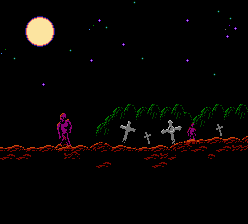
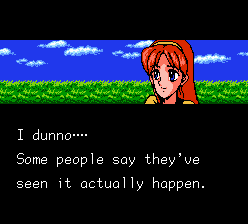
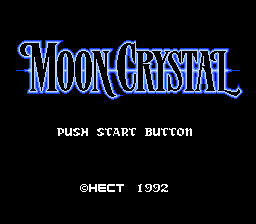 Over time on VC&G, I’d like to introduce vintage gamers to obscure, overlooked or never released in North America games that are worth playing. And unless you live in Asia, you’ve probably never played Moon Crystal, as I believe it was only released in Japan. It’s a shame this title didn’t come to the US — it’s a grade-A quality game, with incredible gameplay, graphics, and animations. The only beef I have with the gameplay is that it takes a long time for your character to turn around (a lot longer than the instant 180 in most games), and that takes a lot of getting used to. All of the monsters and the main character have very fluid animations, with more frames per movement than I think I’ve ever seen in a NES game. Moon Crystal also has a great story-telling intro and detailed, animated, and colorful cinematic cut-scenes between stages (ala Ninja Gaiden).
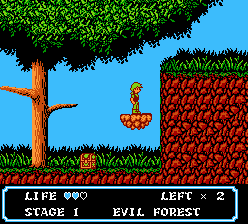 I haven’t played much past the third stage yet, but I’m looking forward to the rest of the game. So far the difficulty level hasn’t been too hard. The style of gameplay is pretty typical action platformer, where you jump around and stab enemies with your sword. You can also get power ups over time to become stronger, which is nice. The main character has a really neat ability taken straight from Prince of Persia — the edge grab. You can jump up to a platform that’s too high for you to jump to conventionally by pressing up on the control pad while jumping. Your character can then grab onto the nearest ledge and pull himself up. This comes in handy as a last-second save: if you underestimate your jumps over an open abyss, you can hold down up and grab on to the side of the edge before you fall in.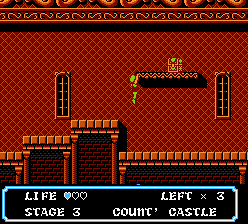
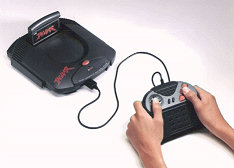 Straight from RedWolf’s vintage text file archives: It’s the original Atari Jaguar Press Release! Sure, you can probably find this elsewhere on the web, but I downloaded this text, as you see it, directly from the official Atari Forum (GO ATARI) on Compuserve in 1993. I was a huge fan of Atari at the time, and news of a new system from them was extremely exciting — exciting enough for me to archive the press release for over twelve years. It’s an entertaining read.