My BBS Alter-Ego Turns 45
Saturday, November 12th, 2005 Back when I started BBSing in 1992, I was only eleven years old. I was very young, innocent, trusting. I told the truth, giving out my real name, address, and age to every BBS I called. But certain devious teenage SysOps took advantage of my youthful tendency towards trust and shattered my confidence, betraying me and making me look like a fool in the BBS community. My innocence as I knew it had been lost. No longer would I be Red Wolf the Boy Wonder SysOp, the celebrated youngest SysOp in the Triangle area — no, that boy went to school every day, played in the woods, and rode his bike with his friends. Online, I would be Red Wolf the confident 34 year old computer professional — the kind of guy no power-tripping teenage BBSers would dare mess with. I went so far as to engineer a fake “real” name, birth date, and background for this alter-ego to give it realistic consistency throughout the years. His name was John Scagon (a silly name, I know), and he often traveled to Chicago for business meetings (a convenient excuse to not answer chat requests, reply to emails, or for the BBS being down a few days). His birthday was 11/12/1960 — an obviously fake-sounding date that was chosen by me because it was easy to remember. I had an address and phone number made up for him too, but I don’t remember what they were. John Scagon even had a friend in his neighborhood that would come over sometimes and look after the BBS while John was “on vacation.” I did this especially when I felt like having some fun with my callers. Make no mistake; this was not some manifestation of multiple-personality disorder. The line between fantasy and reality in my mind was always firmly drawn, and I am very sane. Rather, John Scagon was a simply role I took on when I was online, like an actor playing a part in a TV show. Although sometimes it was a bit deeper — more like an actor living a part in a TV show.
After a few years of masquerading as John Scagon online, nobody remembered that I was only 13 years old anymore. I tried my hardest to act older, and surprisingly enough, people actually thought that I was 30-something instead of pre-puberty. I established my Scagon act so firmly that when I once tried to tell some people (as Red Wolf online) that I was actually only 14 (at the time), they didn’t believe me. And to this day there are probably dozens of people out there who still think I am a lot older than I really am (sorry to break it to you so late, if you found this entry on a Google search). So much more credibility and esteem is yours for the taking as an older guy if you’re making your rounds in an online community composed of mostly teenagers and college students. Strangely enough, over time I became a kind of father figure that many BBSers, ironically my own age or older, looked up to.
My BBS life was a secret life I never mentioned to anyone my own age. Only one friend in school knew of it, and he was sworn to secrecy. A few of my parents’ friends knew about it, but not many. Not many relatives knew either. It was my own private world that I figured no one else could understand. Besides, if I ever even tried to explain a BBS to someone, it would usually be greeted with a “huh?” and a look of profound confusion from the person I was trying to educate. A completely different layer of reality, the online community, existed on top of the one in which mere “normal” people lived, and it was quite shocking for such people to learn of its existence, and very hard for them to grasp for some reason. That’s why I kept it quiet. Only when your very average Joe started using the Internet around 1999 did I even mention to my classmates that I played with computers as a hobby.
The dichotomy of being that arose from my BBS usage created some interesting situations when my offline life would cross over with the BBS one. That is, when some people I knew in person discovered BBSes and would talk to me about them, not knowing that I ran one myself and had been calling them for many years. Of course, I didn’t tell them that I was Red Wolf and ran The Cave BBS — that was part of the fun. But I’ll save those stories for a future entry.
My alter-ego and I separated long ago. I thought about killing him off in a car wreck in Chicago when I shut down my BBS for good. It would have been a cool story to tell, but it didn’t happen; I couldn’t bear to kill an innocent man. So instead, the two of us just went our separate ways. Today I am very much a different person — I am definitely not John Scagon at all. Years ago, a completely new Red Wolf (in fact, RedWolf — the lack of a space in the name came from the Internet world) grew up to fill the hole left by my alter-ego, then no-longer needed after I had attained sufficient age to be confident in my true identity online. But I feel like John Scagon is still out there somewhere now, although I don’t know where he is or what he’s doing. I find myself wondering what his life is like at 45. Does he have a wife, or even kids? Does he still work with computers? I almost want to email him and ask him how he’s doing, to wax nostalgic over our BBS days together as if he’s a long lost friend. But of course, that would be impossible. Still, I’d like to drink a toast to the man who never was: the mentor inside of me, and my personal guide through a tougher world, long past. Happy birthday, Red Wolf.
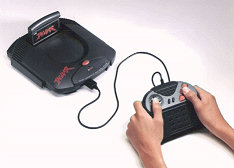 Straight from RedWolf’s vintage text file archives: It’s the original Atari Jaguar Press Release! Sure, you can probably find this elsewhere on the web, but I downloaded this text, as you see it, directly from the official Atari Forum (GO ATARI) on Compuserve in 1993. I was a huge fan of Atari at the time, and news of a new system from them was extremely exciting — exciting enough for me to archive the press release for over twelve years. It’s an entertaining read.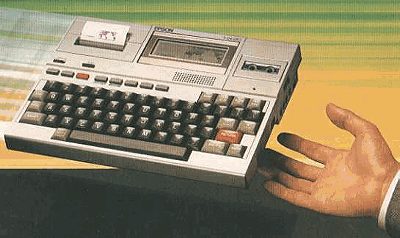
 If you read my introduction or the “About the Author” page on this site, you’ll know that I ran a
  Computer hard disks weren’t always as reliable as they are now. From 1992 up until about five years ago, it seemed that I had a drive crash on me at least once every two years (Hmm.. they ceased right about the time I stopped buying OEM Western Digital drives from a questionable source). A total drive meltdown was always a terrible event, but it was still no where near as catastrophic as it would be now. You see, back then, the data on my computer was usually just stuff I had downloaded from BBSes or the Internet, maybe some text and Word files, and a few games. But these days, people keep their entire lives on their computers, including home movies, digital family snapshots, personal correspondence (in the form of emails), and gigantic music collections. Not to mention that more original creative work than ever is being done on computers these days — musicians record directly to them, photographers process their pictures on them, illustrators draw and paint with them, and writers write with them. This creative data is unique and irreplaceable — you can’t just download it again if you lose it, making a data backup plan absolutely essential for the modern computer user. Of course, I’m sure most people don’t back up their stuff, and computer users everywhere lose valuable data on a daily basis. Considering the importance of the personal data on PCs these days, I find it absurd that computer manufacturers don’t include some sort of redundant disk protection by default in every PC sold (or at least the build-to-order option). As RAID controllers get more economical thanks to the widespread adoption of the Serial ATA standard, such a scenario will become more realistic. I’m going to go out on a limb and predict that in five years, redundant data protection of some kind will be a standard feature on all consumer PCs. From now on (starting with my last two computers), I’ll never build another computer again without at least RAID level 1 (data mirroring) protection. I also do daily backups to an external hard drive on my three main computers for an extra level of safety.
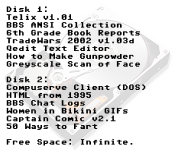 But my backup regimen isn’t really what I want to talk about today. No, it was my complete lack of one that we’ll focus on for the moment. Back when I lost my hard drives, I usually lost most or all the files on them as well. This functioned as sort of a “natural reset” (a
 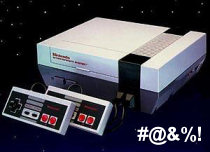 It’s an endless struggle; an epic, no-holds-barred wrestling match: Man vs. NES in a fight to the death. Or at least, in a fight to get your NES games working on that old front-loading NES. You push, it blinks. You pull, it blinks. You blow, you sneeze, you use q-tips, cleaning kits, and wow…it works? You see the title screen, but it’s still a little flaky. Things might be a little garbled, so you hit reset and it looks OK. Then an hour into playing, you accidentally tap the console and the game freezes, forcing you to start your Metroid game all over again. Blast! It’s hard to remember that your NES ever worked on the first try. There’s a fine art to actually getting a game running on an old NES. It takes a lot of patience and a certain flick of the wrist. I used to impress people at parties with my NES-charming abilities, and boy did the ladies love it.
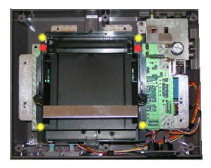
 The crux of this classical problem is a special connector inside the unit that wears out from repeated usage over the years. It was designed in such a way that a game cartridge can be inserted at a slight angle with little resistance, then pushed down in the spring-and-latch loading tray inside the NES, bringing the cartridge’s contacts in full contact with the connector’s pins. It’s sort of like a cartridge port version of a
  I took a dive and went with a
  Yeah, I know, this joystick is old news. It’s probably been reviewed dozens of times. But when it first came out, I didn’t have a Vintage Computing and Gaming blog. So now I get to play catch-up and review all kinds of nifty things I’ve been buying and collecting over the years, just to add another voice to the chorus of public opinion, and to help my fellow enthusiasts, of course. And in this case, I specifically wanted to review the
  I bought my X-Arcade Dual over three years ago, and it has held up very well over the years. I originally used it with a PS/2 to USB adapter on my iMac to play arcade games in MAME. Then for a while I had a dedicated (if pathetic) MAME PC that I used the Dual with to play emulated arcade games, of course. I originally decided to get the Dual model so my buddy and I could play two-player games together (loads of fun and works great), but the extra joystick also comes in handy for games like Robotron: 2084 and Smash TV that use two joysticks in their original cabinets (one for movement and one to fire in a certain direction).
 Ah…the trusty Goodwill store. Once the last bastion for countless old computers thrown out by a thankless middle-class America that had grown tired of them, it’s now merely a graveyard for broken VCRs and 1970s-era crockpots (you can always find at least one crockpot at any Goodwill store). So what happened? Around 2001, if I recall correctly, GCF was choking at the gills with hordes of truly worthless PC-clones that no one ever bought. They kept pouring in, non-stop, stacking up at the back of every store. The only thing
  Paperback books cost fifty cents a piece; hard cover books, one dollar. That’s where I found the first edition of “The Media Lab” by Steward Brand (1987), hardcover and in great condition. This is a really cool find — an excellent addition to my computer history library — at a great price. It’s fun to see what was considered futuristic even as recently as 1987. The book has a great picture section in the middle (Grog no like words, Grog like piktures!), which, since I haven’t actually read the book yet, will have to suffice for a source of a description of the book. There are examples of early computer illustration software, rudimentary 3D computer graphics, anti-aliasing for digital text, force-feedback joysticks, holograms, AI, and something called NewsPeek, which was an idea for an electronic newspaper with eerie echos of the World Wide Web before such a thing existed. If it deals with computers and media, the MIT lab did it all first. And, if I may add personally, they also repeatedly failed to capitalize on their discoveries first, a ridiculous flaw of many a government and corporate think-tank and R&D division over the years (Xerox PARC comes to mind). “But RedWolf,” you say, “That’s not the purpose of a research institution!” I don’t care. Many incredible inventions are made at university labs, but it always takes a maverick separatist entrepreneur to break off from the organization and bring the benefits of those inventions to the masses. Otherwise, great ideas would stagnate there forever, and die on the vine where they were grown. Until new technologies are actively pushed and available in the marketplace, they’re just academic play-toys that don’t help anybody, hoarded by elitist engineers. So am I criticizing academic and big organization research? Hell yes. But hey, that opens up another can of worms, and I think it’s time to eat lunch.
 First of all, the store’s design and functionality is excellent. It is organized in a relatively easy to understand and navigate manner. If I ever ran an online store, I’d probably shamelessly pattern it after AtariAge’s store/shopping cart software (whether custom or a modified package, it’s still good). AtariAge’s checkout process integrates seamlessly into the PayPal system and payment via credit card is easy and fast (AtariAge also accepts check/money order payment, but I haven’t tried that). Their shipping options (typically USPS First Class and USPS Priority Mail) are realistic and actual-cost — no shady handling fees padded onto the total. After waiting a week or maybe less, depending on which shipping method selected, your package arrives. I personally was very happy with the speed at which the products got here, and the professionalism with which they were packed (the padding seemed adequate for the items inside), complete with a packing slip / receipt inside the box. The items that I ordered were exactly as described, obviously handled with care and in excellent condition.
 Over the past 6 years I have been looking for an easy way to interface my original NES pad with my PC so I could play NES games on an emulator with an authentic feel. There was only one realistic option I knew of: a parallel port interface hack that had spread around the Net over the years, but I never quite got around to doing it. Then, early this year I stumbled across