[ Retro Scan of the Week ] Sharp 286 VGA Notebook
Monday, October 19th, 2009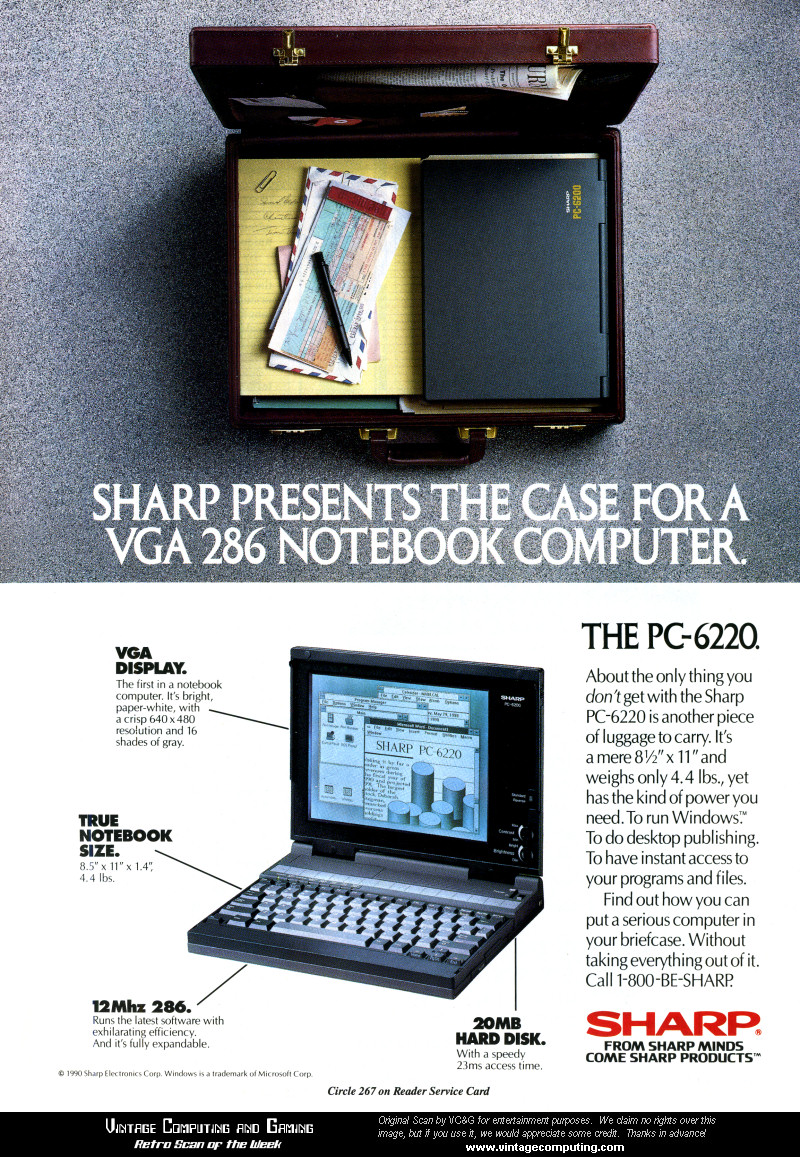 The Sharp PC-6220 Notebook Computer
Discussion Topic of the Week: In your opinion, what’s the difference between a “notebook” and a “laptop” computer?
The Sharp PC-6220 Notebook Computer
Discussion Topic of the Week: In your opinion, what’s the difference between a “notebook” and a “laptop” computer?

Numbered lists, numbered lists. What would the Internet be without numbered lists? I’ll tell you: it would be a lonely, barren place. As much as they seem like a literary cop out, people love them. They go wild for them (or at them). Numbered lists slice and dice facts and figures into tantalizing nuggets of information, easy to consume and digest in today’s frenetically-paced world. It seems nobody has the time to read long-form prose anymore.
Some years ago, I realized that this seemingly lightweight article format is here to stay, so I might as well make the best of it. That’s why I’ve dedicated a portion of my career to writing the best numbered lists possible. I may not always succeed, but at least I try.
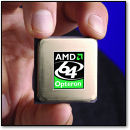
Exhibit A: The 11 Most Influential Microprocessors of All Time. The fine folks at PC World published my latest foray into the numbered-list genre late last night. It explores some of the most important microprocessors ever devised in a slideshow format, replete with nifty graphics.
As always, I’ll include a standard disclaimer that I include for any numbered list: your opinion my vary. Even though it probably will, you might learn something along the way. And perhaps, like me, you’ll be oddly invigorated by the quantification of something typically un-quantifiable. It’s an exciting weirdness that we can’t resist.
I hope you enjoy it.
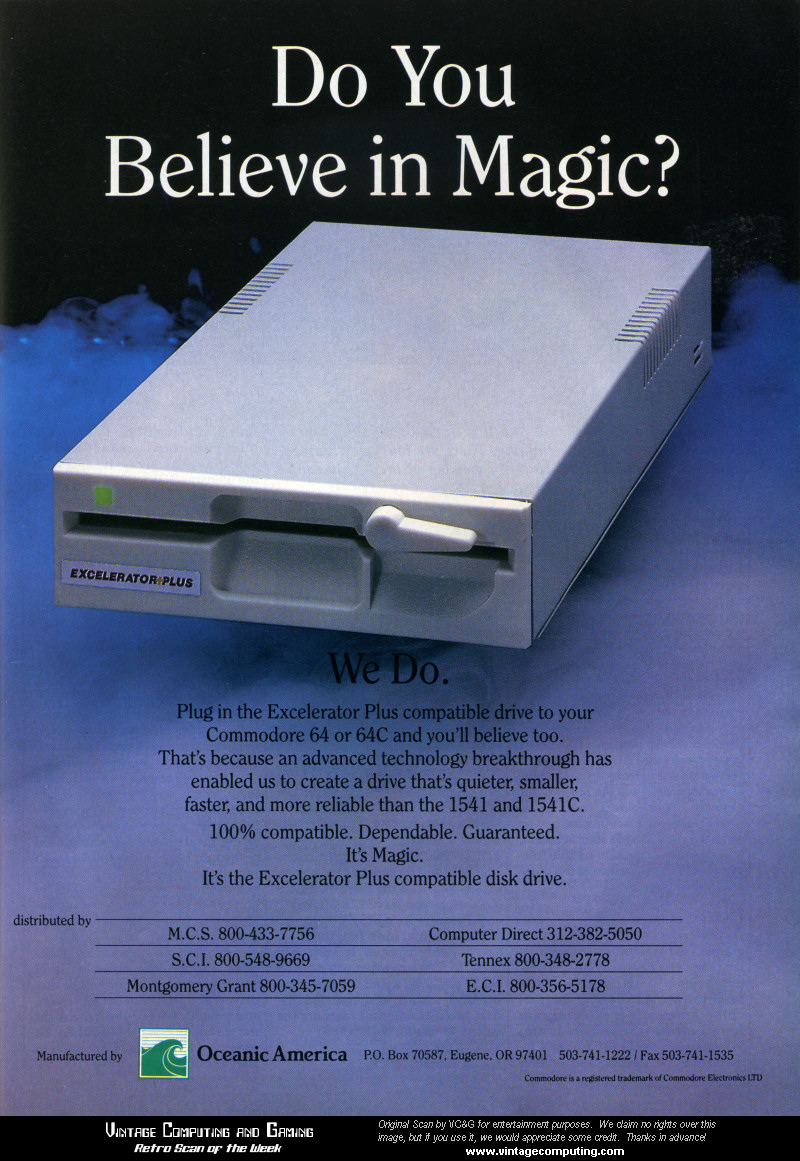 “Do You Believe in Magic?”
Discussion topic of the week: Commodore 64 fans — what’s your vote for the best C64 disk drive ever made?
Up now on Harry McCracken’s Technologizer is my latest VC&G-related freelance work: “15 Classic PC Design Mistakes,” a non-exhaustive analysis of various hardware and software design goofs in vintage computers. In it, I discuss the Apple III, Coleco Adam, TI-99/4A, Macintosh, and more. Feel free to take a look.
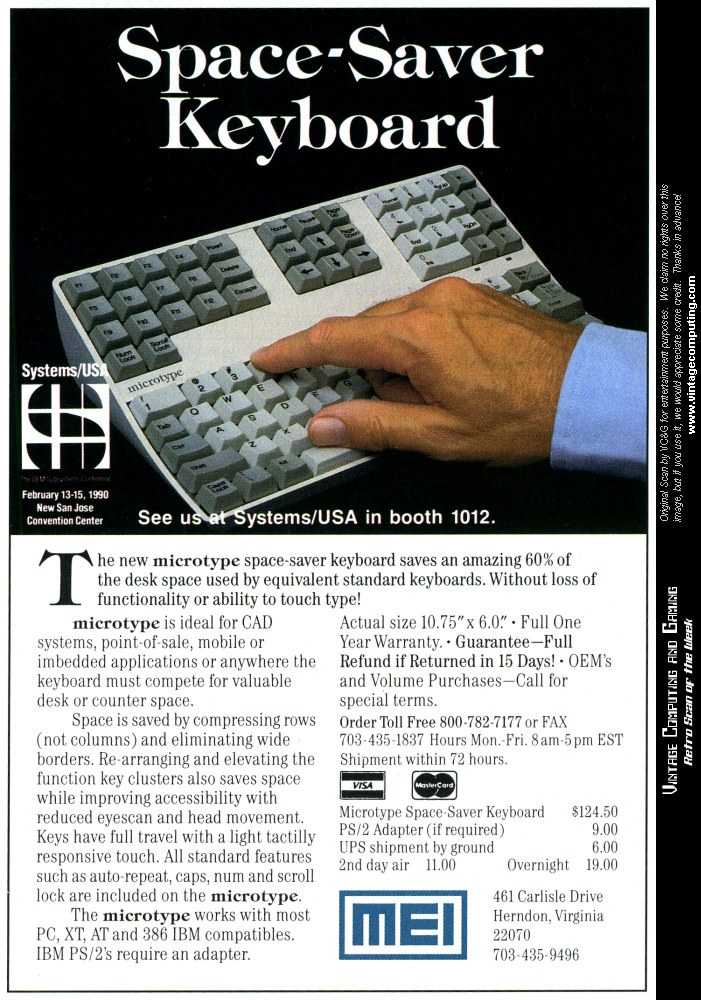 You might accidentally crush it. (click to see full scan)
Discussion topic of the week: Have you ever had trouble using an electronic device because its buttons are too small or your hands are too big? Tell us about it.
If you use this image on your site, please support “Retro Scan of the Week” by giving us obvious credit for the original scan and entry. Thanks.

In case you were wondering, the computer mouse turned 40 today.
… or, at least, that’s what everybody is saying, despite the fact that Douglas Engelbart cobbled together his first mouse in 1963 (which would make the mouse something more like 45). But ah, the vagaries of media semantics — somebody toots their horn and then everybody has to jump on board.
Despite the numbers game, this date is indeed a special anniversary, because 40 years ago today, Douglas Engelbart presented “the mother of all demos” at the Fall Joint Computer Conference in San Francisco. This event was notable, among other reasons, for being the first time the public laid eyes on the computer mouse.
By now, you’re probably saying, “That’s great Benj, but I’m suspicious that you actually posted something on VC&G! Where do you and your professional career fit into this?” Well, I’m getting to that. In honor of this anniversary, Macworld asked me to write a short piece on the history of the mouse. After deliberating with myself for about 30 seconds, I accepted the assignment.
Over the next few days, I managed to assemble a comprehensive timeline that traces the mouse’s technical evolution through the years. Unsurprisingly, you can find it on Macworld.com. Feel free to check it out if you’re interested, and tell them Benj sent ya. Even if you don’t check it out, remember to stare extra hard at your mouse today and contemplate its origins in the vast foggy distance of time.
 I didn’t find this one in the creek.
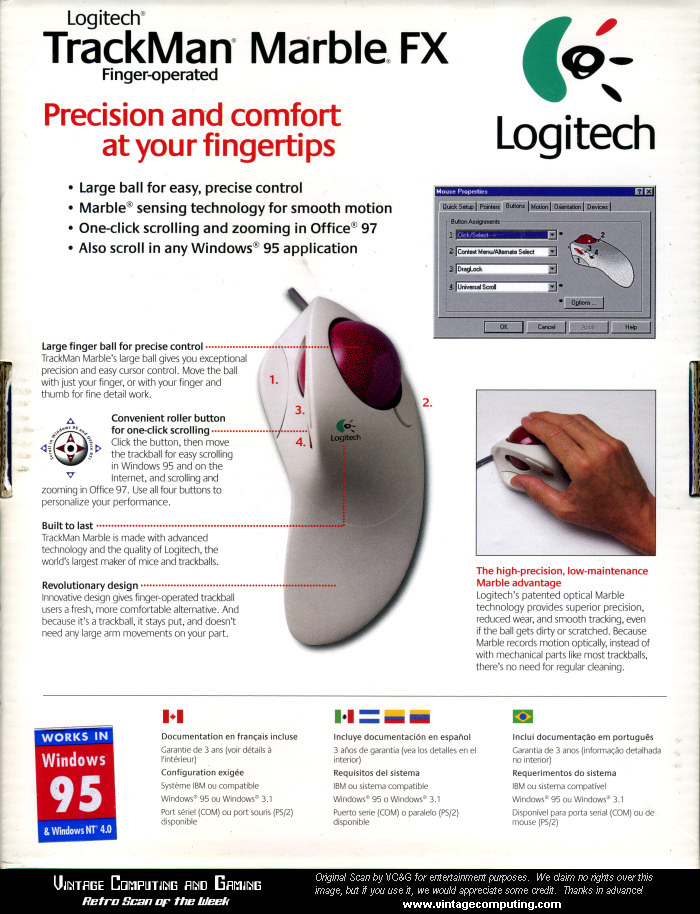
And now, I present to you…a box. I know it’s not that old, but I’ve been hanging on to this scan since I finally threw out the packaging for my TrackMan Marble FX a few years ago (I scanned it first). I believe I bought this trackball around 1998. I had another Logitech trackball before it, but I was fed up with cleaning the rollers every few weeks. The neat thing about the TrackMan Marble series is that it used an optical scanning mechanism that tracked the movement of dots printed on the marbled red ball. I used the FX for years until it finally crapped out — some components inside of it irreparably broke, although I still have the parts. There’s more to my TrackMan Marble story, though, albeit with a different model.
When I moved to a new house a few years ago, I walked out one day to explore a twisty, shallow creek in the woods behind my house. The stream lies in a flood plain that gathers nearly all the water runoff in the area when it rains, so it regularly overflows its banks.
Some ways up the creek, I found a makeshift junkyard of soiled, broken goods both tossed and washed in from every direction. There, among the discarded bicycle spokes, power drills, soggy basketballs and broken mirrors, I spotted a curious looking ball protruding from the mud. I pulled it out and realized that it was a red trackball for a Logitech TrackMan Marble.
 Months later, I found the unit itself, and it looked like this. I took it apart to see if I could salvage anything of interest, but, of course, sitting half a decade in a muddy, wet environment isn’t conducive to the proper operation of electronics. Beneath the dirt — caked and wedged between every crack imaginable — I found nothing but a corroded mess.
For a few weeks, the unit served as a strange fence ornament in my back yard until my wife complained about it, then I threw it out. In the end, I walked away with a nifty red trackball, half-bleached orange from years in the sun, that I still have in my collection. It serves as a token from an almost embarrassingly pitiful lesson in technological humility — how something once new, shiny, high-tech, and amazing can be quickly rendered worthless and derelict by an apathetic hand a coat of mud.
Discussion topic of the week: It’s one of the great debates: trackball or mouse? You tell me!
If you use this image on your site, please support “Retro Scan of the Week” by giving us obvious credit for the original scan and entry. Thanks.
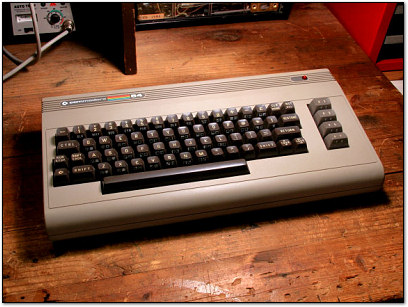
Yesterday, PC World published the latest in my “workbench” series of vintage tech autopsies. For its fifth installment, I dissected the immortal Commodore 64 while documenting the process in vivid color. This slideshow features some of my favorite vintage computer photos yet. I hope you enjoy it.
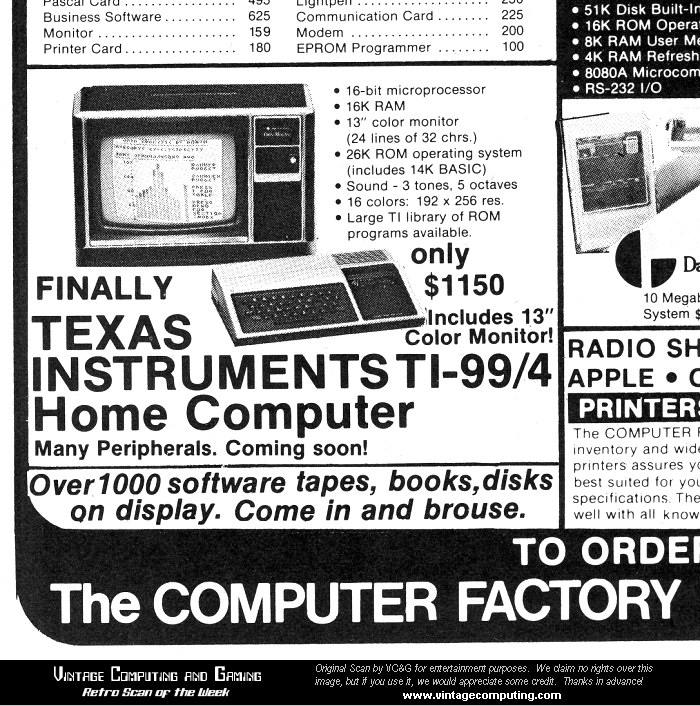 Come in and “brouse” our wyde variatee of computur goodz.
Apparently, in 1979, the computer buying public could barely stand to wait any longer for Texas Instruments to ship their personal computer masterpiece, the TI-99/4. (I mean, finally. They actually released it.) Lucky for us, we have this handy “The Computer Factory” group ad to serve as a window through time, if you will, to allow us to observe the public’s overwhelming demand for TI’s hot new PC as it was in 1979. Apparently.
The TI-99/4 — which happened to posses the 7th worst PC keyboard of all time — might have been the one of the first home computers to ship with a 16-bit CPU, but it hardly took off in the marketplace (read more about its failings here and here). TI slowly learned from its mistakes and released the TI-99/4A a few years later to a more receptive audience. The Alpiner-playing world rejoiced. But it wasn’t long before the Commodore 64 crushed TI’s struggling machine (and the rest of the home computer market) in a fierce price war.
Discussion topic of the week: Have you ever hotly anticipated the release of a certain computer model? Which one got you excited the most?
If you use this image on your site, please support “Retro Scan of the Week” by giving us obvious credit for the original scan and entry. Thanks.
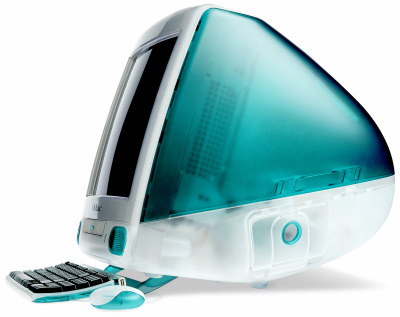
Ten years ago today, Apple released the first iMac, a “Bondi blue” gumdrop PC that shook up the desktop computer world. On that day — August 15th, 1998 — I made a pilgrimage across town to CompUSA to check out the revolutionary machine in person. I was quite impressed, to say the least, and I salivated over the iMac line until I finally bought one of the new iMac G4s in 2002. I haven’t upgraded to a newer iMac model since then (I’m effectively still in debt from the last one!) but boy, would I, if I had the chance.
To celebrate this anniversary, I wrote two articles on the subject for two different publications. First up is a nifty gallery of iMac models through the years on Wired News (note: I’m not responsible for slides #11 and 12). The second piece is an analysis for Macworld entitled, “Eight Ways the iMac Changed Computing.” I hope you enjoy them.
It’s amazing that the iMac was released a decade ago. That means it’s slipping into decidedly vintage territory. So welcome, iMac, to the ranks of vintage computers. I suspect that this won’t be the last VC&G will see of them.