Author Archive

[ Retro Scan of the Week ] When EA Wasn’t Evil

Sunday, April 15th, 2012
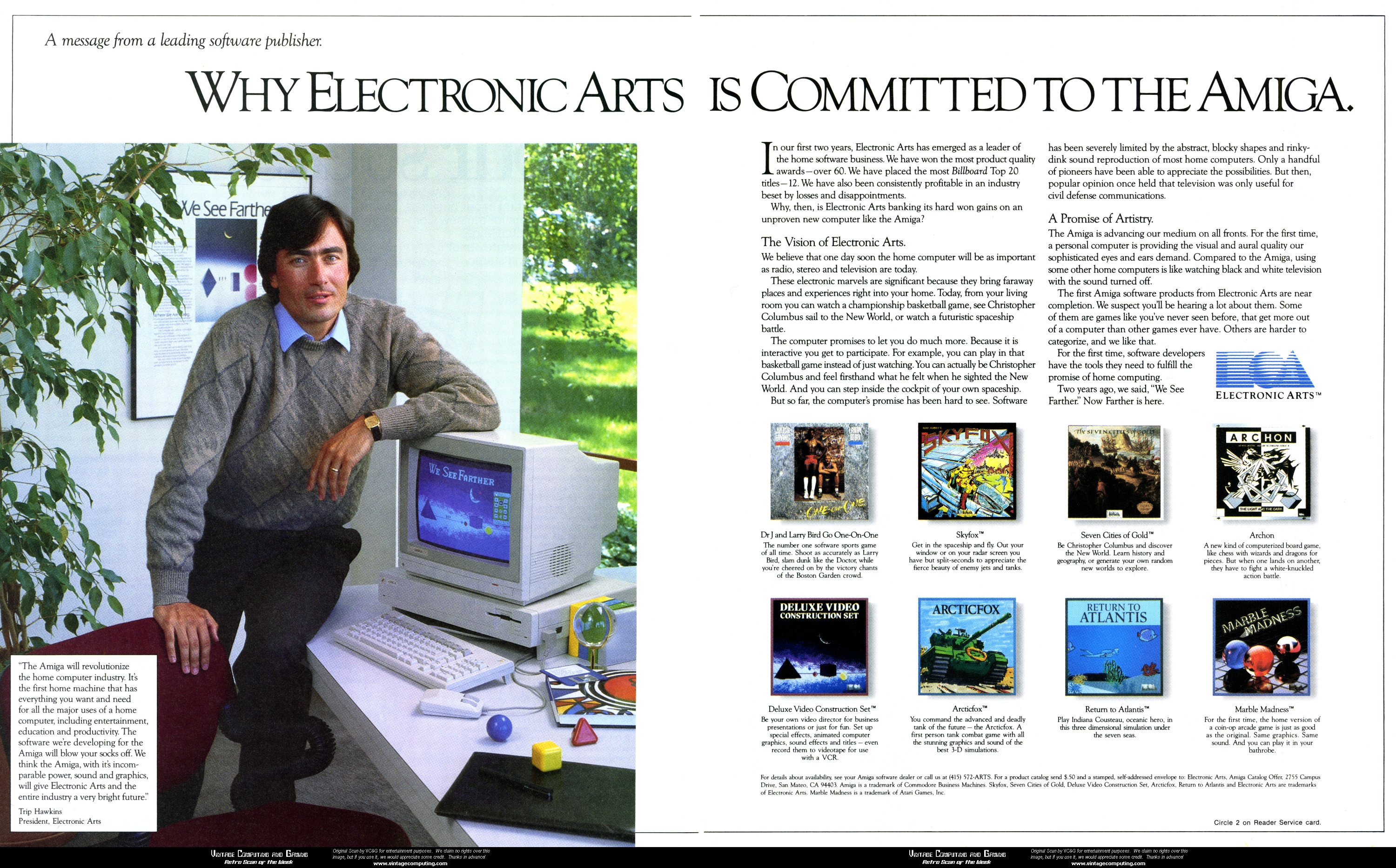
Why Electronic Arts is Committed to the Amiga Ad - 19851980s breakthroughs in workplace ergonomics led to this optimal seating position.

Long before the gaming public considered Electronic Arts the worst company in America, EA made its name as a creative haven that valued its talent.

No, really.

EA went out of its way to convey a developer-friendly image in its early years, prominently featuring designers’ names in the company’s box art and marketing materials. Gamers bought into it, in large part, because EA developed and published some of the most advanced and highly regarded early home computer games of their time (think Archon, M.U.L.E., The Seven Cities of Gold, etc.). EA must have been doing something right.

Of course, things changed over the years. From a personal standpoint, I remember when public sentiment seemed to turn against Electronic Arts in the mid-1990s after it acquired legendary development house Origin (most famous for the Ultima series) and proceeded to drive it directly into the ground. Origin would not be the last highly regarded game development firm to suffer this fate at the hands of EA.

[ Continue reading [ Retro Scan of the Week ] When EA Wasn’t Evil » ]

Jack Tramiel (1928-2012)

Tuesday, April 10th, 2012

Jack Tramiel RIPIn Memoriam: Jack Tramiel (1928-2012)
Founder of Commodore, ex-CEO of Atari Corp.

Windows 3.1 Turns 20

Monday, April 9th, 2012

Windows 3.1 - Twenty Years Later at PC World

Twenty years ago this month, Microsoft released version 3.1 of its famous Windows operating system. At the time, however, Windows could not stand alone as a true OS by itself. Instead, it served as a sophisticated graphical shell that ran on top of command line MS-DOS.

Windows 3.1 introduced many innovations to the Windows product line, including TrueType fonts, baked-in multimedia support, and even the first appearance of the dreaded Windows Registry (really!).

In celebration of this anniversary, I produced a slideshow outlining some of Windows 3.1’s most important improvements and features for PC World. If nothing else, the custom screenshots should serve as a trip down memory lane for many folks. I hope you enjoy it.

Read “Windows 3.1: Twenty Years Later” at PCWorld.com

[ Retro Scan of the Week ] Grand Prix Hair

Monday, April 9th, 2012

Accolade Grand Prix Circuit Ad - 1988This makes me want to watch Top Gun for some reason.

This magazine ad for Accolade’s Grand Prix Circuit (1988) reminds us of a time when folks were less kind to their hair — and when sunglasses engulfed half of your face.

It also reminds me of how wonderful it was when racing games switched to polygon-based graphics. If any video game genre benefited most from the shift from sprites to 3D polygons, it was racing. I mourned the loss of 2D pixel art in just about every game style except racing games, where the freedom of movement afforded by 3D environments heralded a new dawn for the genre.

[ From Compute’s Gazette for Commodore Users, December 1988, p.2 ]

Discussion Topic of the Week: What did your hair look like in the 1980s? Bonus points if you can link to a 1980s photo of yourself!

[ Retro Scan of the Week ] TRS-80 Model 100 Video

Monday, April 2nd, 2012

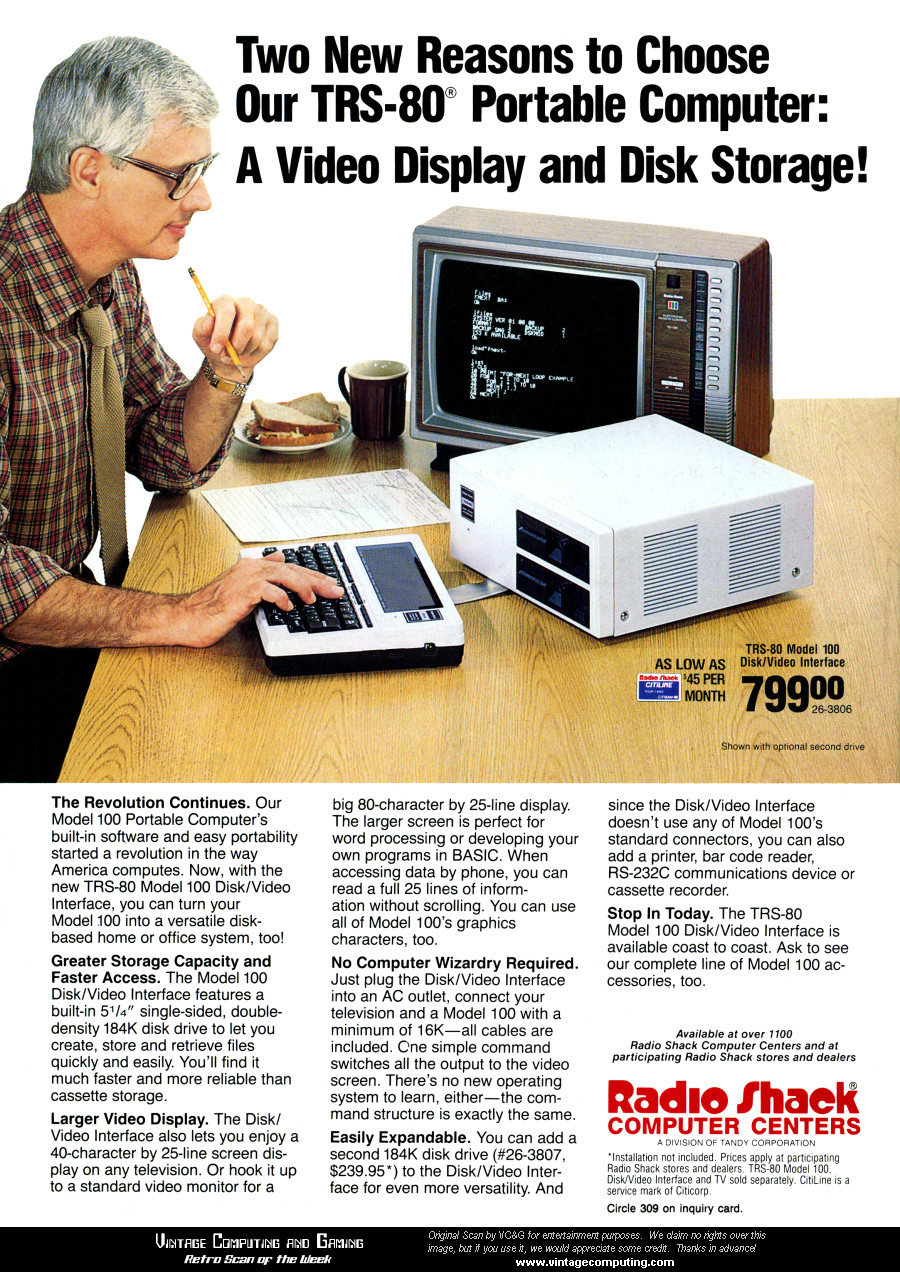
Radio Shack TRS-80 Model 100 Disk-Video Interface Ad - 1984You can’t tell from the photo, but this table is actually 200 feet wide.

Since I bought my first Model 100 over a decade ago, I’ve always wanted the TRS-80 Model 100 Disk/Video Interface (a device we see here in this 1984 advertisement) to go with it. The interface not only allows you to hook your Model 100 to a TV set or monitor (80 x 25 text display!) but it also provides two floppy disk drives on which you can store your data.

In other words, that’s quite an expansion for a computer with an 8 x 40 character display and minimal RAM-based user storage that loses its contents with battery failure. It essentially converts the Model 100 — which is a light, portable machine — into a desktop PC.

[ From BYTE Magazine, April 1984, rear cover ]

Discussion Topic of the Week: Have you ever set up a desktop computer on your kitchen table? Tell us about it.

[ Retro Scan of the Week ] Game.com Internet Module

Monday, March 26th, 2012

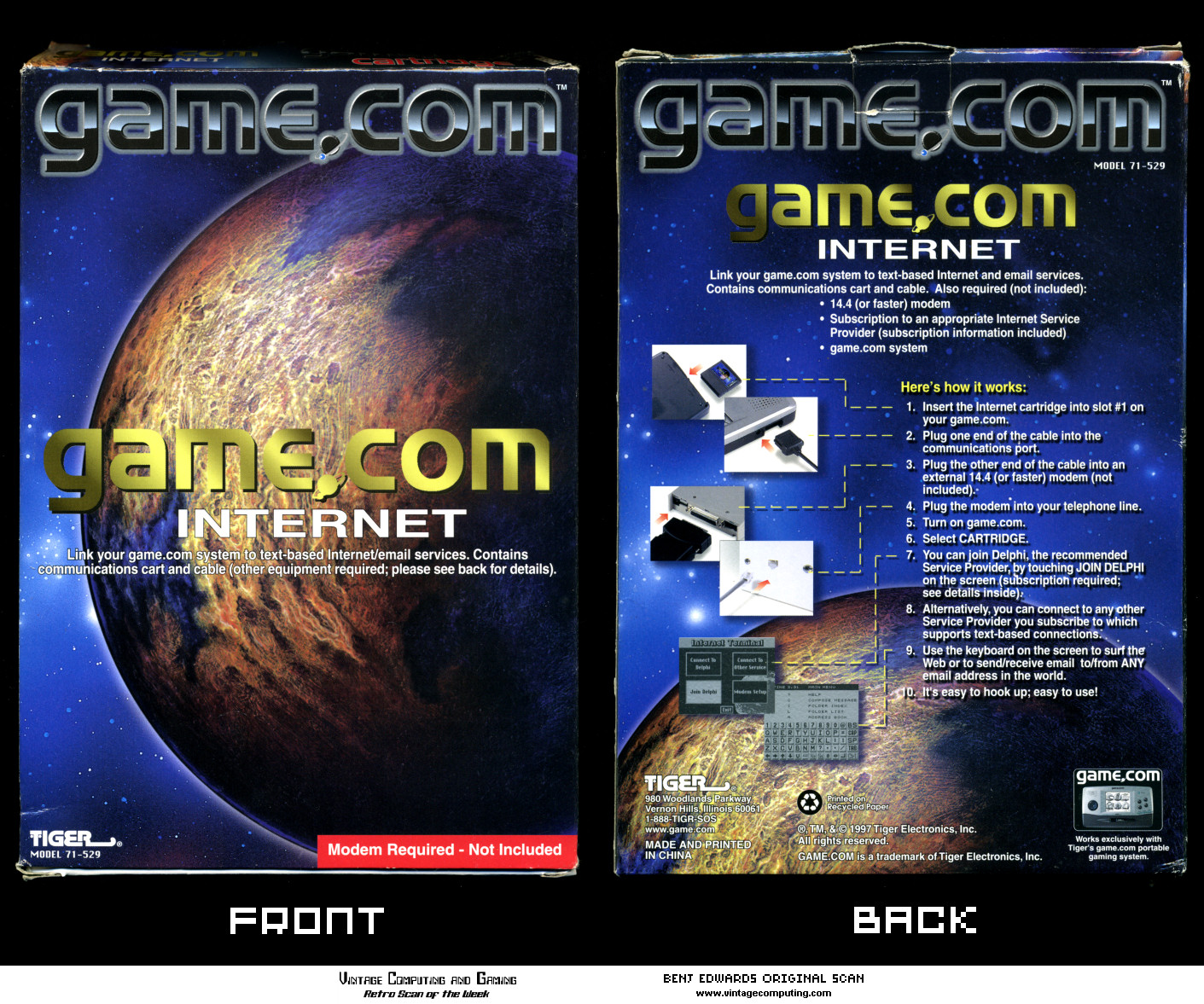
Tiger Game.com Internet Module Box Front and Back - 1997Tiger Game.com Internet Module Box

Two years ago, I posted a scan of the Tiger Game.com instruction manual. Today, I bring you the box for that console’s little-understood Internet cartridge, released in 1997.

The box you see above included a Game.com serial cable (which allowed the console to be hooked up to an external RS-232 Hayes compatible PC modem) and a cartridge with the “Internet” software on it. In truth, the cartridge contained little more than ASCII text-based terminal emulator software.

In my previous Game.com Retro Scan, I described the Game.com’s Internet connectivity, which I will quote below:

The Internet on the Game.com wasn’t nearly as exciting as it sounds. Sure, it supported “checking your email” and uploading high scores to the Tiger website, but a user had to access the ‘Net through a text-only terminal emulator cartridge — and then only via a serial cable that linked to a stand-alone dial-up modem.

It was a messy business. Being text-only, the user had to type in commands to whatever ISP the user chose (assuming they provided shell access) with the stylus on a tiny on-screen keyboard. Tiger did provide its own ISP that made the process slightly more user friendly. While far from practical, having a terminal emulator was an amusing capability. I used the Game.com call some BBSes around in 1997 for a chuckle.

As you can see, the Game.com’s Internet feature wasn’t very practical or useful, but it certainly serves as an amusing footnote in game console history.

By the way, Tiger once offered (or planned to offer) its own Tiger brand external modem for use with the Game.com. I’m not sure if it ever made it intro full production, but it is extremely rare either way. If anyone out there has seen one, please let me know.

[ From Tiger Game.com Internet box (module 71-529), circa 1997 ]

Discussion Topic of the Week: What was the first video game console you bought that could communicate with the Internet?

[ Retro Scan of the Week ] Keystick: Keyboard Joystick

Monday, March 19th, 2012

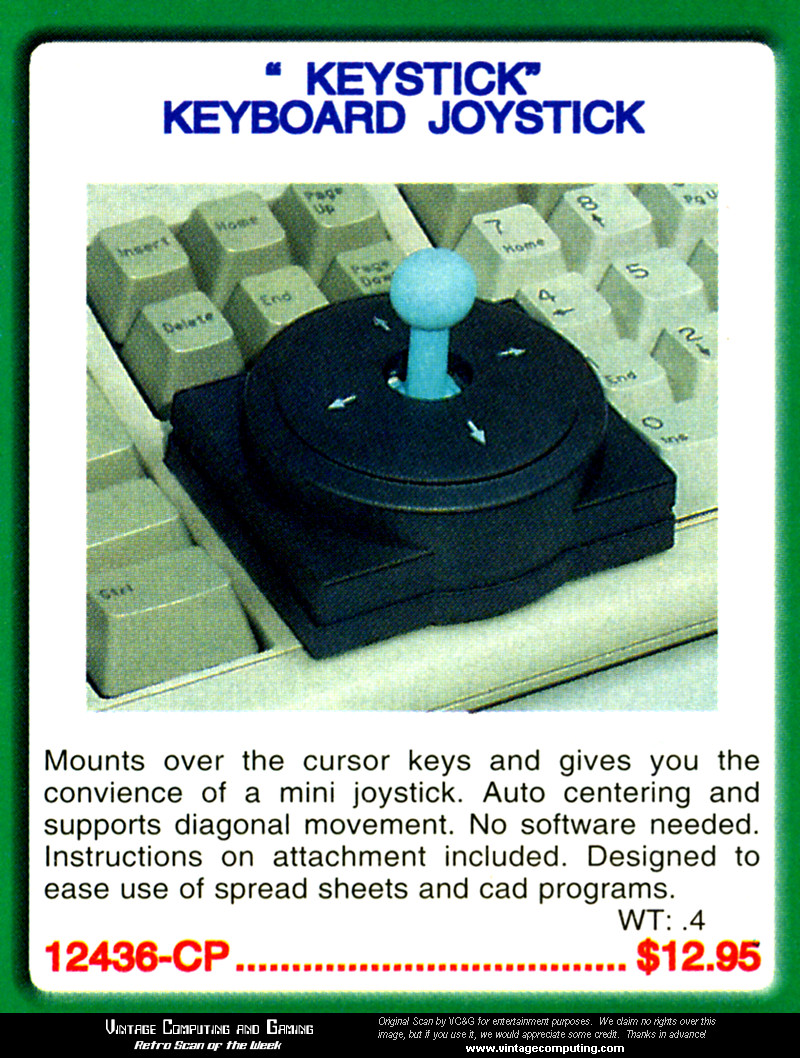
Keystick Keyboard Joystick in Electronics Catalog Ad - 2000That must be one heck of a spreadsheet you’re working on.

[ From Marlin P. Jones and Associates Electronics Catalog, 2000 ]

Discussion Topic of the Week: Do you prefer playing classic PC games (say, pre-Doom) using a keyboard, a mouse, or a joystick?

[ Retro Scan of the Week ] The iPad of the 1980s

Monday, March 12th, 2012

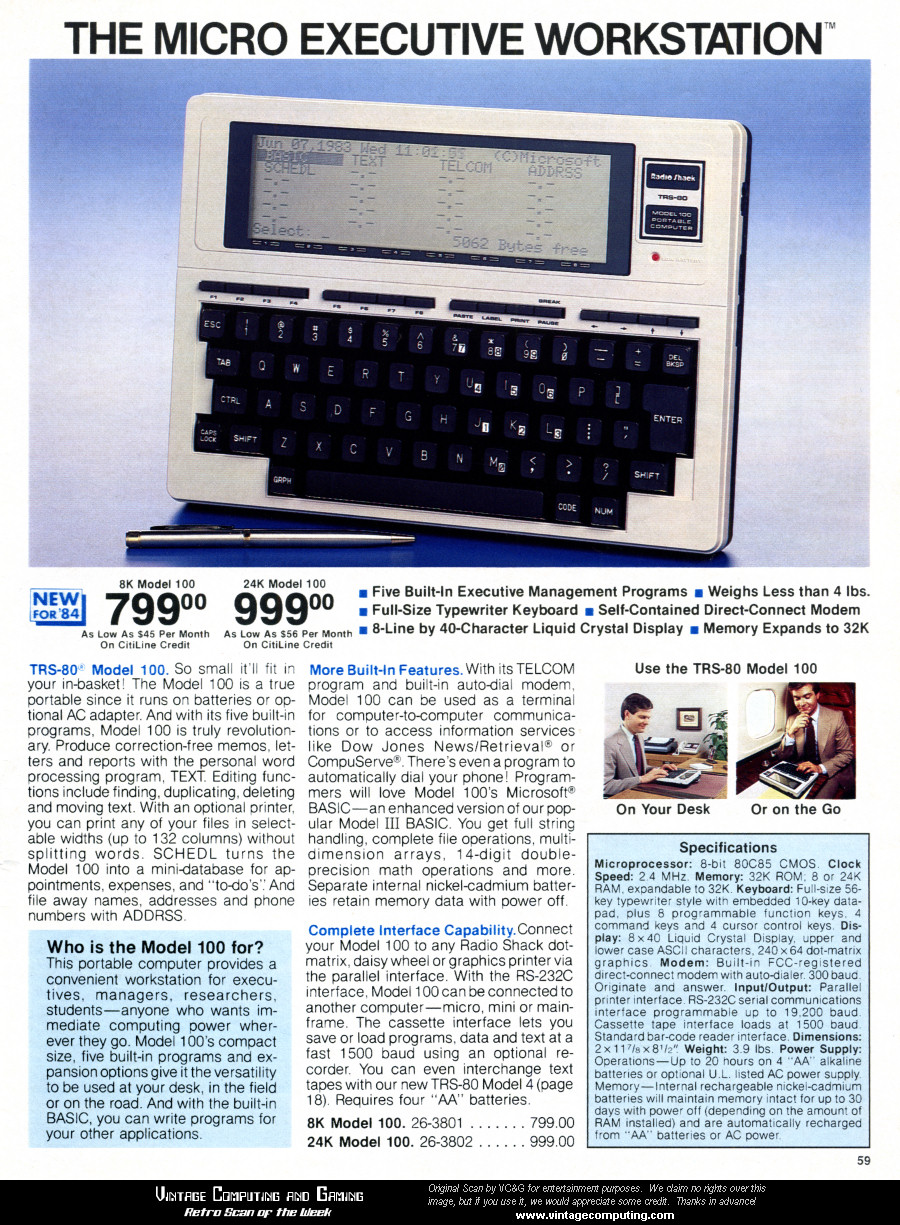
1980s iPad - TRS-80 Model 100 Catalog Page - 1984It’s the MICRO EXECUTIVE WORKSTATION, people!

iPad, schmyepad. In the 1980s, we had hair on our chests, far fewer seat belts, and we walked backwards downhill halfway from school every day in the monsoon season. AND WE LIKED IT. We also used the TRS-80 Model 100 — a sleek 3.9-pound, 2-inch thick machine that could run 20 hours on a single set of four AA batteries — for all of our mobile computing needs.

Imagine 8 kilobytes of RAM. Imagine a full travel keyboard and a 240×64 display that could fit in your lap. Imagine downloading stock prices at $12/hour from CompuServe at 300 bits per second over two acoustic couplers. It’s not a fantasy — it’s life in 1983.

Below, I present for your perusal a stat-by-stat comparison between the mighty Radio Shack wonder and today’s iPad, then I ask you: which is truly superior?

[ Continue reading [ Retro Scan of the Week ] The iPad of the 1980s » ]

10 Computer RPGs That Defined the 1980s

Monday, March 12th, 2012

10 Computer RPGs That Defined the 1980s

Over the weekend, PCMag.com published a slideshow I put together covering 10 classic computer RPGs of the 1980s. Here is a passage from the introduction that excited Slashdot recently:

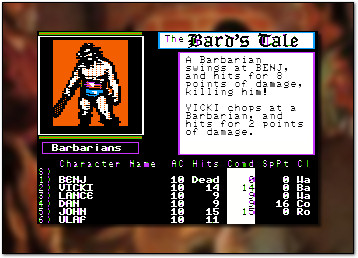
Throughout our story, we’ll cover 10 classic computer games that both defined and extended the definition of the RPG in the 1980s. You’ll see names like Ultima, The Bard’s Tale, and Might and Magic, which may seem familiar, but you’ll also find a few surprising titles that you may never have heard of.

It’s funny — I was going to try to sneak this one past the Internet populace with a modest, unassuming title instead of something like “THE TEN MOST IMPORTANT RPGS OF THE 1980S.” But nooo, someone found it anyway, dug out the interesting kernel of truth buried in the introduction, and put it on Slashdot for all to see.

I bet if I had titled it something like “10 Games,” we would be hearing about it on the CBS Evening News tonight.

All that being said, I hope you enjoy it.

Read “10 Classic Computer RPGs” at PCMag.com

[ Retro Scan of the Week ] Get Pocket Power!

Monday, March 5th, 2012

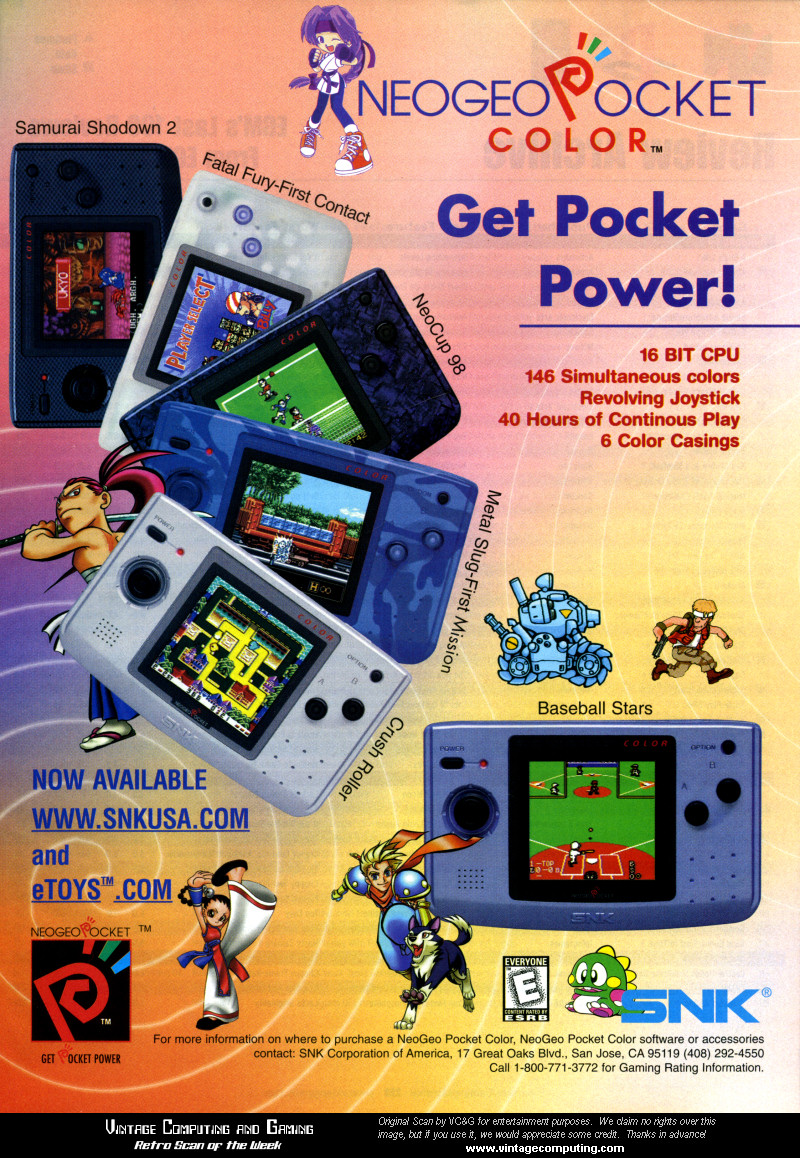
SNK Neo Geo Pocket Color Ad - 1999Why 146 simultaneous colors? Because it’s one more than 145!

I previously wrote about the Neo Geo Pocket Color in a Retro Scan of the Week from 2010, but I ran across this colorful 1999 ad for the console recently and couldn’t resist. I’ve always had a soft spot for this would-be Game Boy killer that never lived up to its true potential.

[ From Electronic Gaming Monthly, September 1999, p.219 ]

Discussion Topic of the Week: Why do you think the Neo Geo Pocket Color failed to achieve long-term success?