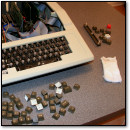
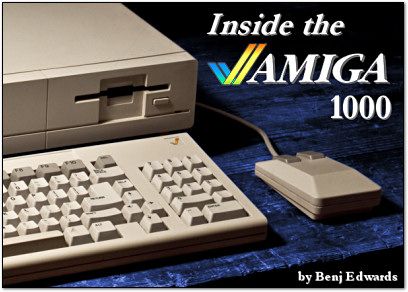
Commodore first shipped the legendary Amiga 1000 in July of 1985 — twenty-five years ago. In honor of the Amiga’s birthday, I did what comes natural to Benjs of all sorts: I took one apart. And I did it for PC World, making this the tenth entry in my “workbench series” of tech autopsies.
Giving the Amiga 1000 its place in the limelight is only fair because I took apart its arch-nemesis, the Atari 1040STf, back in March (the ST series also turned 25 this year).
I hope you enjoy it. When you’re done, I encourage you — no, urge you — to share your fondest Amiga memories in the comments below.
You remember Mr. Wizard’s World, right? It was a light science show for kids that aired on Nickelodeon in the 1980s. On one episode, Mr. Wizard took a peek inside the Atari 1200XL with his usual juvenile accompaniment. Here’s a clip.
The real fun begins as Mr. Wizard tries to explain the function of a row of eight chips on the motherboard around 1:40 into the segment. He quickly lapses into apparent nonsense:
You see these eight all here? This is an eight bit computer. You’ve heard of that? OK. Each one of these sends a, uh, byte off to the screen and, uh, each little dot has to have a signal from each one of those.
I probably don’t have to tell you this, but that’s not how the Atari 1200XL works. This is Internet, though, so I’ll explain it. Those eight chips are RAM chips, and their exact quantity in any computer is mostly independent of the CPU’s word size (i.e. 8-bit, 16-bit).
The fact the Atari’s CPU is 8-bit and that it contains eight RAM chips is a coincidence that apparently confused Mr. Wizard. The 1200XL had 64KB of RAM, so those are likely 8KB chips (8KB x 8 chips = 64KB). To make up the same amount of RAM, Atari could have used (for example) four 16KB chips or sixteen 4KB chips.
The rest of his explanation for those eight chips doesn’t make any sense either. But hey, it’s Mr. Wizard! Other than that, he does a pretty good job showcasing the 1200XL in a kid-show context. The joystick-sans-stick demonstration is classic Mr. Wizard fare — he’d always change things around and make you think about an issue in an unexpected way. That was his genius.
I loved Mr. Wizard’s World dearly as a kid. In fact, I learned many basic physics principles from that show. We could really use someone like him again.
P.S. If you like Mr. Wizard as much as I do, watch him on The Late Show with David Letterman in 1982.
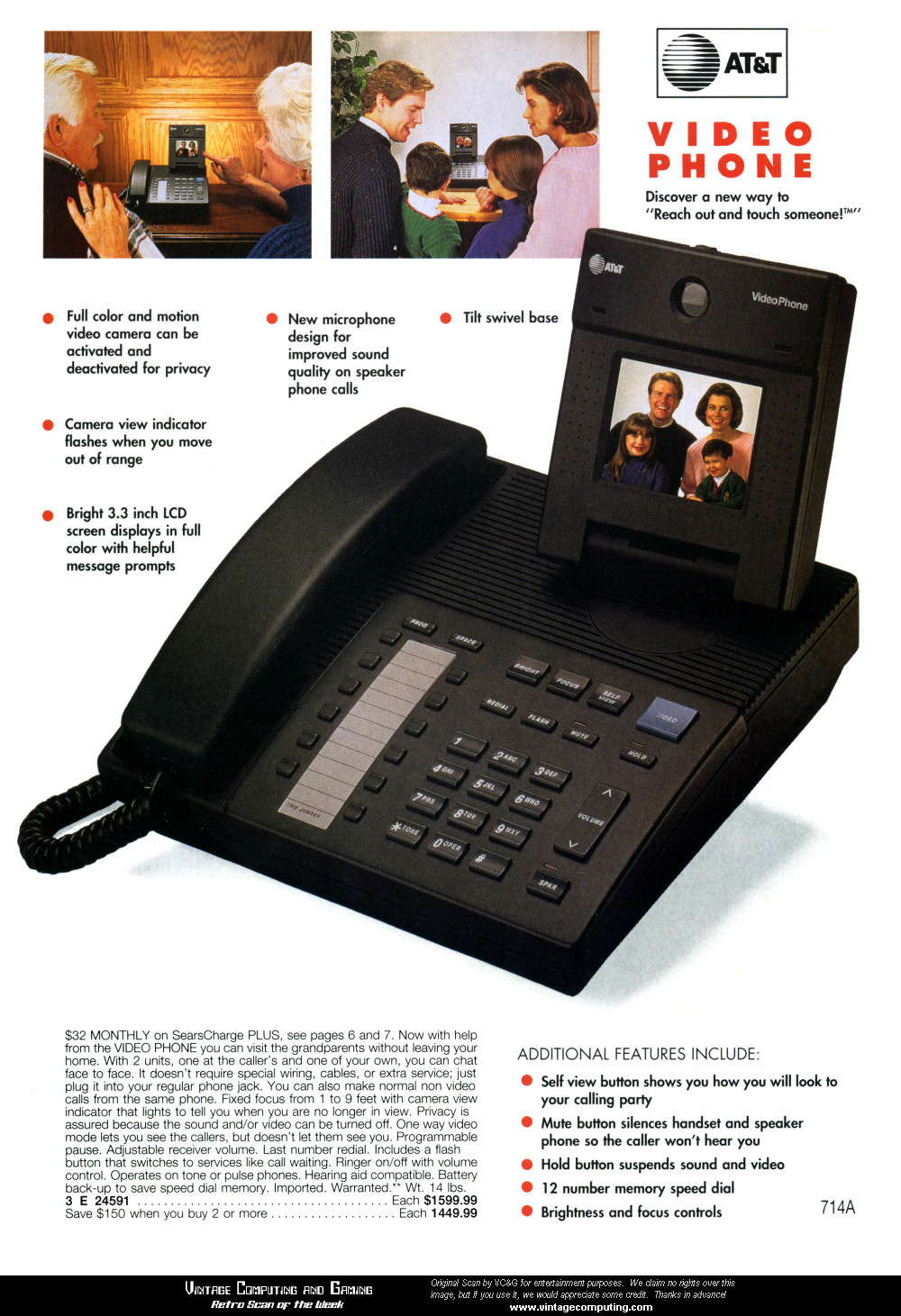
“Discover a new way to ‘Reach out and touch someone!'”
AT&T launched the VideoPhone 2500 in 1992 with high hopes that it would finally bring video calling to the masses. Ultimately, it fared no better than AT&T’s previous attempts at commercial video phones, all of which exited the market quickly after their introduction.
For $1599.99 ($2,486.19 in 2010 dollars), you received a single phone unit that could send audio and color video (at up to ten frames per second) simultaneously over a regular phone line. It worked its magic through a 19.2 kbps data stream, which is minuscule by today’s standards, but was state of the art in 1992. Unfortunately, the video functionality of the VideoPhone 2500 was useless without another $1599.99 phone to interact with — perhaps the fatal flaw in AT&T’s plan.
If you’re interested in learning more about the history of video telephone technology, check out my latest Technologizer slideshow, 132 Years of Videophones.
[ From Sears Great American Wishbook, 1992, p.714A ]
Discussion Topic of the Week: If you owned an easy-to-use videophone device — and everyone else had one — how often do you think you’d use its video functionality?
There was a time in the early 1980s when one could find ads for many different unauthorized Apple II clones in the back of just about any computer magazine. The ads promised inexpensive reverse-engineered copies of the Apple II computer hardware designed to use Apple II software and peripherals. Apple wasn’t too happy about the illicit machines and even managed to win some import bans on them in the US, but many remained on the market.
Some folks, like my father, even bought underground replicas of the Apple II motherboard, copied the Apple ROMs onto EPROMs, and built their own Apple IIs from scratch. It was a lot cheaper than buying directly from Apple, so many people with the technical know-how chose that path.
[ From Interface Age, November 1983, p.104 ]
Discussion Topic of the Week: Have you ever owned or built an unauthorized Apple II clone? Tell us about it.
[ Memory Dump is an irregular series wherein Benj dives into his garage, pulls out a random technological artifact, and describes what he knows about it for your entertainment. ]
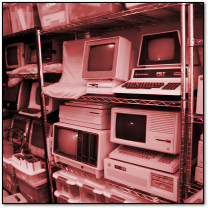
I own a garage full of history. Literally. It’s dark, dusty, and sometimes damp, but that space houses most of my computer and video game collection. It’s almost a crime not to dive in there and share it with VC&G readers more often. And believe me, the guilt of not doing so has tortured me for years.
That task is an overwhelming one, though. It’s hard to know where to start. The sheer mass of history crammed in the place is enough to give one a panic attack on sight. For the sake of the Internet’s safety, I dare not publish a picture of my garage’s contents larger than 200×200 pixels. Anything larger and mass hysteria may erupt.
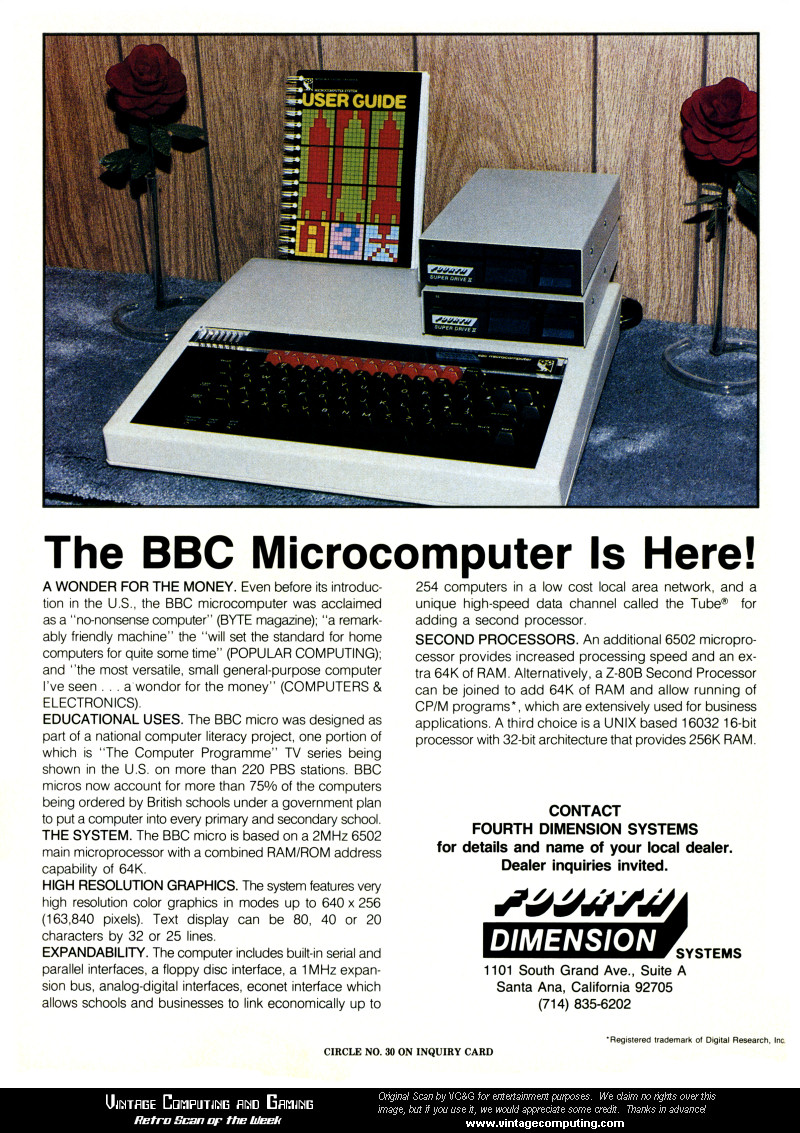
This scan of an American BBC Microcomputer ad might be of particular interest to our British friends, who may be curious as to how one of the UK’s most famous early PCs was received in the United States. The truth is that the BBC Microcomputer is virtually unknown here. I’ve never seen one in person, and I’d never even heard of it until the Internet era. I suspect US sales of the BBC Microcomputer were limited in part due to the low market footprint of importers like “Fourth Dimension Systems,” as seen in this ad.
I know very little about the BBC Microcomputer (although I’d love to have one, if anyone wants to send a unit over). If any readers out there are familiar with the BBC Micro, I’d be interested to hear some history and trivia about the machine in the comments.
[ From Interface Age, November 1983, p.30 ]
Discussion Topic of the Week: Have you ever owned a British-designed PC? If so, tell us about it. If many, tell us your favorite.
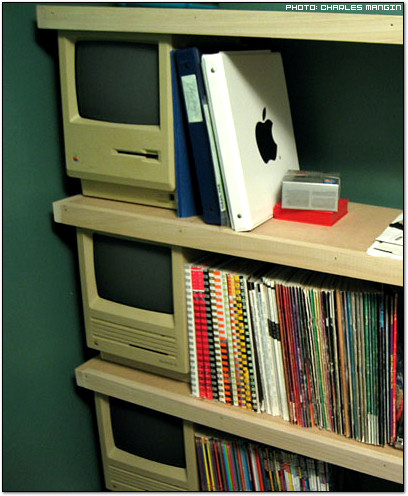
Hot on the heels of my recent post about the “Mac Pedestal” in which I suggested building shelves with compact Mac supports, VC&G Reader Charles Mangin informed me that he did just such a thing and wrote about it on his blog in 2007.
You can see the result above. Nice work, Charles. With all the Macs I have in my garage, maybe I should try this myself and redefine the meaning of “Mac Shelf.”
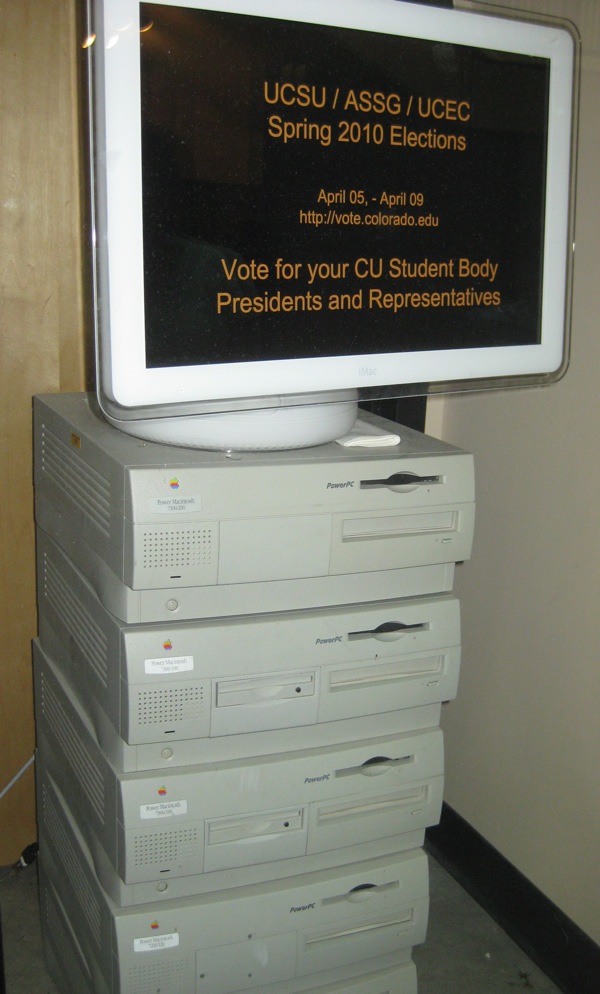
Long-time VC&G reader Mike Melanson recently emailed me this photo of an interesting encounter he had with a stack of retired Apple Macintoshes. He writes:
Upon visiting my alma mater last week (University of Colorado @ Boulder), I snapped this picture of a stack of vintage PowerMacs topped with an old iMac that was rotating through some generic campus announcements.
Not a bad use for five Power Macs, I’d say. I could imagine an interesting table with Power Macs for its legs — or a bookshelf supported only by Mac Pluses at the ends. Any other ideas?
— Have you seen any vintage computers in the wild recently?
If so, snap a photo and send it in.

 [ Memory Dump is an irregular series wherein Benj dives into his garage, pulls out a random technological artifact, and describes what he knows about it for your entertainment. ]