Archive for 2009

[ Retro Scan of the Week ] Corvus Apple II Hard Drive

Monday, November 16th, 2009

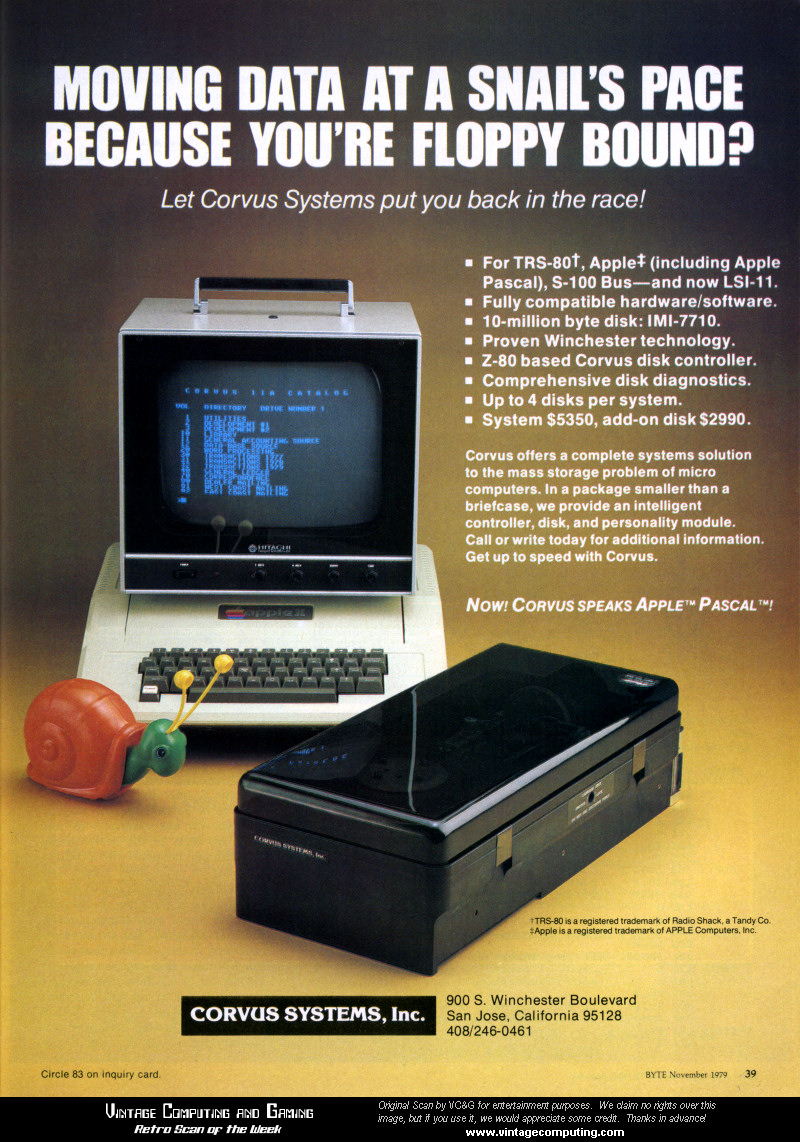
Corvus Hard Drive IMI-7710 for Apple II Ad - 1979The snail was not amused.

Wow. $5,350 for a 10 megabyte hard drive system that’s almost as big as your computer. What a bargain! It’s like a tiny coffin for your data.

In case you’re taking notes, this Corvus hard disk system sold for $15,915.07 in 2009 US dollars. Its retail price constituted a whopping 53% of the average American’s yearly income in 1979 (about $10,121). Yes, in 1979, you could spend half of your annual salary on a single 10MB hard drive setup.

Just out of curiosity, how many of you owned a hard disk for your PC before 1985? Raise your hand.

Not many, and now you see why. Even as prices dropped, most hard disks were well out of the realm of affordability for most home PC users in the 1970s and 80s. Even at 1/5th the cost, this hard drive would have still been beyond the reach of most US households.

[ From BYTE Magazine, November 1979 ]

Discussion Topic of the Week: What was the size (data capacity) of your first computer hard drive?

SNES PowerPak Materializes

Thursday, November 12th, 2009

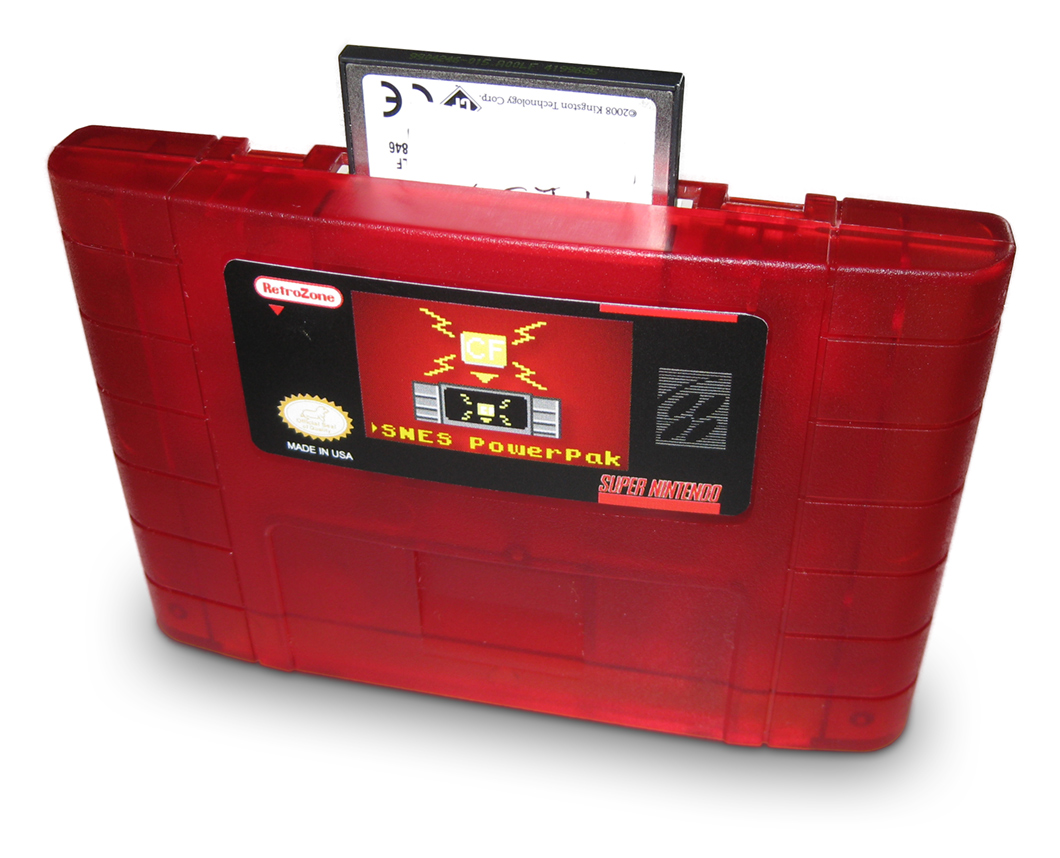
RetroZone SNES PowerPak

Remember the PowerPak — that wondrous device from RetroZone that allowed you to cram every NES game ever made into one cartridge? Well, two years later, RetroZone has released its follow-up, the SNES PowerPak for the Super NES.

Well, they’ve kinda released it. Sales appear to temporarily be on hold in order to “investigate system compatibility,” according to the RetroZone website.

RetroZone Temporarily UnavailableFor those unfamiliar with the original PowerPak concept, the SNES PowerPak allows one to copy SNES ROM files onto a compact flash card, place the card into the SNES PowerPak cartridge, and then play those games on a real Super NES unit. It supports multiple games through on-screen menu selection.

More Info to Come

When I stumbled across the new SNES PowerPak today, I initially felt like jealously hoarding the knowledge so I’ll have less competitors when I try to get my hands on one of these magical devices.

But then I realized that I have a responsibility to let you guys know about this, since so few sites out there cover the world of Nintendo hacking and modding — and especially since the proprietor of RetroZone doesn’t make much effort to get the word out.

Whenever I get one, I’ll write a review for VC&G. Until then, you can drool over it like me at the RetroZone site.

Jason Scott Needs Your Help

Monday, November 9th, 2009

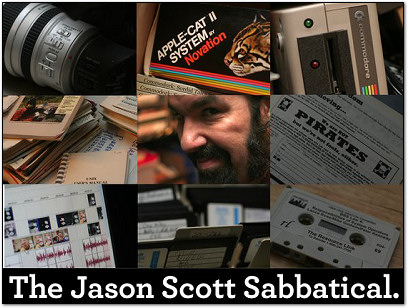
Jason Scott Sabbatical

Jason Scott is a singular fellow. He’s the man behind the BBS Documentary, the upcoming Get Lamp documentary (on text adventure games), and creator of textfiles.com. He also spearheaded a recent attempt to archive all of Geocities before Yahoo took it down recently.

This fellow historian, friend of VC&G, and archivist extraordinaire recently lost his long-time job as a system administrator. Like many who have found themselves unemployed recently, the situation inspired a little soul-searching from Scott, who realized his stressful years as a system administrator had worn down his health.

Something important dawned on him: he already spent so much of his spare time and money on his main passion — preserving and documenting computer history — why not try to do that full time?

That’s where the Jason Scott Sabbatical fund at Kickstarter.com comes in. Scott is seeking donations from people around to globe to fund a 3-4 month sabbatical wherein he can focus on his history and archiving work full time. So far, hundreds of people have chipped in (including myself), but he still needs more donations to push him over top of the hill.

I can honestly say there’s no one else out there like Jason Scott, and we will likely never see another single individual so fiercely (and I mean fiercely) dedicated to preserving the overlooked backwaters and forgotten alleys of our digital history. Scott’s goal is a worthy one, and he does monumentally important work that future historians will thank him for.

Jason Scott -- The Showman

This sabbatical concept via Kickstarter is a somewhat radical idea, I know. Some of you will have doubts about it — for example, if he will spend the money properly. But I don’t fear that outcome: that’s for Jason Scott to sort out, and for his own conscience to live with.

If you contribute a modest amount, you have little to lose. If he blows the cash, so what? But if you contribute and Scott does what he promises to do, I predict that history will have a lot to gain — not only in terms of added, productive years on Jason Scott’s life, but in countless terabytes of priceless historical data that will serve as the foundation of our ancestors’ understanding of the past.

As a historian, I need Jason Scott to continue his work. As a human with a responsibility to the legacy of your species, you need Jason Scott to do his work. Please consider helping him out.
[ Retro Scan of the Week ] Wall Street Kid (NES)

Monday, November 9th, 2009

Sofel NES Wall Street Kid Ad - 1990Coming Soon: Ben Bernanke’s Bail-Out!!

[ From Video Games and Computer Entertainment, November 1990 ]

Discussion Topic of the Week: How has the current U.S. economic recession affected you?

Inside the Atari 800 (30th Anniversary)

Friday, November 6th, 2009

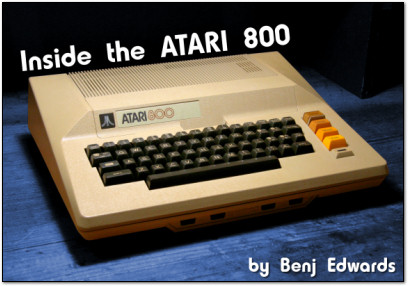
Inside the Atari 800 - PC World

Thirty years ago this fall, Atari shipped its first entries in the personal computer market, the Atari 800 and 400 computers. I’m particularly fond of the Atari 8-bit series because I grew up with an 800 as my first computer and video game machine — it was especially potent and impressive in the pre-NES days.

Sadly, no publication I queried was interested in a full in-depth history of the computer (although I was poised to do one), so you’ll have to settle for my latest slideshow on PCWorld.com.

In “Inside the Atari 800,” I dissect my family’s beloved Atari 800 unit and explore what makes it tick. This article is the eighth entry in my “workbench series” of tech teardowns, and it might be my best. If nothing else, it sports my favorite self-designed introduction slide yet (seen above) — I should turn that into a poster.

By the way, PC World drastically improved its slide show system, so if you weren’t a fan of it in the past, check this one out. I think they’ve retrofitted all my old slide shows to the new system as well. (Even so, I’m not too happy they made my sharp photos look terrible with extreme JPG compression.)

So give it a look-over; I hope you enjoy it. Please feel free to share your Atari 8-bit memories and well-wishes here. I’d love to know how many Atari 8-bit fans we have out there.

Here are my previous teardowns, if you’re interested: Commodore 64, Nintendo Game Boy, Nintendo Famicom, Apple IIc, IBM Model M Keyboard, TRS-80 Model 100, and Macintosh Portable.

Vintage vs. Modern PC Prices

Tuesday, November 3rd, 2009

Classic PCs vs. New PCs Technologizer

Amongst all the heady VC&G anniversary festivities (I’ve been to five parties this week alone*), I almost forgot to tell you about a new VC&G-related article that popped up last week on Technologizer. It’s by a guy named Benj Edwards, which probably explains why I’m writing about it here.

For my latest Technologizer article, Classic PCs vs. New PCs, I selected six vintage personal computers from yesteryear and figured out what you could buy today for the same price. And we’re not talking original retail price here; I took inflation into account.

For example, the Commodore 64 — once considered a low-cost home computer — originally sold for the equivalent of $1,331.62 in 2009 dollars. Today you can get quite a bit for that much money. How much? That’s what we’re going to find out.

* Five all-nude FORTRAN coding jamborees, invitational

VC&G: Still Here After Four Years

Monday, November 2nd, 2009

Vintage Computing and Gaming LogoFour years ago today, I posted my first (somewhat awkward) entry on this blog. I was new to blogging then. Heck, blogging was new to blogging then. Or at least it feels that way to me now.

I was by no means an early adopter of blogging in general, but quite a bit has changed in the “blogosphere” (I die a little every time I say that term) over the last four years — years that have seen a choice few video game and gadget blogs consolidate power with very influential voices in their respective communities. They’ve gone from sloppy wannabe video game/gadget press to actually absorbing, replacing, and becoming the video game/gadget press in some respects as traditional print magazines continue to fall by the wayside.

Where’s VC&G in all this? Heh, I don’t know. We’re no powerhouse, but we (I say “we” in the most singular sense of the word) have an impressive Google footprint in the video game and computer history realm. It’s a bizarre feeling when I’m researching my freelance articles and I come across multiple links to VC&G posts or images from Retro Scan of the Week on every Google results page. I have to avoid quoting myself.

Vintage Computing and Gaming SiteAt the end of the day, Vintage Computing and Gaming is still an enthusiast blog that’s not updated very frequently (since 2007 or so). But at least we’re still here after four years. That’s a long time to consistently maintain any blog, and I’m proud of that much.

I like the stability and consistency that VC&G provides in my writing life, and my regular readers (that’s you) feel like old buddies to me now. Thanks for continuing to humor me in moments both odd and insightful.

On another note, I honestly never thought I’d keep the same theme and site design for this long. Back in 2005, I used to plan site redesigns for my websites every few years, but this layout served the blog so well that I just said, “What the heck. If it works, keep it.”

And now, some statistics. There are currently 491 posts and 5,165 comments on VC&G. That’s an average of 3.5 comments a day since November 2nd, 2005, and a whopping 10.5 per post. Not too shabby. Keep it up!

Discussion Topic of the Year: Share your favorite VC&G moments. If you had no nominate a post or two for a hypothetical “Best of VC&G,” what would they be?

[ Retro Scan of the Week ] 30 Years of VisiCalc

Monday, November 2nd, 2009

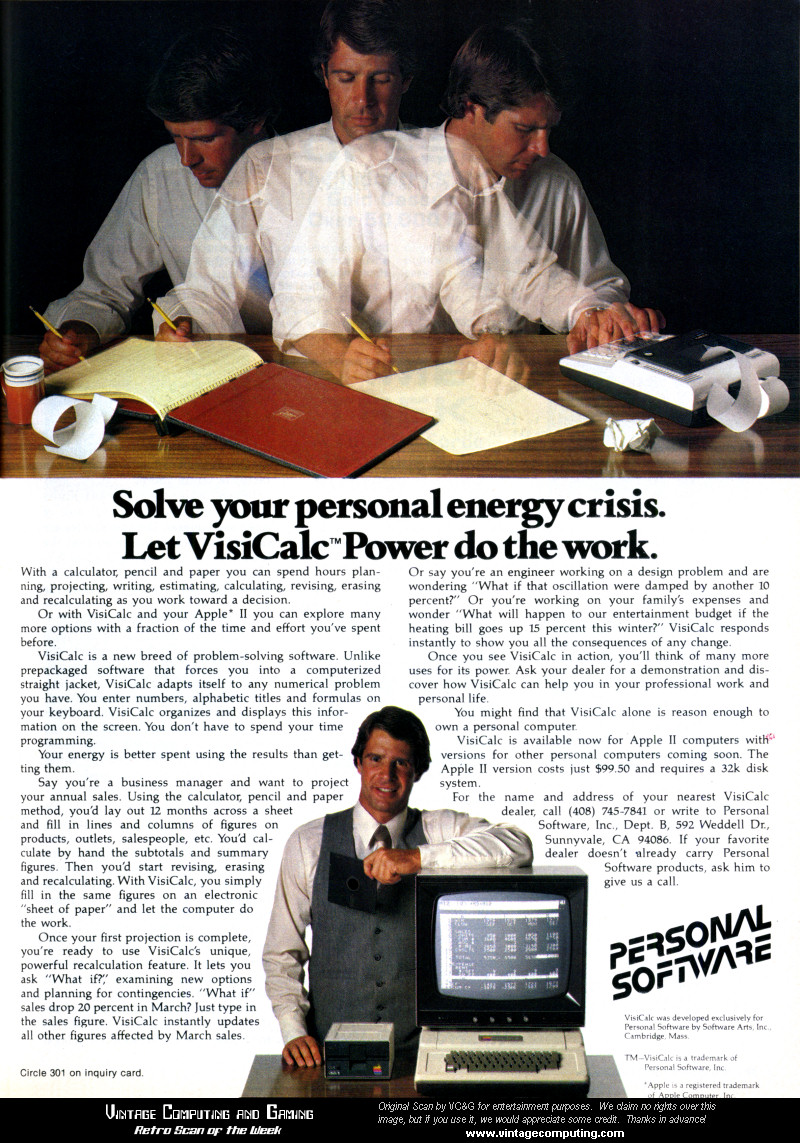
VisiCalc Ad - 1979Reminds me of a Superman comic book cover.

Thirty years ago this October, Personal Software unleashed VisiCalc, the world’s first spreadsheet software for personal computers, upon an unsuspecting computer populace. Invented and developed by Dan Bricklin and Bob Frankston of Software Arts, VisiCalc has become legendary for its influence on the personal computer industry.

VisiCalc, with its almost magical ability to instantly and intelligently crunch multiple cascading figures, proved to be the Apple II’s killer app — the application that gave the Apple II a viable foothold in the business market and drove the machine’s sales.

Of course, other spreadsheet packages (Lotus 1-2-3 and Excel come to mind) soon imitated and then eclipsed VisiCalc in sales, but we should all raise a glass and toast the original on this fine 30th anniversary.

For more information, check out Dan Bricklin’s website. Dan also has a new book available that you might be interested in.

[ From BYTE Magazine, November 1979 ]

Discussion Topic of the Week: What was the first spreadsheet software you ever used?

I Hate It When This Happens (Leaky Battery Blues)

Sunday, November 1st, 2009

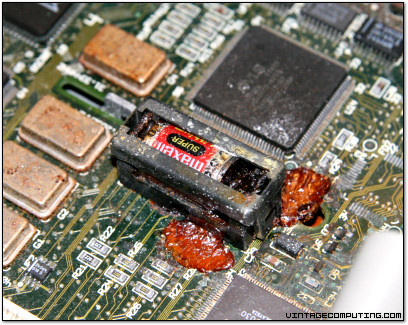
Burst Macintosh Clock Battery
VC&G Collecting Tip: Remove your old computer clock batteries.

Right now.

I’m serious: do it. Despite my regular battery purges (done to avoid just such a situation), I forgot to remove the Mac IIsi PRAM battery you see above because the computer was buried under a bunch of stuff. The battery electrolyte leaked out and corroded everything it touched, ruining the logic board. Sometimes you can recover from battery leaks with extensive cleaning if the damage isn’t that bad. In this case, it wasn’t worth the effort. Bye, bye, IIsi.

While you’re ditching the vintage clock batteries, do yourself a favor and remove the main power batteries from any laptops in your collection. I typically store laptop batteries in a gallon zipper bag each. Even if the batteries are dead/bad (which they usually are), I save the plastic cases for re-use if I plan to rebuild the battery in the future.

As a good rule of thumb, never keep batteries (no matter how new) in any electronic device for longer than a couple weeks of non-use. Any longer, and you’re just playing Russian roulette with your gadgets.

Almost all batteries leak eventually. If your old ones haven’t leaked already, you’re very lucky. Focus on alkaline and NiCd batteries first, because they leak the worst; lithium cells can leak as well (as seen above), but it’s less common overall.

Regardless of the type, if they’re old, remove them now — even if it requires clipping or desoldering — and spare yourself the leaky battery blues later on.

[ Retro Scan of the Week ] Splatterhouse 3

Monday, October 26th, 2009

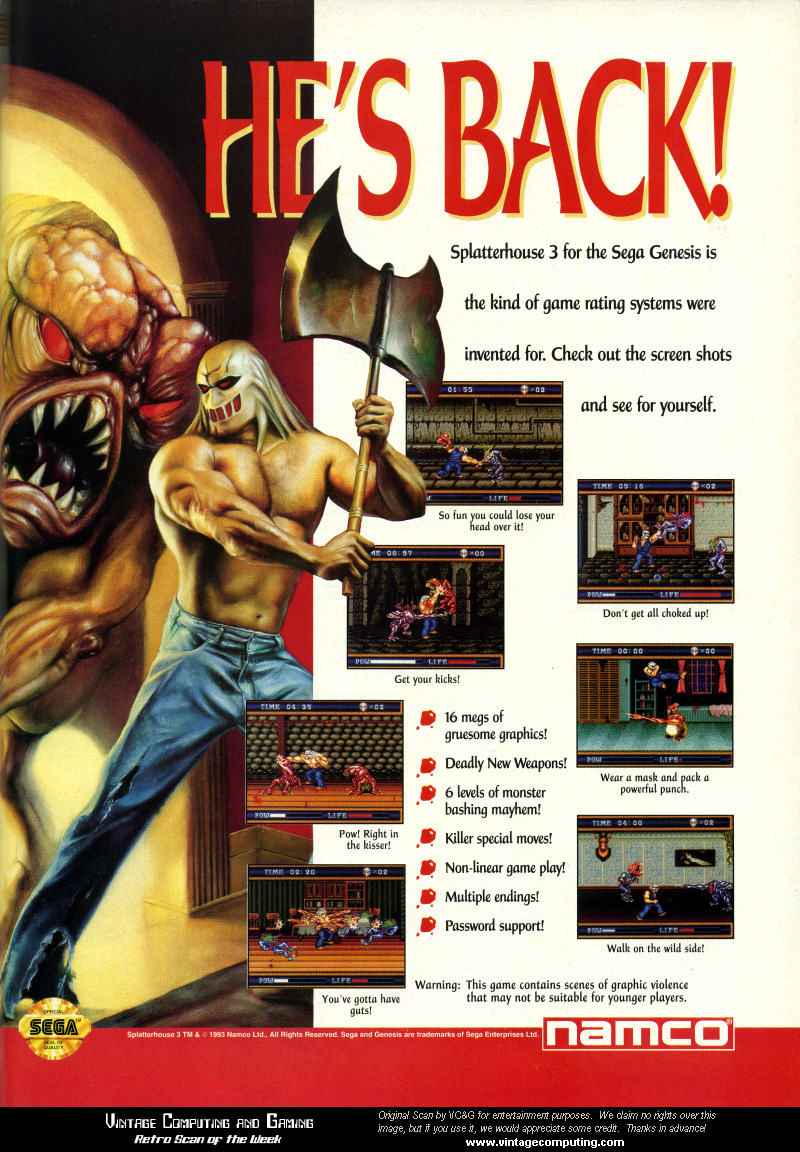
Sega Genesis - Splatterhouse 3 Ad - 1993“The kind of game rating systems were invented for.”

Splatterhouse 3 is by far my favorite entry in the Splatterhouse series. The other two just don’t cut it for some reason. I prefer Splatterhouse 3’s room-based approach to the game, and its controls are pretty good. It incorporates an on-screen map too, which makes it feel more like an adventure game.

Happy Halloween, by the way!

[ From Electronic Gaming Monthly, November 1993 ]

Discussion Topic of the Week: What’s the goriest video game you’ve ever played?