[ Retro Scan of the Week ] Sierra Battle Bugs
Monday, June 15th, 2015 “This is it, boys. Over the anthill.”
Discussion Topic of the Week: How many insect-themed computer or video games can you name off the top of your head?
“This is it, boys. Over the anthill.”
Discussion Topic of the Week: How many insect-themed computer or video games can you name off the top of your head?
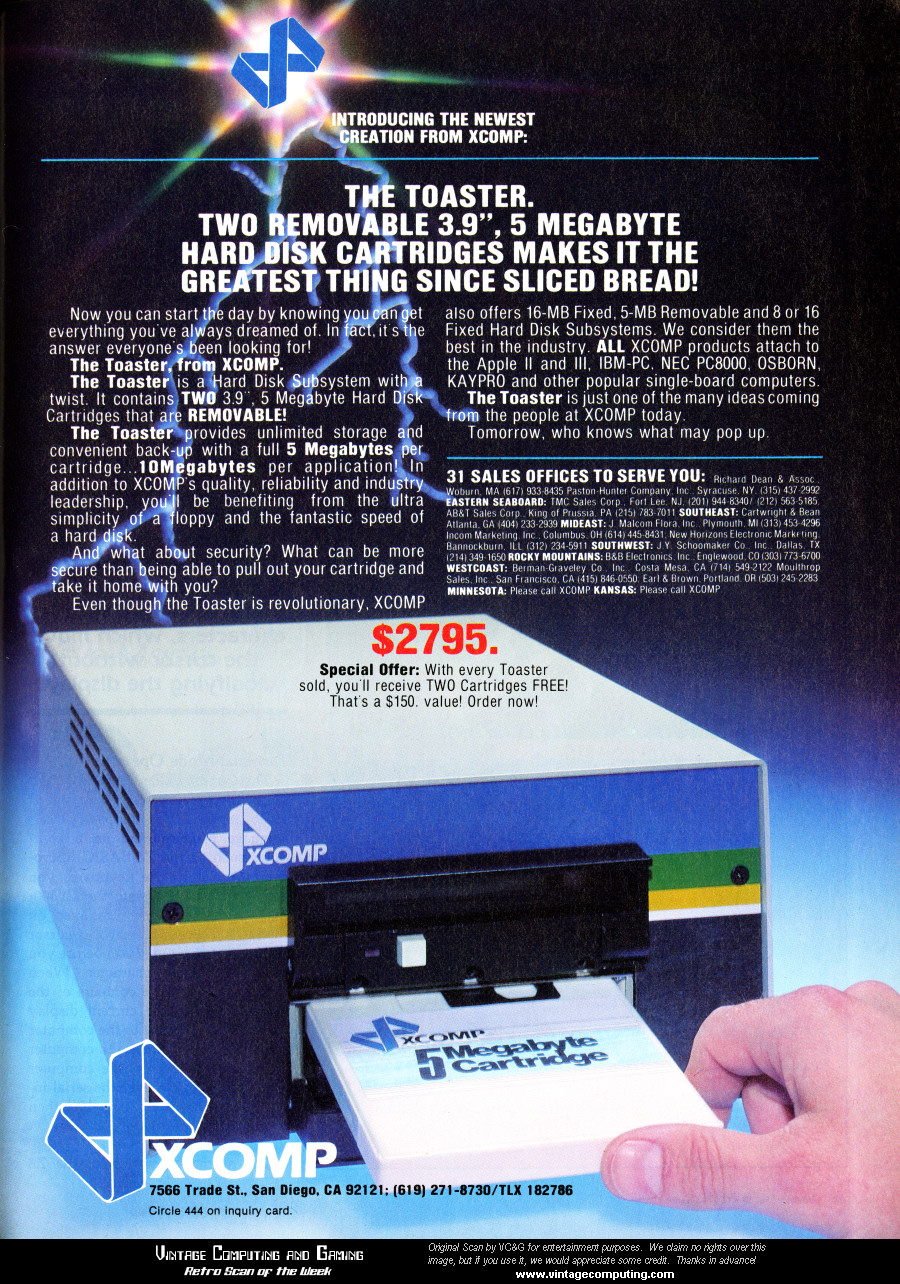 It burns your disks
I know nothing about this dual removable hard disk device — called “The Toaster” — by XCOMP. The only time I’ve ever seen it is in this ad. But judging by the lightning, it was completely awesome.
It was also completely expensive — about US $6,639.50 when adjusted for inflation.
Discussion Topic of the Week: Have you ever used a removable hard disk system?
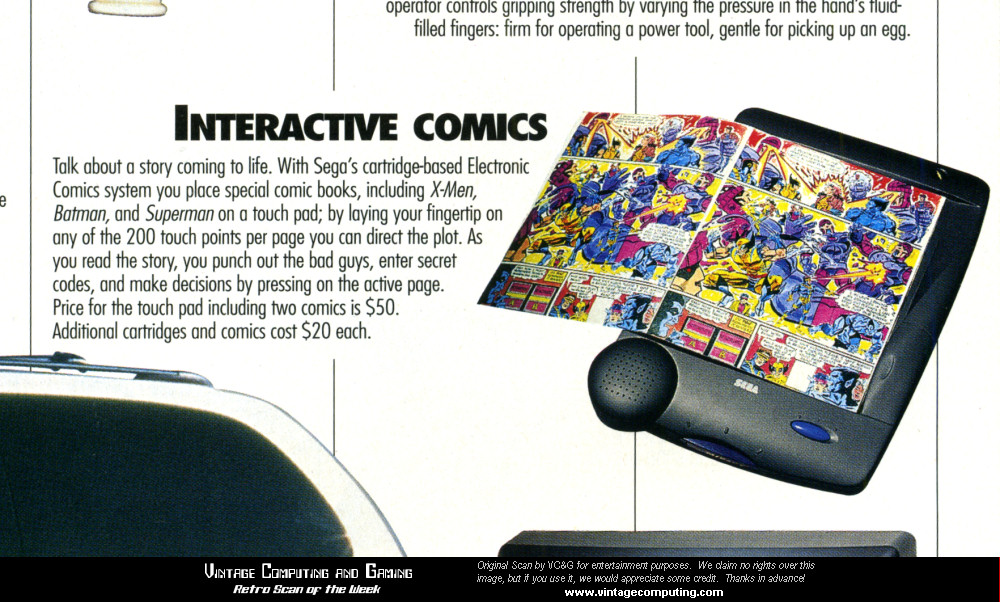 WHAM! POW! ZAP!
I’ve been intrigued by this Sega Electronic Comics System prototype since I first saw it in Popular Science’s What’s New section back in April 1995. Here is an excerpt from that very magazine.
As far as I know, this device never made it into production — in fact, the only mention I can find of it on the Internet as of this writing is this post on the Collectors Society forums.
Apparently, the Sega Electronic Comics device worked in conjunction with a tailor-made paper comic book that one would place onto the device. A series of pressure-sensitive buttons beneath the comic book could be pressed to somehow direct the narrative of the book. (Perhaps like Choose Your Own Adventure — i.e. if you do this, turn to page 3.)
This reminds me of the comic book device Tom Hanks’ character outlines in the film Big (1988), albeit without any type of electronic screen. The crazy thing is that 15 years after this Sega Prototype, you could buy an iPad that could store and display thousands of entirely digital comics in a much thinner form factor.
Discussion Topic of the Week: Do you use an electronic device to read comic books? Tell us about it.
 Make it no, Number One.
I once lampooned a Klingon keyboard for a PC World slideshow back in 2009 (looks like the images on that slideshow are broken now — bummer), so I found it especially fun when I ran across this entry for a Star Trek-themed keyboard and mouse in a 1995 Things You Never Knew Existed catalog.
The year 1995 seemed like the height of TV Star Trek, with TNG ending not long before, Voyager starting, and DS9 still on a roll. So it was as an appropriate time as ever to market a keyboard and mouse like this. Sadly, neither one looks very comfortable to use. But if ergonomics were the point of novelty products, then Things You Never Knew Exsited would have never existed.
By the way, I love the extremely 1995 hairstyle. I think my hair looked like back then too.
Discussion Topic of the Week: What is the weirdest keyboard or mouse you have ever used?
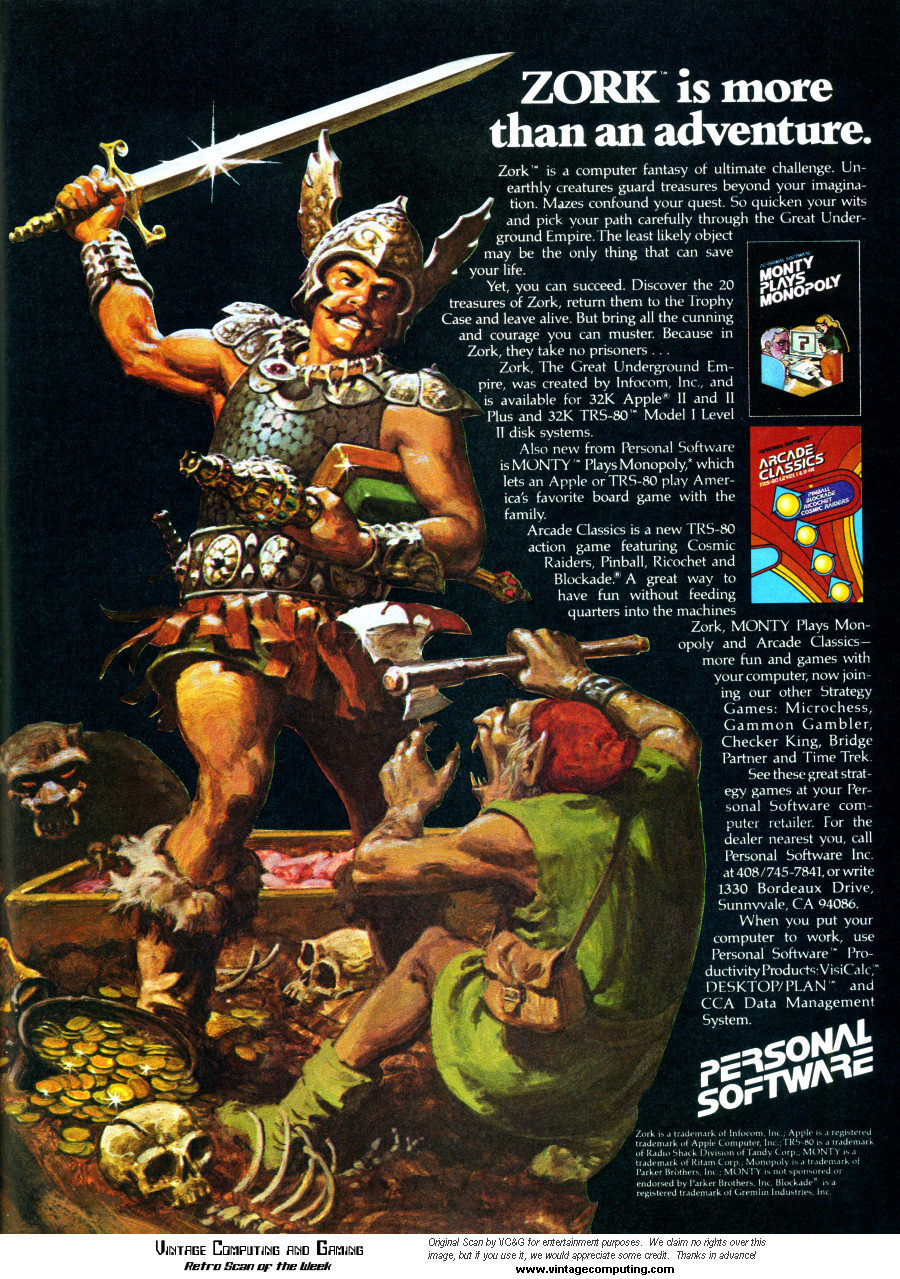 A scene from “Zork: Brick Collector”
This is it, folks: an early ad (maybe the first) for the original commercial release of Zork, the famous Infocom text adventure, published by Personal Software ca. 1980 for the TRS-80 Model I and III home computers.
(This site has some wonderful background history on this release.)
I love the artwork featured in this ad. It is excised from the full cover art for the Personal Software version, which captures a great deal of the majesty and wonder of the seminal adventure title — plus a hefty dose of out-of-place machismo.
The mere mention of Zork takes me back to the mid-1980s when my older brother delved into the Great Underground Empire with the aid of photocopied maps and worn out InvisiClues on our family’s Atari 800. Warm, fuzzy memories. Of course, by then, Infocom published the title directly.
Discussion Topic of the Week: What’s your favorite text adventure game of all time? (Modern ones count.)
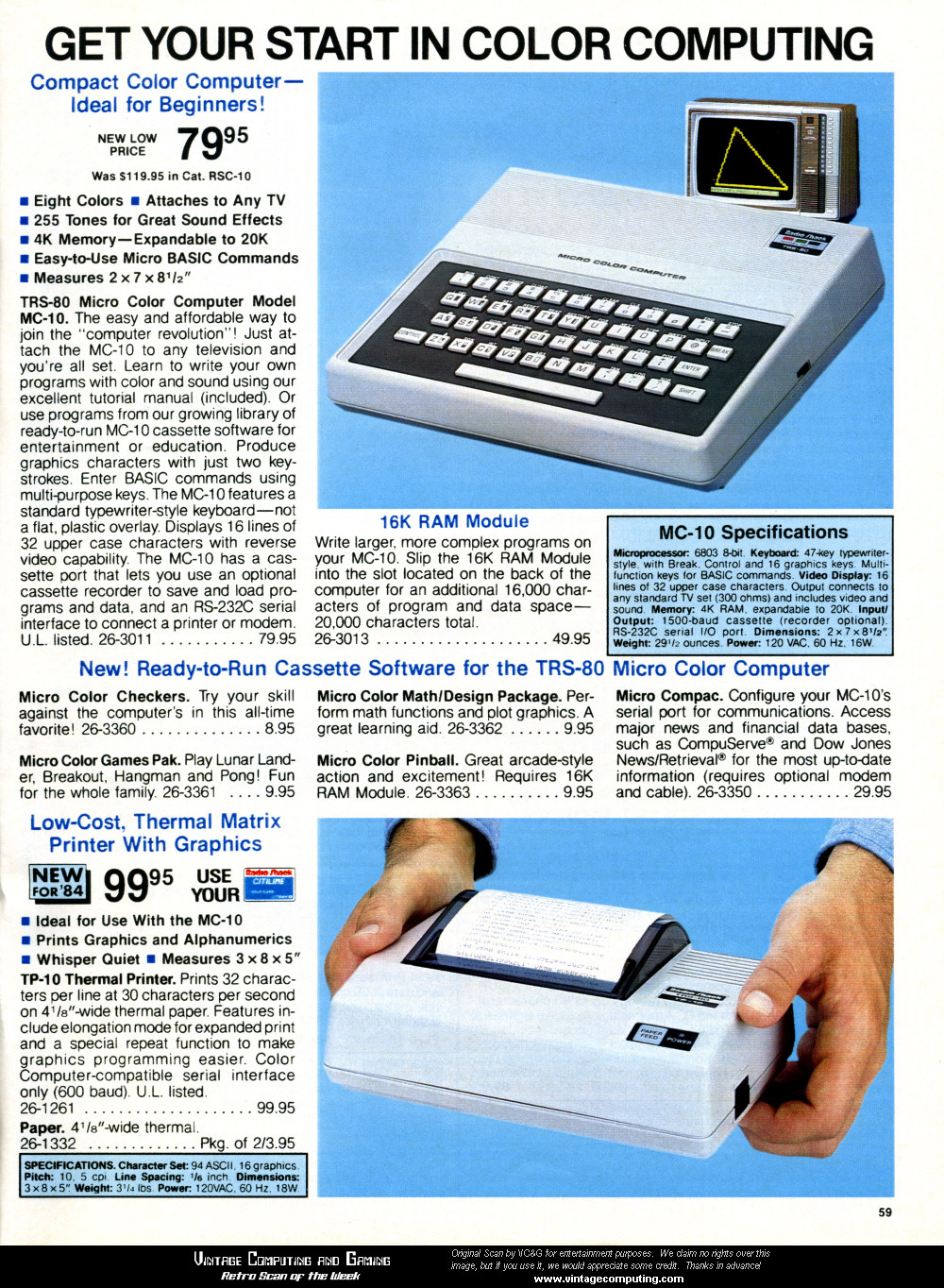 SMALL ENOUGH TO FIT IN A DINOSAUR SHOE
I’ve owned a TRS-80 MC-10 since at least 1996 (according to this photo), so it holds a nostalgic place in my collection. It’s a really neat little machine despite its limitations (chief among those problems? Tiny chiclet keyboard). But Radio Shack designed this machine as a low-cost entry-level PC for the home, so most of of those issues can easily be overlooked.
The MC-10’s price at the time of this catalog printing had slipped to just $79 (about $178 today when adjusted for inflation). For comparison, the Apple IIc (a far more sophisticated machine, but typical for a home PC at the time) retailed for $1295 upon its introduction that same year (that’s a whopping $3,688 today). Price wise, that’s similar to the difference between buying a low-end Windows 8 tablet and a Mac Pro. The technological difference was not nearly that dramatic, however.
Perhaps the coolest thing about the MC-10 is that you can now download software for it over the Internet in the form of audio files and load them into the MC-10 via its cassette port. Check out this site for an awesome array of homebrew MC-10 games.
Discussion Topic of the Week: If you were stuck on a desert island and you could only use a TRS-80 MC-10 or a Sinclair ZX81, which would you pick?
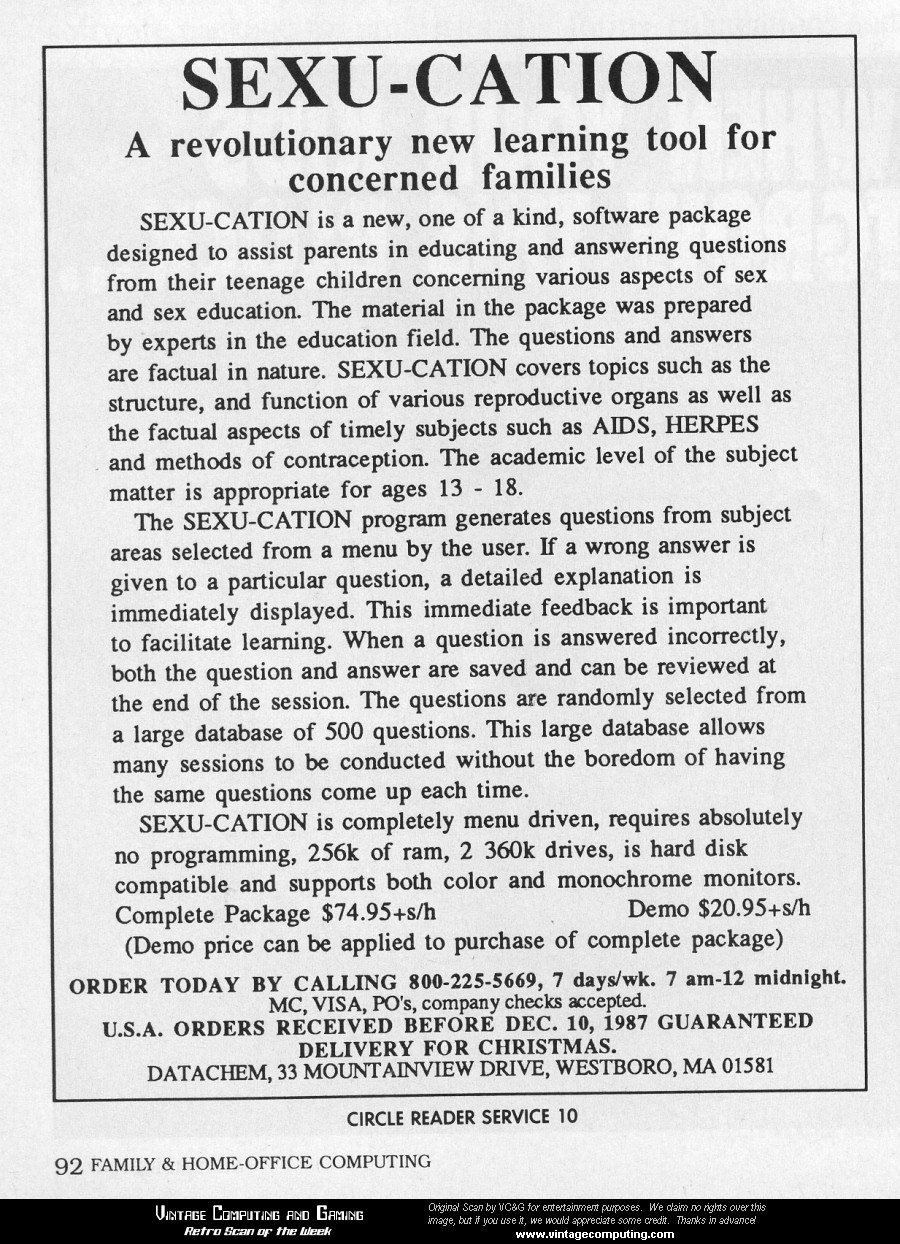 Outsource your sex educations needs to Datachem
“Mommy, where do babies come from?”
“Well, after a wild night of CTRL-ALT-DELETE, your father hit my CTRL-C then pressed CTRL-V, and nine months later, you came out from LPT1.”
Discussion Topic of the Week: Have you ever played any sex-related computer games? (Or heck, even educational software.)
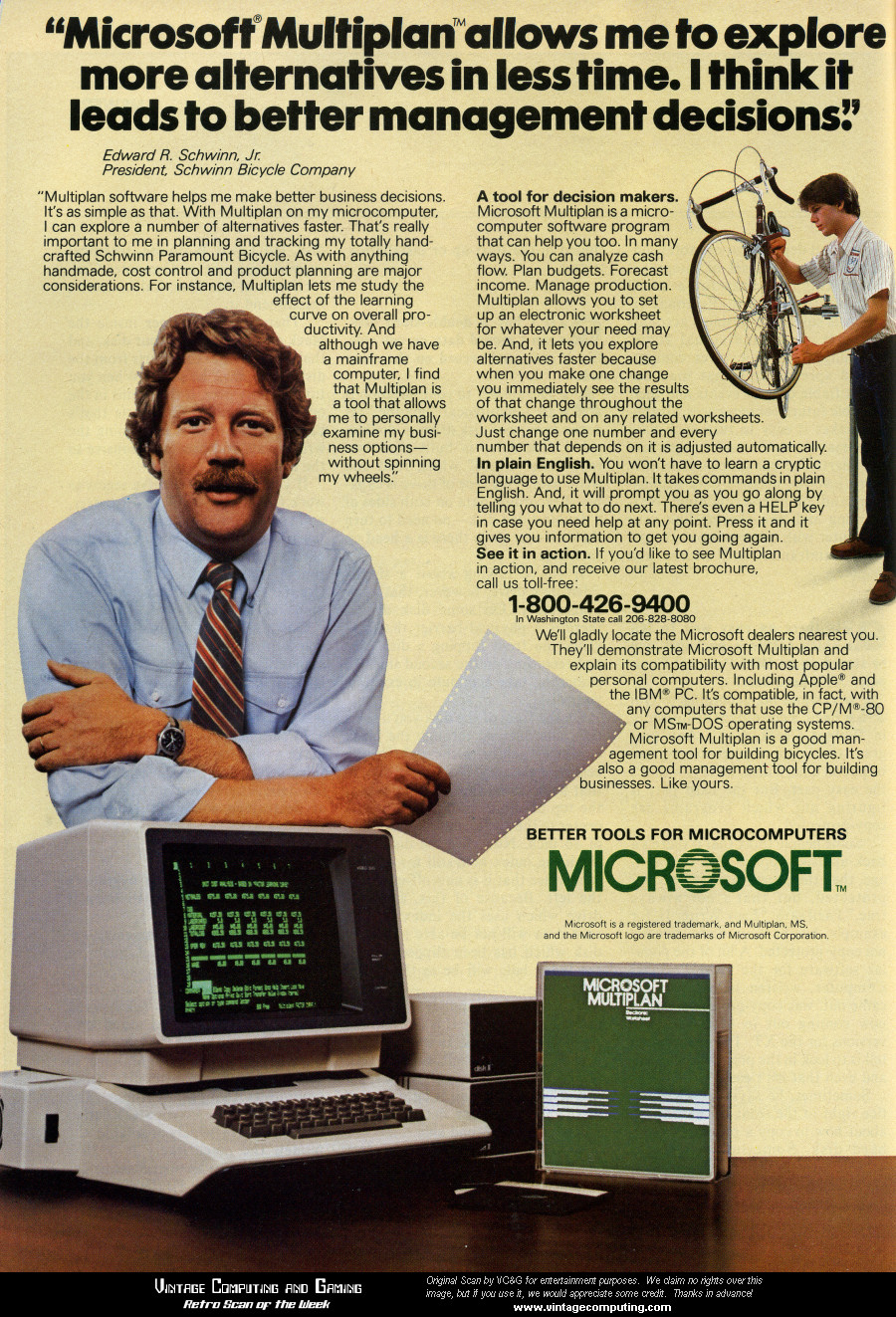 Leeloo Dallas Multiplan
Discussion Topic of the Week: What was the first electronic spreadsheet program you ever used?
 The Ultimate Helicopter Eclipse Simulator
Discussion Topic of the Week: Other than Civilization, what is the best MicroProse title of the 1980s and 1990s?
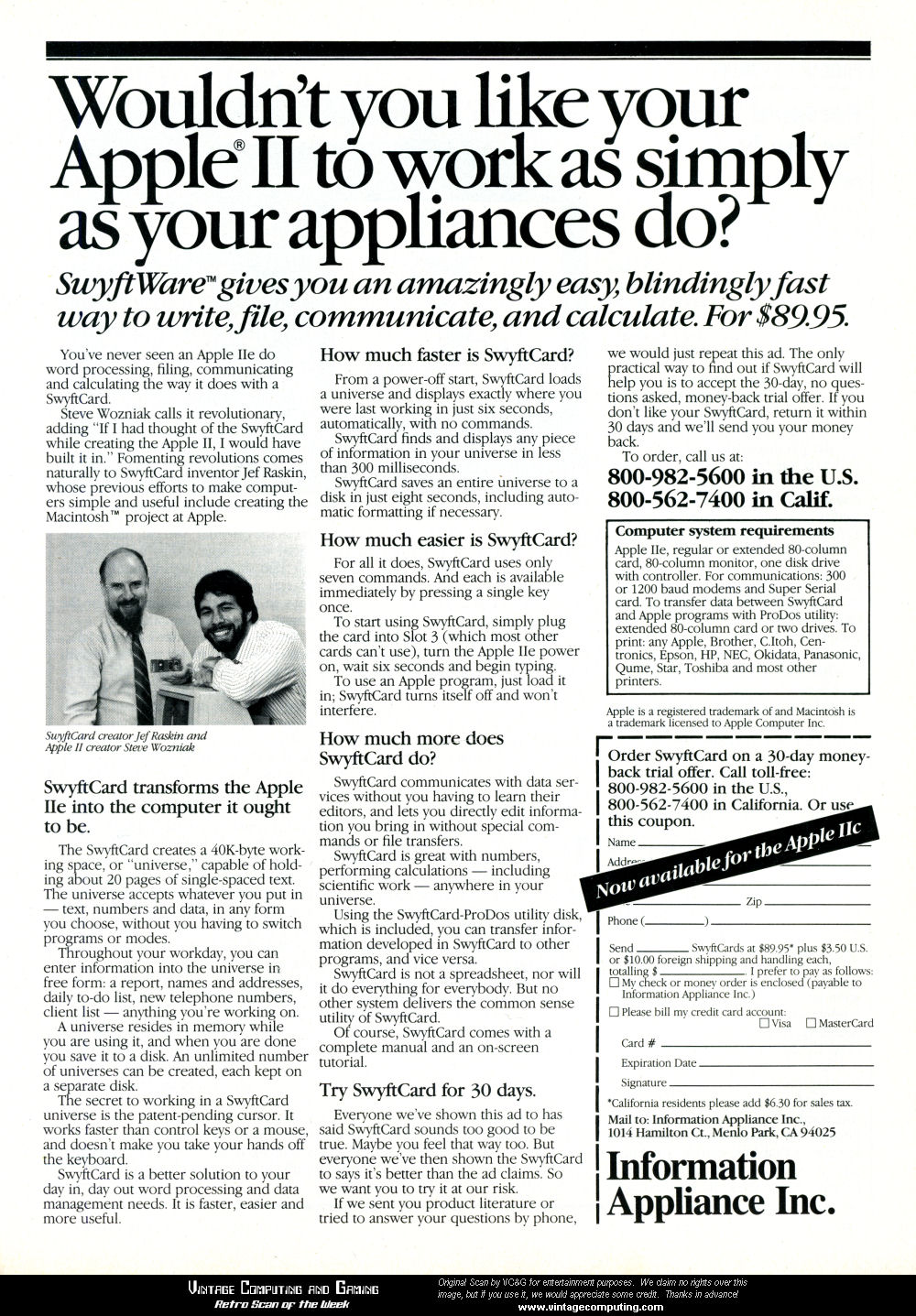 Paid for by SwyftCard Veterans for Truth
From the land of exotic Apple II accessories comes the Information Appliance SwyftCard, a plug-in peripheral card that gave the Apple IIe a built-in suite of ROM-based productivity tools, all unified around a novel scroll-based [PDF] user environment called SWYFT.
SWYFT was the brainchild of former Apple employee Jef Raskin, who originally spearheaded the Macintosh project. After disagreements with Steve Jobs over the direction of that project, Raskin left Apple and founded Information Appliance, Inc. (consequently, Jobs took the Mac project in a completely new direction).
The SwyftCard originated as an Apple IIe-based prototype for a dedicated machine centered around Raskin’s SWYFT environment, but it proved so effective and compelling that it became its own product. The dedicated concept would later emerge as the Canon Cat in 1987.
SwyftCards are very rare (I’ve never seen one in person over 20 years of collecting Apple II hardware), so Apple enthusiast Mike Willegal has provided instructions for building your own. Pretty neat!
P.S. I emailed this ad to Steve Wozniak (who is featured in the ad) and he said, “Cool reminder!”
Discussion Topic of the Week: Jef Raskin vs. Steve Jobs: Who do you identify with the most?