Archive for the 'Regular Features' Category

Great Images in 1-Bit Color: Mona Lisa

Thursday, September 2nd, 2010

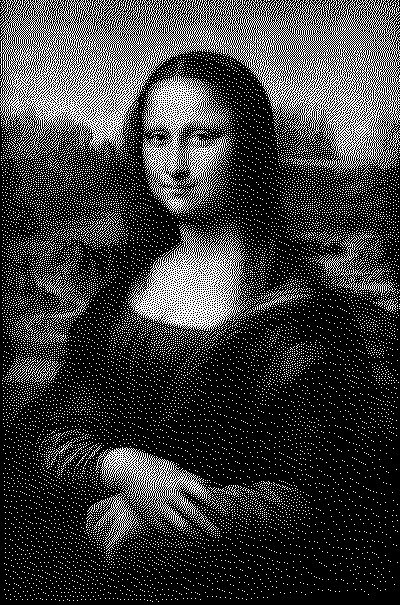
Mona Lisa in 1-bit ColorMona Lisa in 1-bit Color
Mona Lisa (c. 1503-1506) by Leonardo Da Vinci

An image like this should be familiar to early Macintosh users, since the first Macs only supported 1-bit color. That is, two colors total: each pixel could be black or white — on or off — and nothing in between. The image above uses only black and white and a dithering effect to trick your brain into perceiving shades of grey. Somehow, it makes me feel warm and fuzzy inside.

Update: Hover over the image to see 1-bit Mona Lisa rendered with Floyd-Steinberg error diffusion, which is another algorithm for converting color images to black and white.

[ Retro Scan of the Week ] Times of Lore

Monday, August 30th, 2010

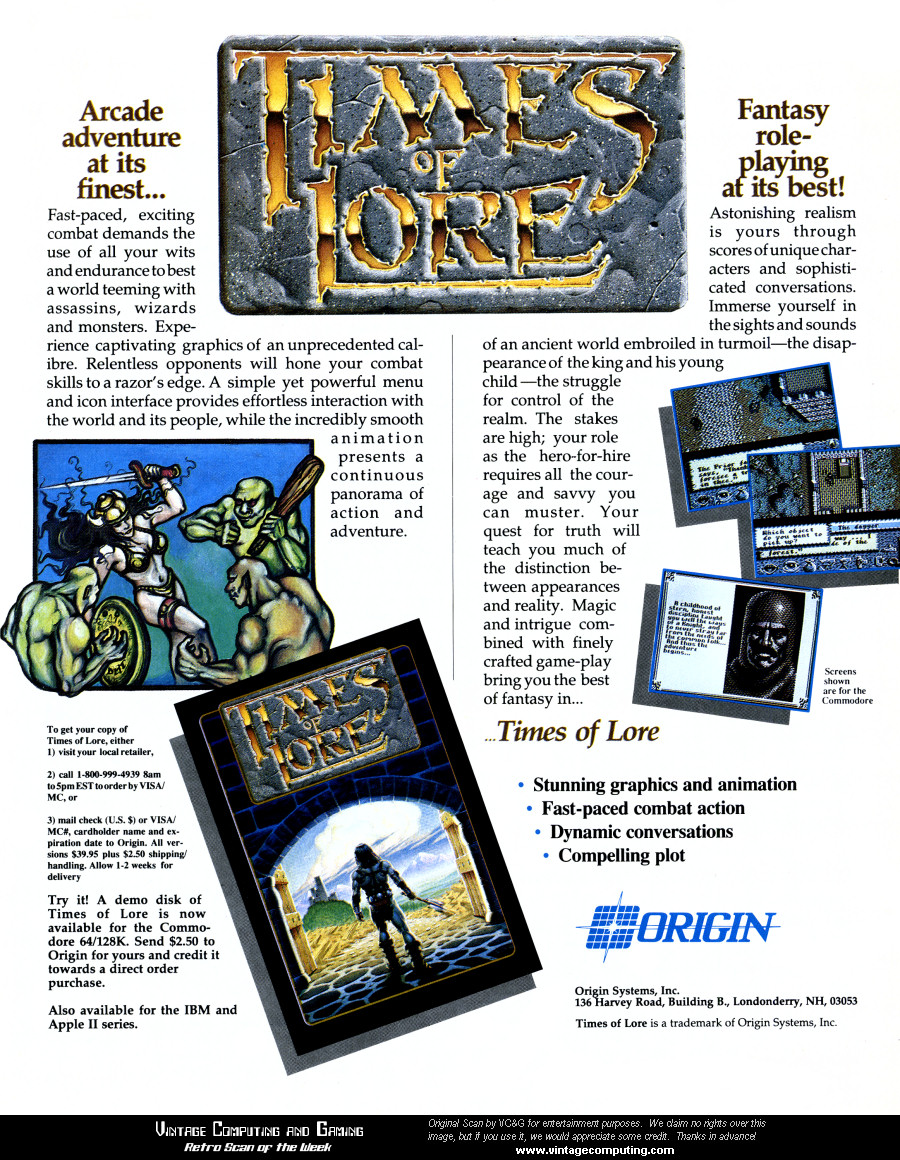
Origin Times of Lore RPG for Commodore 64 Ad - 1988Origin’s Times of Lore for the Commodore 64

[ From Compute’s Gazette for Commodore Users, December 1988, p.5 ]

Discussion Topic of the Week: What’s your favorite computer RPG of all time? Any year, any computer platform.

[ Retro Scan of the Week ] Grolier’s Encyclopedia on CompuServe

Monday, August 23rd, 2010

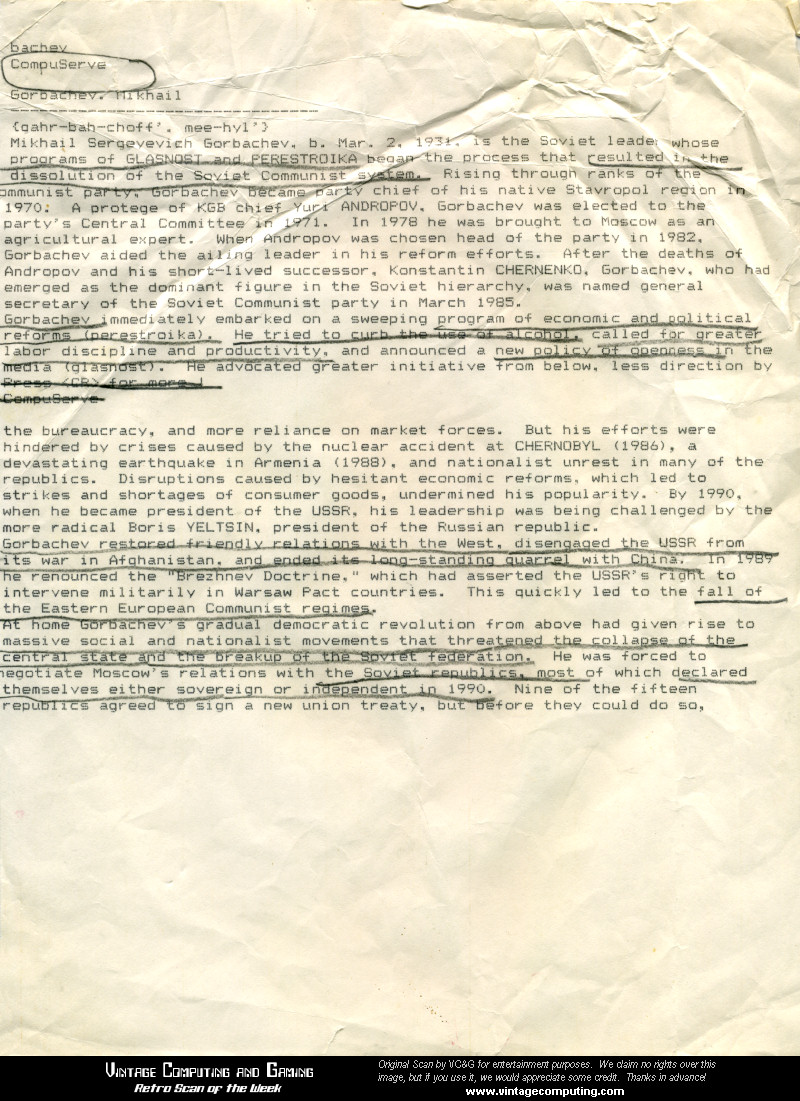
Gorbachev CompuServe - 1993“Press <CR> for more”

For my sixth grade social studies class, I wrote a report on Mikhail Gorbachev, former President of the Soviet Union. And he really was “former” then — the USSR had fallen apart just two years prior to my report in 1991. For that report — which I ran across recently — I used every resource available to me, including a novel one at the time: Grolier’s Encyclopedia on CompuServe Information Service. My family subscribed to CompuServe — that massive, pre-ubiquitous-Internet dial-up service that cost amazingly large fees an hour — and I loved it.

What you see above is part of the Gorbachev encyclopedia entry in the form of a dot-matrix printout from the DOS version of CompuServe Information Manager (a front-end client for CompuServe) that I printed myself. Various lines are crossed out and underlined, noting areas of interest that I was to paraphrase for the report. This wasn’t plagiarism — I even cited the online encyclopedia in my report’s bibliography. That fact is actually kinda impressive to me in retrospect.

CompuServe’s online encyclopedia was amazing at the time (1992-1993 era). It was so easy to just search for a term, look it up, and print it out. It sure beat our family’s musty 1968 World Book Encyclopedia set that I used for every report prior to this one (yes, the information in my reports was often woefully out of date). For Christmas 1993, my dad bought us Microsoft Encarta on CD-ROM, and that served as the meat of my school reports for the next few years after that. But that’s another story entirely.

[ From Grolier’s Academic American Encyclopedia (CompuServe printout), 1993 ]

Discussion Topic of the Week: When did you first use an electronic encyclopedia — CD-ROM or otherwise? What did you use it for?

ULAF CAPTURE THE SPEED WITH SPEEDBOARDS

Thursday, August 19th, 2010

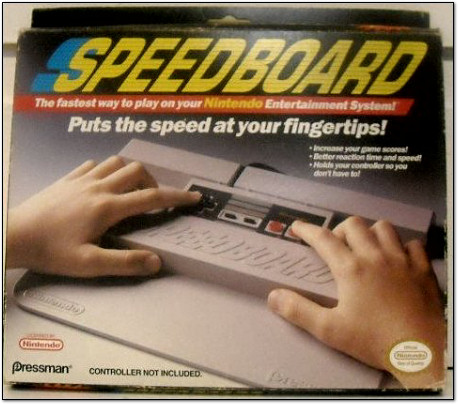
NES SPEEDBOARD IS THE SPEED

SOME PEOPLES ASK ULAF THIS: HOW IS IT THAT MY MIND CAN CAPTURE THE SPEED? TO WHICH ULAF RESPAWN A SIMPLE WORDS: WITH THE SPEEDBOARDS OF COURSE. IT IS TRUE THAT THE SPEED OR THE BOARDS HAVE BEEN HARDEST TO TAME OF ALL ELEMENTS, SO THE MAGIC OF THESE DEVICE CANNOT BE UNDERSTOOD.

SO THEN ALWAYS RECALL THIS DAY THAT HERE YOUR MIND SEES THIS SPEEDBOARDS PHOTOGRAPHY, ONE PICTURES OF THAT ULTIMATE MASTER DEVICES FOR THE NINTENDO ENTRAPMENT SYSTEM (NES FOR ABBREVIATED). ULAF USE IT AND USE IT, THEN OBTAIN HIGHEST SCORE EVER DURING MEGA MEN II WITH FINGERTIPS. NO SMALL FEET.

JUST A QUICK NOTE FROM MY MIND. GO BACK TO LIFE NOW. UNTIL NEXT TIME THIS IS ULAF SAYING BE THE MASTER.

Ulaf Silchov is an expert in video games and computers. He also writes for “Svadlost Weekly” and “The Almost Perfect Circle Newsletter.”

[ Retro Scan of the Week ] Quake II Meat Market

Monday, August 16th, 2010

Quake II Meat Market Ad Playstation N64 - 1999“Hand-cranked and chock full of juicy new tidbits.
All stuffed into authentic id Software casing.”

Quake II will be 13 years old this December — has it been that long already? Seen here is a 1999 advertisement from EGM promoting the PlayStation and Nintendo 64 ports of the classic PC shooter. The designers of the ad chose a clever theme that parodies a grocery store circular (commonly inserted into newspapers here in the US), complete with a fake coupon and flashy pricing. Very clever, and very effective.

[ From Electronic Gaming Monthly, September 1999, p.73 ]

Discussion Topic of the Week: Let’s talk Quake. Best game console version of Quake? How about Quake II?

[ Retro Scan of the Week ] All Hail Bob, Destroyer of Worlds

Monday, August 9th, 2010

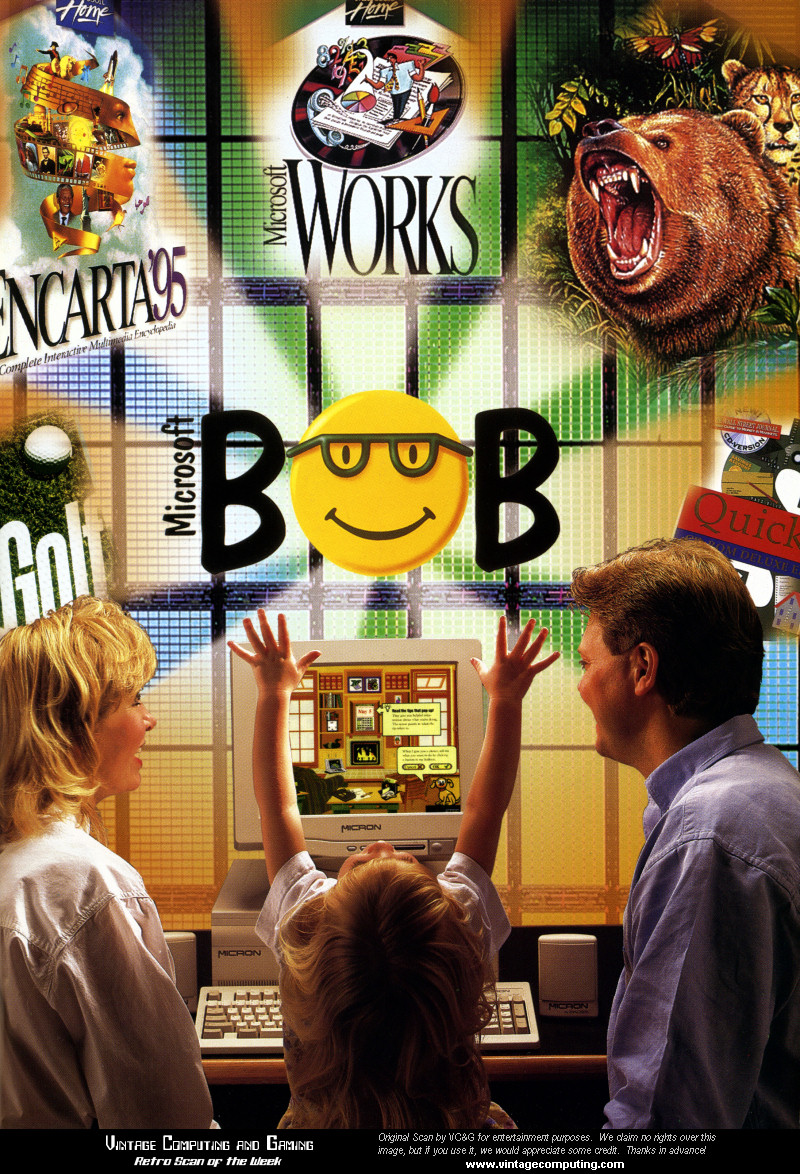
Micron P75 Home MPC Computer Microsoft Bob Worship Ad - 1995The pagan god manifests in many forms, demanding a tribute of small children.

This image is part of a two-page double-sided fold out ad attached to the back cover of Home PC magazine. Its main subject was not actually Microsoft Bob, but a Micron P75 PC (click there to see that page).

Microsoft designed Bob (1995) to serve as a friendly graphical interface and operating environment for beginners, but the product flopped mightily and has since become a tech punchline.

Speaking of Bob, my buddy Harry McCracken has written more about Microsoft Bob than any other living human being on the planet. A good place to start would be his Bob Chronicles, which talks about the origins and history of Bob.

[ From Home PC, September 1995, back cover flap ]

Discussion Topic of the Week: Have you ever used Microsoft Bob? What did you think about it?

[ Fuzzy Memory ] Grinning Triangle Man Toy

Wednesday, August 4th, 2010

Fuzzy MemoryEvery once and a while, I receive emails from people looking for a certain game, electronic toy, or computer from their distant past. I then pass it on to intrepid VC&G readers to crack the case.

The Clues

Pseudo3D writes:

Hello. While reading about the Sega Pico on another website, I suddenly had a flashback to a toy I used to have a long time ago. I’m going to describe it in the best detail I can…

It was a yellow toy made by Texas Instruments (96% sure), all yellow (logo was in blue). It was larger than a modern TI graphing calculator or an original Game Boy, and also had a handle. Anyway, it consisted of an LCD screen (like a calculator would have), the mascot (I guess) was a grinning triangle man. To run the “games”, you inserted a card into the front, which was a flimsy-looking touch-sensitive surface. The cards were made of paper and had a colored border on one side. The games were relatively simple. One was a simple calculator card, one had this Simon-like memory game…I’d say there were about 20 or so cards (I think they were two-sided). Unfortunately, when I google Texas Instruments toys, all I get is Speak & Spell (and its variants) and two more things that were definitely not it. Can you help?

The Search Begins

It’s up to you to find the object of Pseudo3D’s fuzzy memory. Post any thoughts or suggestions in the comments section below. Pseudo3D will be monitoring the comments, so if you need to clarify something with him, ask away. Good luck!

Have a memory of a computer, video game, computer software, or electronic toy you need help identifying? Send me an email describing your memories in detail. Hopefully, the collective genius of the VC&G readership can help solve your mystery.

[ Retro Scan of the Week ] ASG Video Jukebox

Monday, August 2nd, 2010

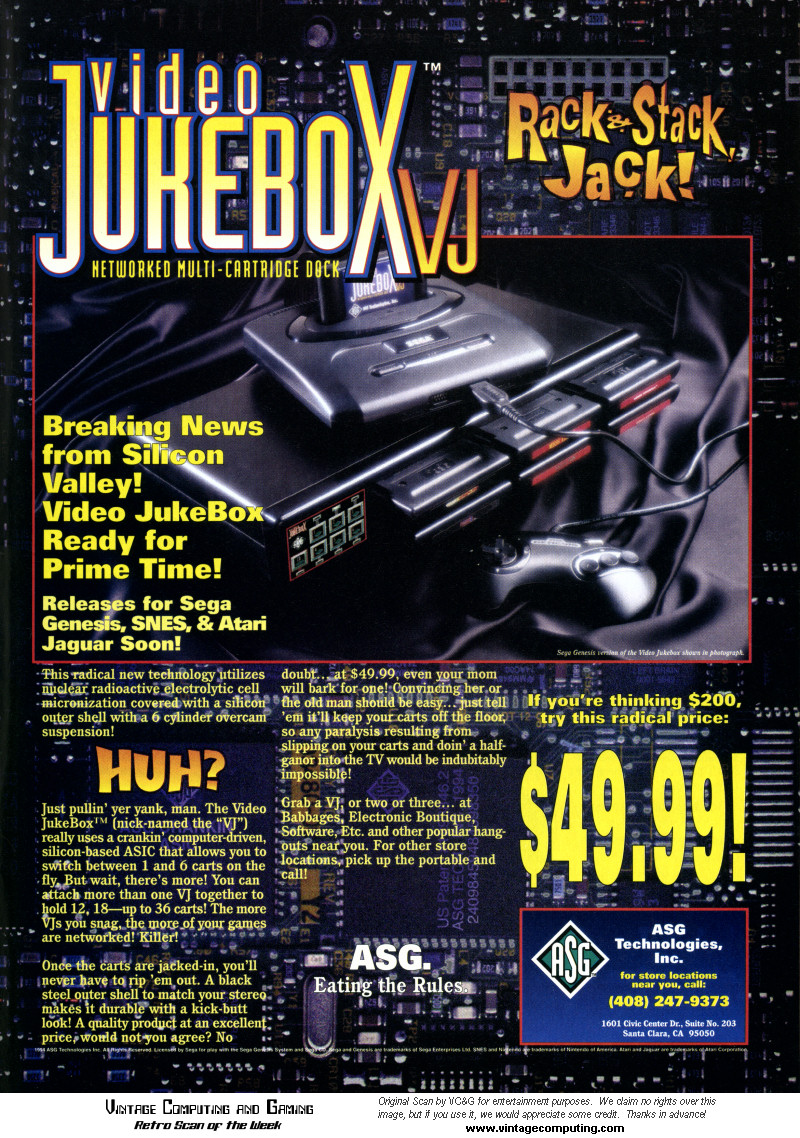
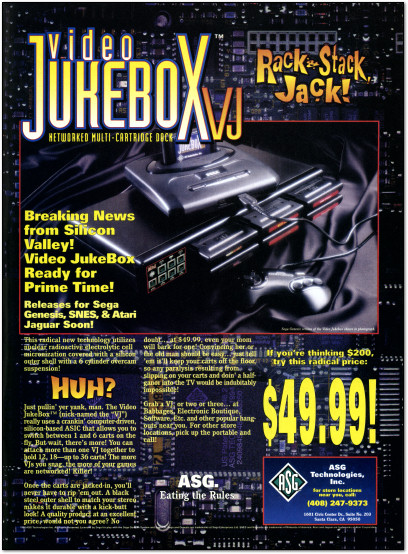
ASG Video Jukebox VJ Dock for Sega Genesis Ad - 1994“ASG: Eating the Rules” (It really says that.)

Rack and stack, Jack! This totally radical ASG Video Jukebox allowed you to play six of the Sega Genesis games you already owned for only $49.99. Imagine finally being able to play those games you bought without having to insert and remove them from the system every time. Imagine.

The problem with this device was one of scale. If you had only six carts to choose from, it’s wasn’t worth buying a jukebox device to let you switch between them quickly: keeping track of six cartridges was easy. The ad says you could chain up to six of these jukeboxes together for a total on-line selection of 36 carts. By that point you were looking at a $300 investment in gadgets that weren’t actually that useful.

On the other hand, if you had a device that let you switch between 100, 200, or 500 carts at once, that would have been legitimately handy. But the device would have cost $1000 and nobody owned that many carts back then anyway. Today, we have the same functionality in the form of emulator software, so lazy Genesis fans have long since been appeased.

If anybody actually bought one of these, I’d be interested to know about it.

[ From GamePro, September 1994, p.123 ]

Discussion Topic of the Week: How many Sega Genesis cartridges do you own? How many did you own in 1994?

[ Retro Scan of the Week ] The Whole Dam Thing

Monday, July 26th, 2010

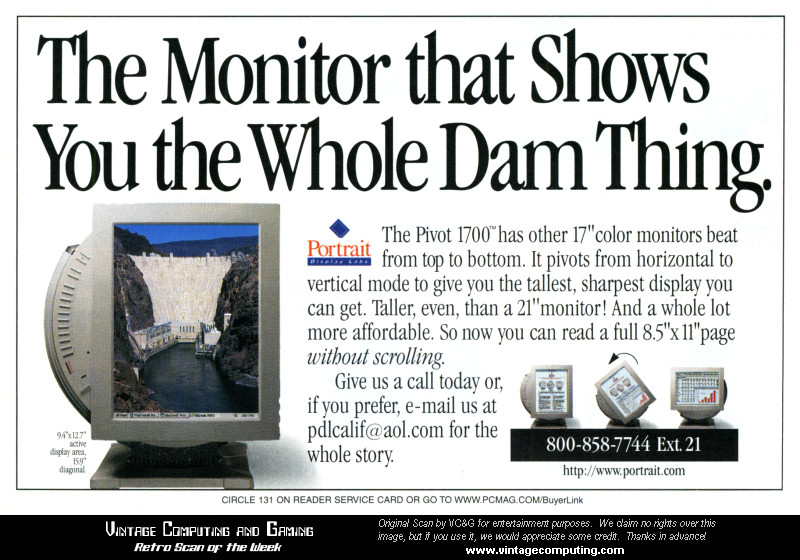
Portrait Display Labs Pivot 1700 Monitor Ad - 1997The Portrait Display Labs Pivot 1700

When I was a kid, I found myself wondering why all monitors didn’t rotate from a horizontal to a vertical orientation. I thought I had invented the idea myself. Turns out, at least one company actually did make a monitor like that — the Pivot 1700 — and you’re looking at it now.

Full-page displays were something of a marketing fad during the rise of the desktop publishing revolution from the mid-1980s to early 1990s. They were designed with a vertical orientation so that someone could read or edit a full 8.5″ x 11″ letter-sized page on screen at one time.

I have no doubt those displays came in handy for certain document designers and secretaries, but their high price and specialized function limited them to a small market. To this day I have never seen one being used in the wild, although I have encountered a few full page displays out of service in my collecting adventures.

In more recent years, I’ve seen some LCD monitors that can rotate on their base to change orientations rather easily. There’s no doubt that it’s a much easier trick to pull off considering the small size and weight of LCD panels verses their bulky CRT counterparts. Now whether anybody needs it or not with today’s super high resolultion 30″ displays, I don’t know.

[ From PC Magazine, March 4, 1997, p.242 ]

Discussion Topic of the Week: What’s the largest CRT computer monitor you’ve ever used? How big is your monitor (any kind) now?

[ Retro Scan of the Week ] Road Rash 64

Monday, July 19th, 2010

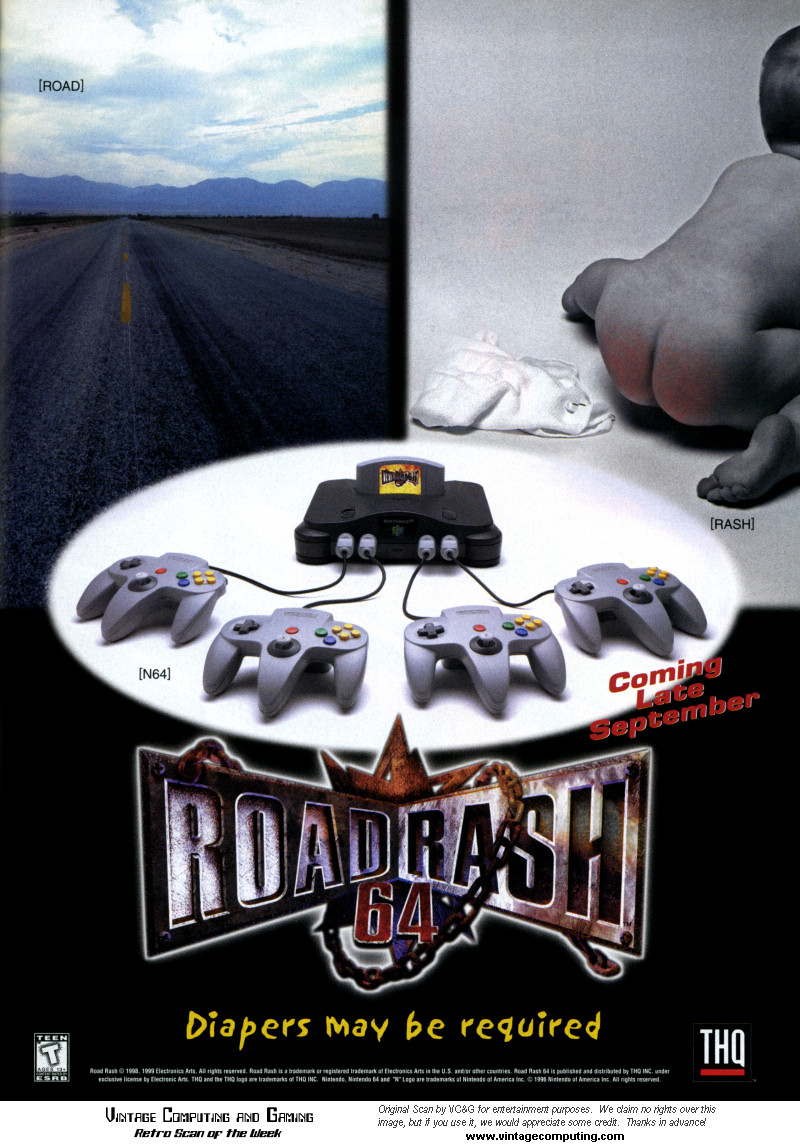
Road Rash 64 N64 Nintendo 64 Ad - 1999Road + Baby = Road Baby

[ From Electronic Gaming Monthly, September 1999, p.41 ]

Discussion Topic of the Week: What’s the best four player game for the Nintendo 64? Feel free to list a few if you like.