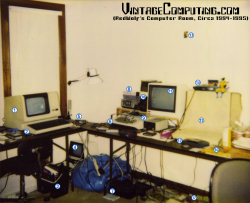
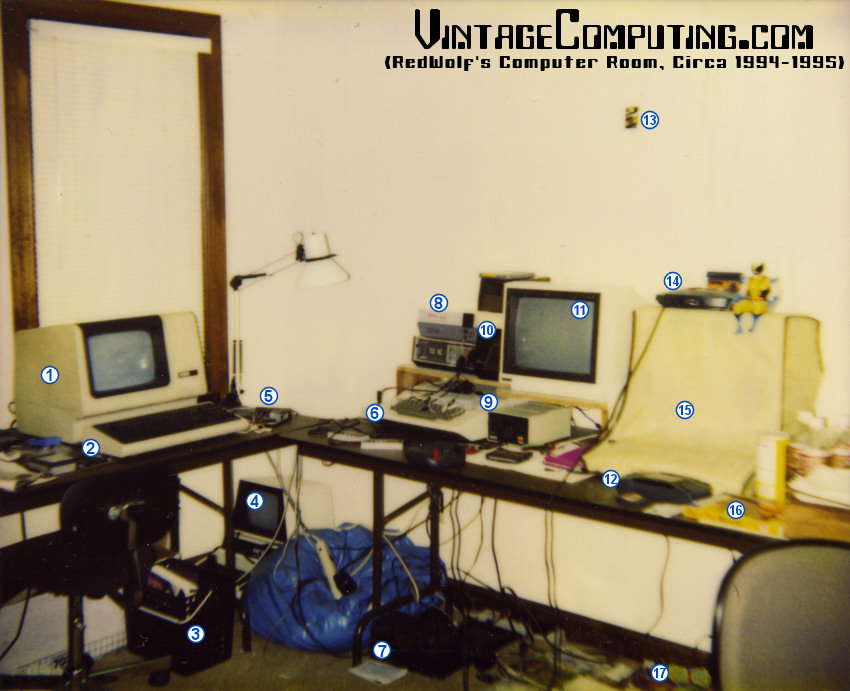
 Late last year I found this classic (for me, anyway) picture lurking in my files and scanned it. It’s a Polaroid photograph of one corner of my then “computer room” taken by myself somewhere around late 1994 or early 1995 (yes, my family was lucky enough to have the space for another room dedicated mainly to my BBS computer, but filled with my other junk as well). I was 13 or 14 at the time. As you can see on the picture, I’ve labeled certain items in the room with numbers. Each number is associated with an item that I talk about below. With that out of the way, click on the image to open up the bigger version and let’s start the tour!
1. DEC VT-125 Terminal – A true classic in the terminal world, pulled from a dumpster. The neighbor of my father’s company serviced minicomputers and was always throwing neat stuff out. I got about 3-4 of these, took a few apart, eventually throwing them away for space concerns. But I think I still have one or two left.
2. Micromint Z8 Board – Part of the Micromint Z8 Basic Computer/Controller set. Inherited from my father’s old workplace. The Micromint Z8 system was a BASIC language-programmable microcontroller, essentially for early “embedded computer” applications. I have a bunch of cool expansion boards too, including one that lets you save/load your program to cassette tape, and another that lets you burn EPROMs of your BASIC programs! Cool stuff — I should play with it again.
3. NES Games – Back in 1994, my NES game collection could actually fit in one cubic foot of space. Crazy. A NES Game Genie code book can be seen here, awkwardly sticking out of the top of the plastic basket. Eventually my collection would spill out of the pictured basket and beyond…
4. Commodore CBM 2001-32 – This was had at a hamfest for $10, including the separate companion disk unit. It’s tucked away in the far back corner of the room, so I guess I didn’t use it very much.
5. Zoom 2400 BPS Modem – My first modem, given to my family by a friend. The top cover is off because I was playing around with hooking the speaker audio output to headphones — both for kicks, and for late-night modem sessions without waking the parents (I did this before I figured out the Hayes AT command to turn off the internal speaker) . This very modem is responsible for introducing me to the world of BBSes sometime in 1991. Of course, this being 1994-95, my main workhorse at the time is an Intel external 14400 modem across the room (not pictured).
6. Apple II+ – My dad bought this for me around 1990-91 (from a hamfest, big surprise) so I could learn BASIC on it. And I did, having loads of fun with it over the years. At the time of this picture I had the luxury of a color composite video monitor (#11). Up until then, I was stuck with a monochrome green-screen. But somehow it almost didn’t feel like an Apple II any more once it was in color.
7. Odyssey2 Games – Yes, this black blob is actually fifteen Odyssey2 games in interlockable cartridge racks, purchased for $10 along with an Odyssey2 console at a hamfest in the early 90s.
8. Nintendo Entertainment System – Back then, I took everything I owned apart, and the former “family NES” was not spared this treatment. Thinking myself clever, I switched the one and two player ports around, along with the “power” and “reset” buttons. How delightfully obnoxious. This unit, 11 years later, went on to become the NES DVD Player hack I did recently.
9. EPROM Eraser – It’s the gray rectangular box on top of the Apple II+ (#6). Never really used it very much. It was inherited along with the Micromint Z8 controller board stuff (#2) and was used to erase EPROMs programmed by the unit. It works by shining UV light through a tiny quartz window on the EPROM.
10. Apple II Disks – Stacked here are two boxes of Apple II disks. The lower one is mine, the upper one was given to me by a friend (with all his Apple II disks in it!). In fact, it was the same friend who gave my family the 2400 BPS modem (#5). It’s nice to have good friends.
11. Composite Video Monitor – What a grand day it was when I acquired my first color composite video monitor at a local hamfest! In this picture, the monitor is performing triple duty between the Apple II+ (#6), NES (#8), and Atari Jaguar (#14). I simply switched the AV connectors at the back depending on which one I wanted to use.
12. Atari Lynx – I bought this under-utilized portable wonder in used condition from a guy who regularly called my BBS (“Raven,” if you must know) in 1993 or 94. The transaction was done entirely by mail and we never met in person (imagine that!).
13. Mystery Sticker – I’m not sure what this is. It looks like a random peel-off trading card-sized sticker just stuck on the wall at an odd angle. Weird. This picture have been taken after my dad made me take down the 100-odd posters and other crap I had tacked and taped all over the walls, believing they were a fire hazard.
14. Atari Jaguar – I was a total Atari nut in the very early 90’s, believing strongly that Atari was the greatest company ever. “What’s this Nintendo business?” I said. “Atari was first!” I heard rumors of their Panther, then Jaguar, consoles and waited anxiously for their release. My birthday in 1994 was one of the happiest days of my life: I received an Atari Jaguar System and Super Metroid for the SNES. Here, Doom can be seen in the cartridge slot, a version of the seminal 3D FPS rivaled on consoles only by the PlayStation version.
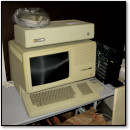
15. Apple III – The prize of my collection at the time. When I first heard about the Apple III years before, it was like some magical, mythical beast. Would I ever catch sight of one, much less possess it? Naturally, I was extremely excited when my father and I came across this one later at a hamfest (again, big surprise). $10-20 later, I had my first Apple III, complete with dust cover (pictured on the unit). I only had the Apple II emulation disk for it, though, and to this day have never run any native Apple III software. Shortly after my Apple III was obtained (turned out they were not as rare as I thought), the Apple Lisa quickly became the next mythical beast to be had — a beast I’m still chasing in the wild to this day.
16. Plug ‘N’ Play Mosaic Book – This book is how I got my first copy of Mosaic, the first graphical web browser (it came on a floppy disk in the back). Shortly after, I began to develop my first home page, and boy did it suck. It’s funny reading lists of “cool” web sites from back then because, well…there were only about ten web sites back then. Ergo, all of them were cool (and listed in this book).
17. Handheld Video Games Magazine – I just found this particular issue (Spring 1991) again recently while working on my “Game Ads A-Go-Go” column for GameSetWatch. Good issue. I apparently didn’t value it very much at the time because it’s sitting on the floor right next to the spot where our cats would leave all the dead birds they’d caught that week. Yum.
Well that’s the tour, hope you enjoyed it. Thanks for accompanying me on a nice walk down memory lane.
 I’m currently looking for writers who might like to contribute articles to this “blogazine,” Vintage Computing and Gaming. If you have a passion for old computers or video games and like to write, then you’d be a great candidate. Of course, it’s not a paying job…I don’t get paid and I run the place. It’s a labor of love — for enthusiasts, by enthusiasts. If you have any unique ideas or insights about computers or gaming (especially the vintage kind) that you’ve always wanted to share with the world, now’s your chance. If you’re interested,
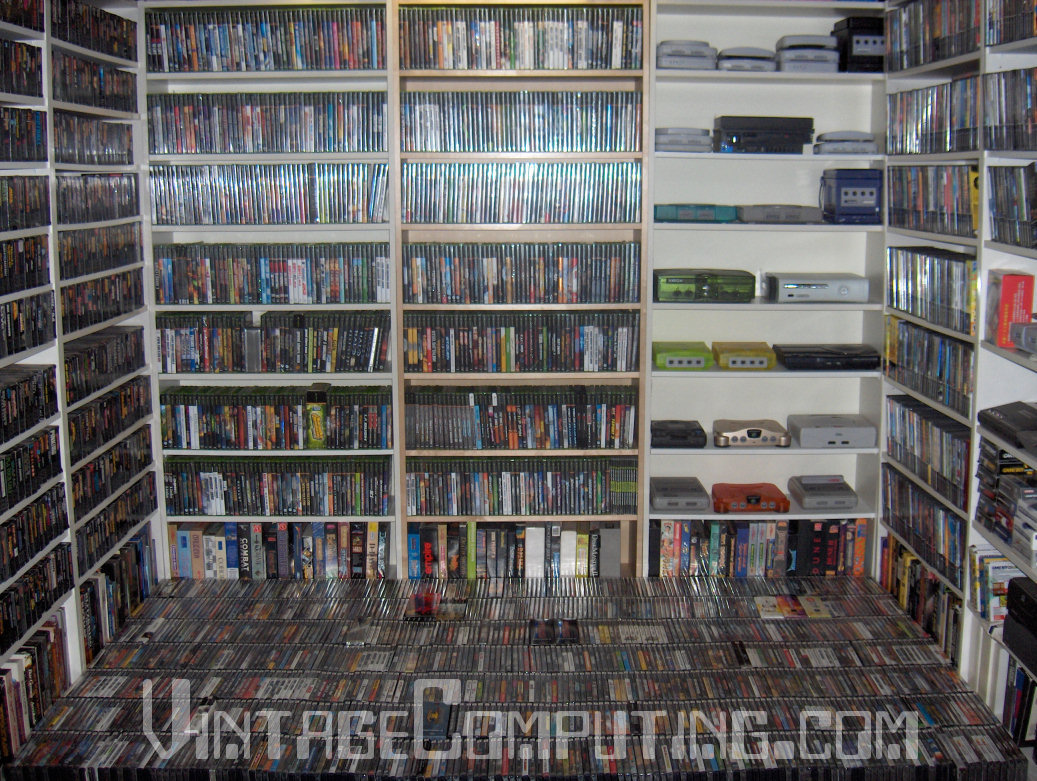
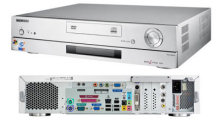 I have always wanted to build something that I like to call a “Universal Game System” (UGS). You could also call it the “ultimate game system,” since it would play all games for every game system ever released. Well, theoretically it could — with a powerful enough processor and the right emulators. That’s why I call it “universal.” But for now I’ll set my sights lower and stop at the N64 generation. The UGS itself would have a simple interface to launch every game, would have ports for every type of controller for each system (or at least a select few that could be used on most games), it would hook up to a TV, and it would require nothing more than a game controller to select the games and operate the interface. You, the user, would provide the ROMs and controllers, and the UGS would do the rest. I suppose this would be kinda like a making a “
 It is my goal to one day build one of these, but the requisite software is not quite together yet. I’m not aware of all the latest and greatest in the emulator scene, but maybe something that would help me build a UGS is in the works. I know about
 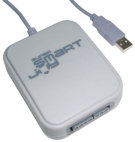 But the software is only half the battle. I also need a small, compact, quiet, and cool PC case that can hold the right cards for the I/O required, while also being able to hold a powerful enough processor to do the job (processor-generated heat is the main factor in dictating noise level and case size). Inside said box would be a versatile computer video card with an excellent composite or S-Video analog TV-out that looks good on regular old TVs. I’ve tried a few cards so far, but the video is always lackluster, and you have to reference a VGA monitor on the side to actually read what you’re doing (to select the games to play, etc.). As far as interfaces go, I plan on building a large controller interface box that has ten or more types of classic system controller ports that would all hook up to a USB connection, similar to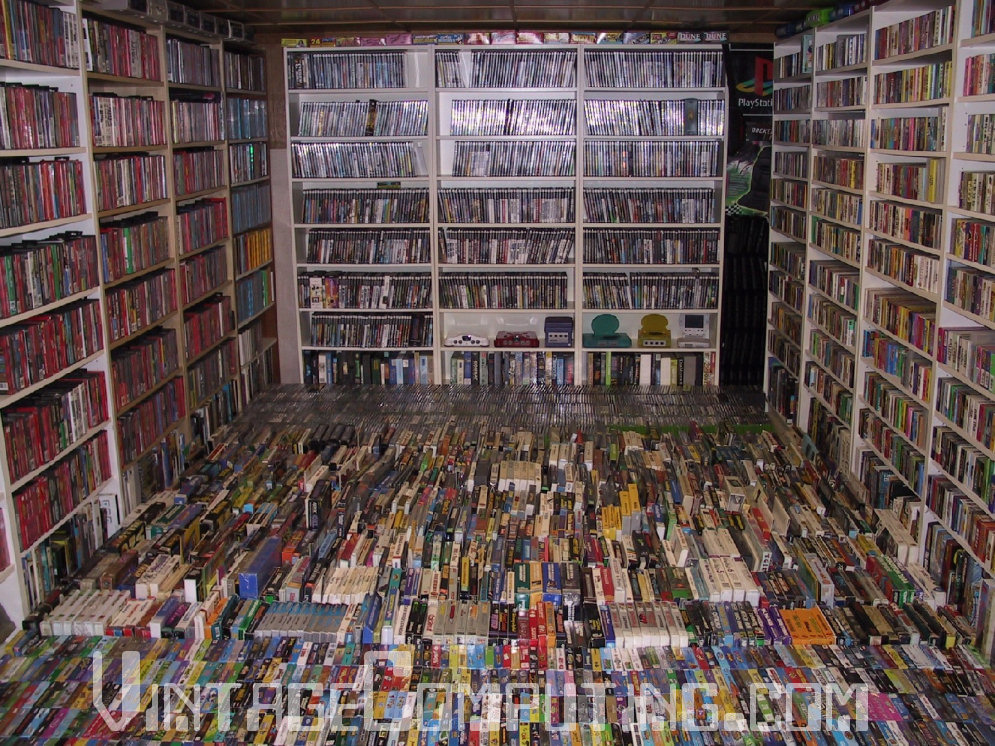


 [Editor’s Note: This article was written by Procyon as his first contribution to VC&G, with additional writing by RedWolf.]
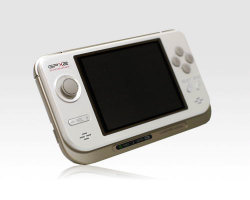
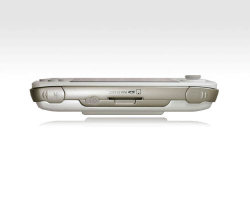 The GP2X uses Secure Digital media (aka SD cards) to store multimedia files and executable programs (games, emulators, etc). Putting an emulator on your GP2X is as simple as downloading one from the Internet, connecting your GP2X to your computer via USB, and transferring the necessary files to a SD card inside the GP2x. Alternatively, you can use any PC-compatible SD writer to write to an SD card, then place the card inside your GP2x. The GP2X has an eight-direction digital joystick, eight face buttons, and two shoulder buttons, making it ideal for nearly any emulated system configuration. It is capable of direct composite video output to a TV through the aid of the GP2X TV-out cable, and it runs (for better or worse) on two regular AA batteries. It’s backed by a 200MHz ARM CPU, coupled with a 200MHz dedicated 2D graphics accelerator, but how does it perform?
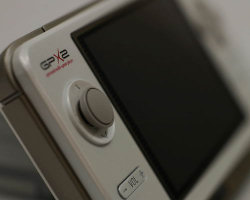 The GP2X is not perfect or without flaws. Many users have complained about the choice of a convex, mushroom-shaped cap that adorns the joystick. A particularly popular user on many of the GP2X forums has gone to the trouble to design, manufacture, and sell a concave replacement that has been highly rated by customers. Additionally, the battery life for the system is disappointingly short. Two ordinary alkaline batteries can be depleted in less than 2 hours. Users have generally opted to use rechargeable camera batteries that maintain a constant voltage through the lifetime of the battery, and their reusable nature certainly cuts down on replacement battery costs. When using these types of batteries, cordless play time can increase to just shy of 4 hours. An AC adapter is also available for purchase separately.