[ Retro Scan of the Week ] Disk Box Modern Art
Monday, October 20th, 2014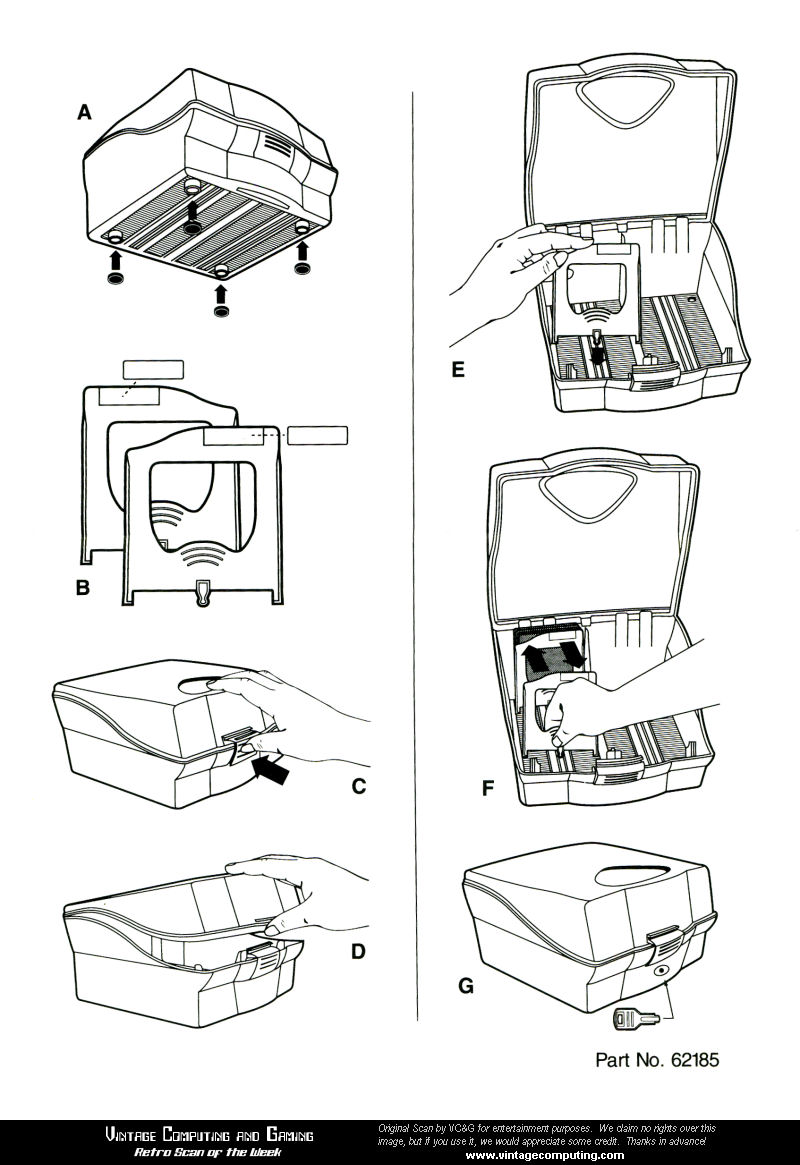 The beauty of silent instructions
Discussion Topic of the Week: If you had to guess, how many floppy disks do you own?
The beauty of silent instructions
Discussion Topic of the Week: If you had to guess, how many floppy disks do you own?
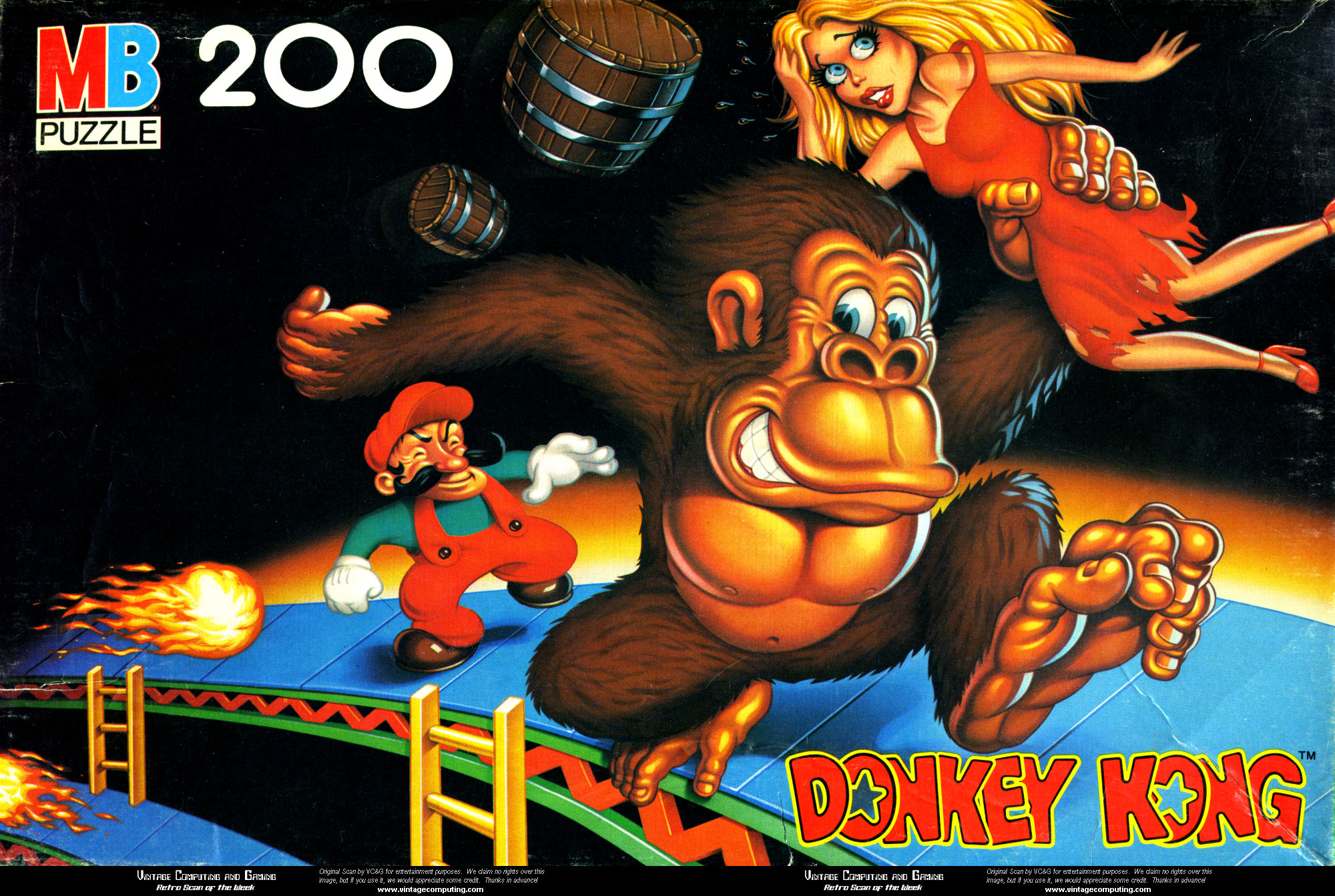 That is one dangerous and sexy construction site
When it comes to vintage 1980s puzzles, few can beat the sheer cultural nostalgia value of this 200-piece Milton-Bradley Donkey Kong puzzle, which comes straight from my childhood. This is a scan of the front of the box.
It’s not often that I find a true surprise lurking in our old family toys, but I had completely forgotten about this puzzle until I ran across it in the back corner of my mom’s attic a few months ago. Memories of poring over the lush, vibrant artwork on the box rushed back to me as I pulled it from where it had lay, dusty and neglected, for 25 years.
Look at the highlights, the curves, the gradients. The richness.
Luckily for me, all the pieces were still in the box, so I have now re-assembled the puzzle and framed it. It will never be lost again.
The artwork for this puzzle no doubt echoes the side cabinet art of the Donkey Kong arcade machine, but with added detail and an airbrushed vividness. I think it would make an awesome poster — does anyone know who the artist was?
By the way — even though I find it insanely difficult at times, the original Donkey Kong is one of my favorite arcade games. It was also one of the first video games I ever played, courtesy of a port to the Atari 800.
P.S. Pauline is way hotter than Princess Peach.
Discussion Topic of the Week: In your opinion, which is better: Donkey Kong Jr. or Donkey Kong 3?
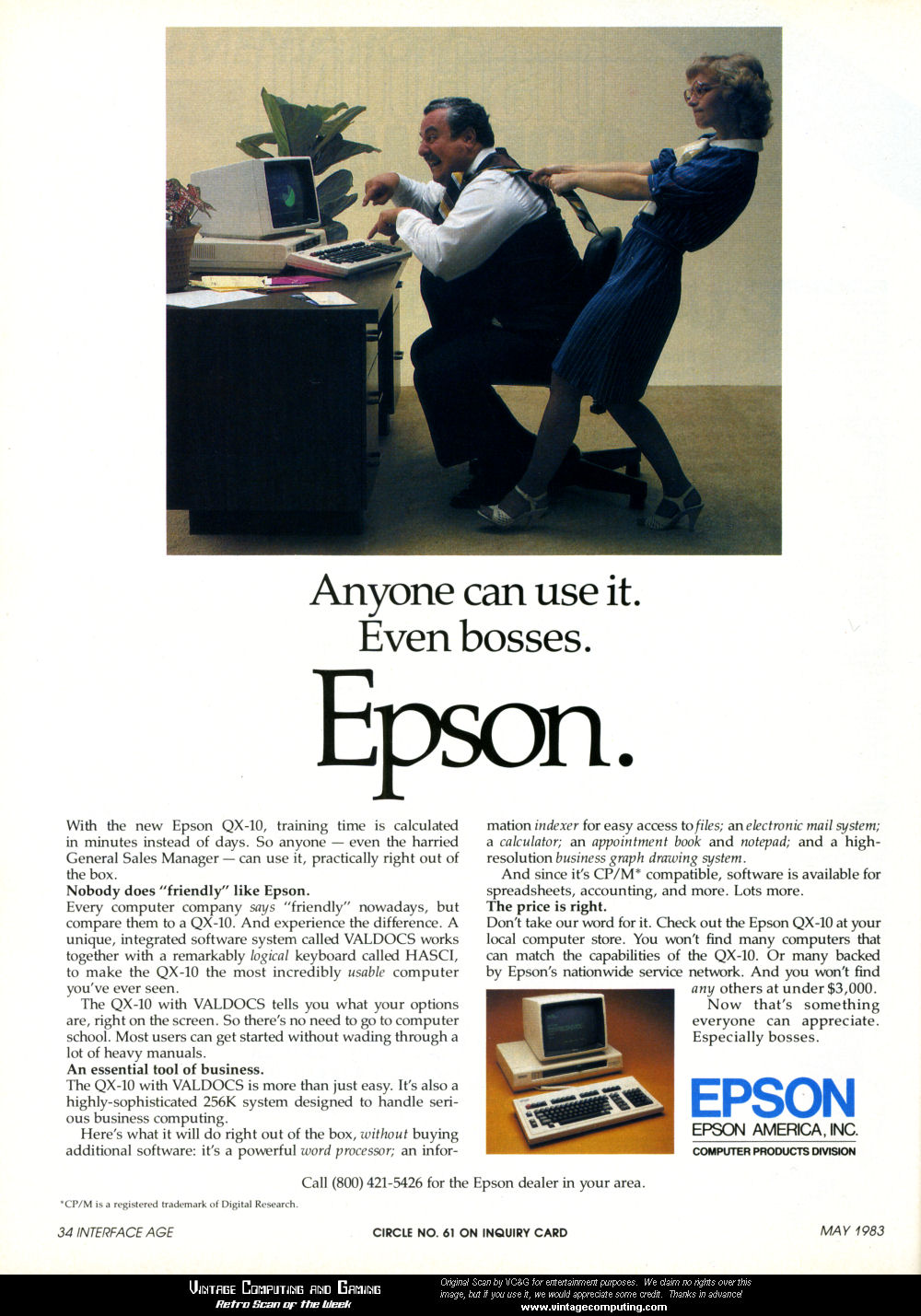 There’s a madman at the computer!
A fellow donated an Epson QX-10 to my collection some years ago, but I have never run it because I lack the proper monitor cable. This fascinating machine ran the CP/M operating system and came with a full suite of office-centric software tools, called VALDOCS, wrapped in a semi-graphical user interface layer that ran on top of its host OS.
As far as I’ve noticed from my QX-10, one of the coolest things about it is that it has specially engineered low-profile 5.25″ floppy drives. That was a unique thing to have in 1983, and it made the QX-10’s case very dense and compact.
Discussion Topic of the Week: What do you think the world world be like if CP/M, rather than MS DOS (PC DOS), shipped on the IBM PC in 1981?
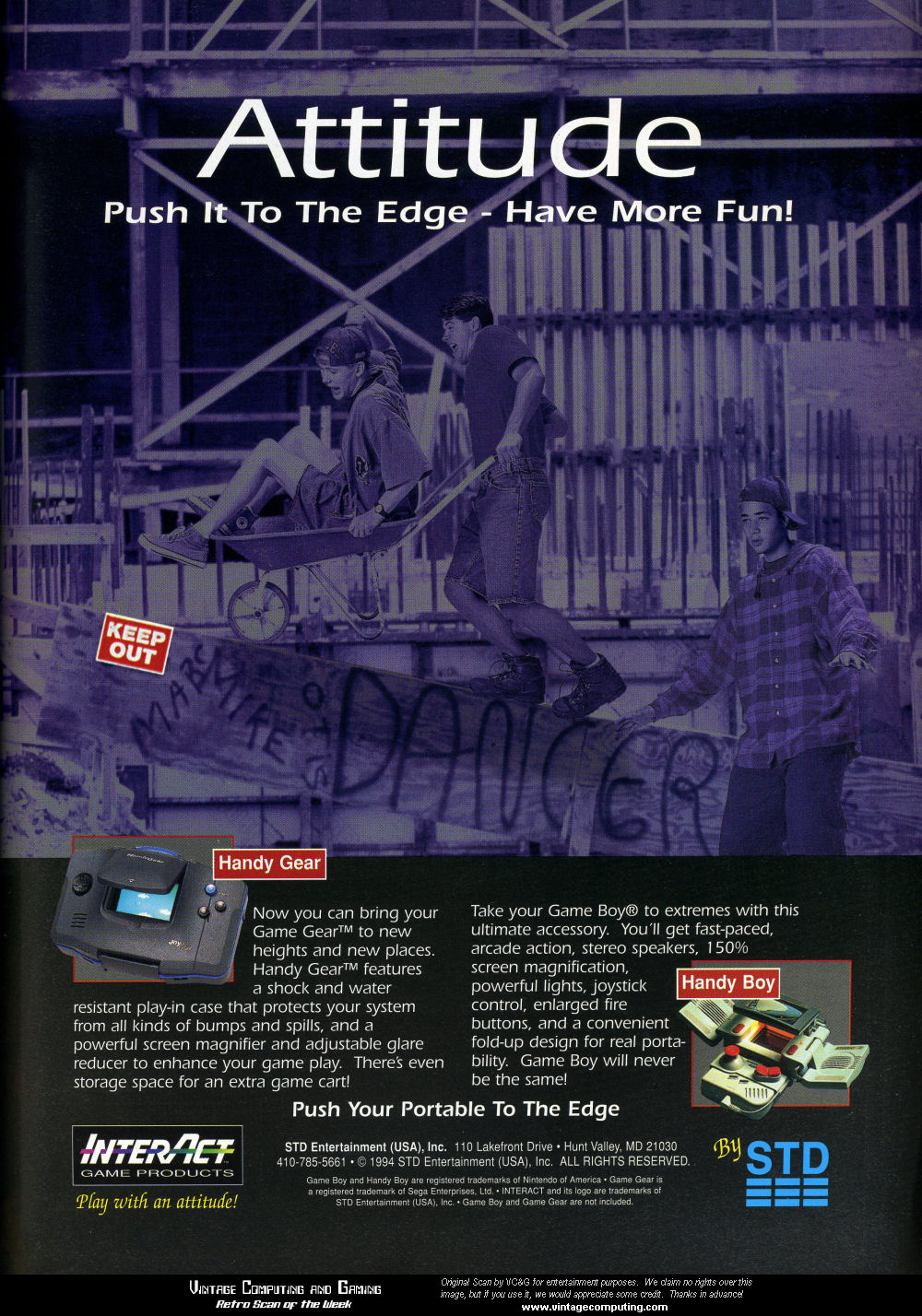 Push your friends to the edge — literally.
There is a certain irony to this pair of products by STD: one of them, the Handy Gear, makes your portable game console more rugged and less likely to break. The other, the Handy Boy, makes your console less rugged and more likely to break.
And both of them make you want to kill your friends, as this ad shows.
But seriously. One of my friends as a kid (who is amazingly still living) owned the Handy Boy accessory that snapped onto and around your Game Boy. The controller extension part looked cool but was useless and made playing games more difficult. But the magnifying glass and light were genuinely useful (especially the light part), since the Game Boy was notoriously difficult to play in low light conditions — which meant just about anywhere indoors.
By the way, long, long, long time readers of VC&G might remember that I lampooned this ad eight years ago in a column for GameSetWatch. But I just realized that I never featured it as a proper Retro Scan, so here it is.
Discussion Topic of the Week: Did you (or do you) own any notable Game Boy or Game Gear accessories? Tell us about them.
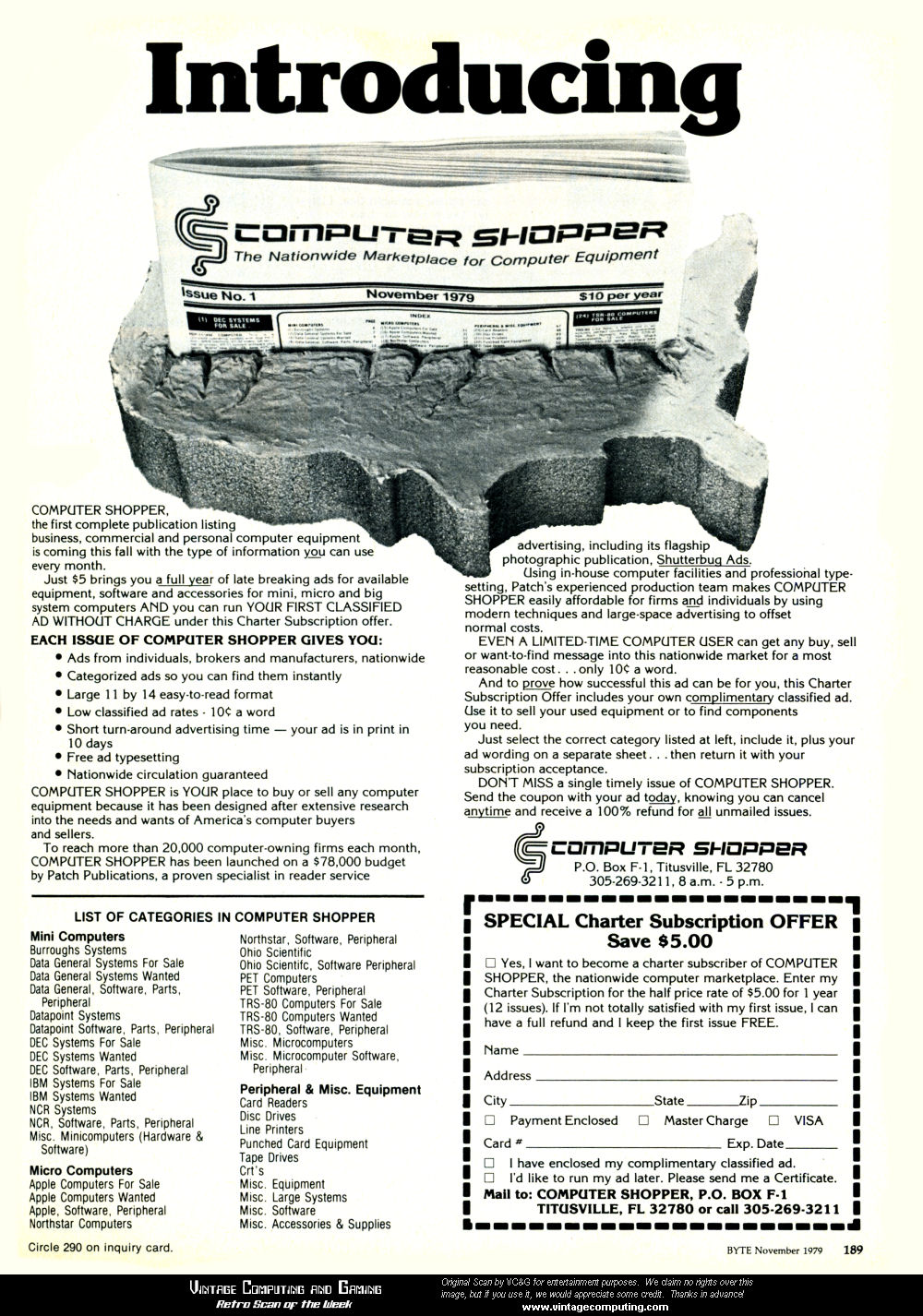 “The most divisive magazine in the USA.”
Veterans of the computer scene will no doubt recall Computer Shopper, a massively large (11″ x 14″, later 10″ x 13″) and thick (usually around 1.25″) monthly publication that mostly ran classifieds and paid advertisements for PC vendors. The magazine ended its print run in 2009, 30 years after it launched.
I only know when it launched because of this advertisement for the launch of Computer Shopper that appeared in the November 1979 issue of Byte. It’s interesting to see a legend at its birth.
I was never a huge fan of Computer Shopper, since it was essentially a month’s worth of computer junk mail stuffed into an awkward and almost unreadibly-large magazine format. But I did respect it as a mainstay of the computer industry — as familiar as a phone book and as timely as a newspaper. May she rest in peace.
Discussion Topic of the Week: Did you ever read (or more accurately, peruse) Computer Shopper? What are your memories of the publication?
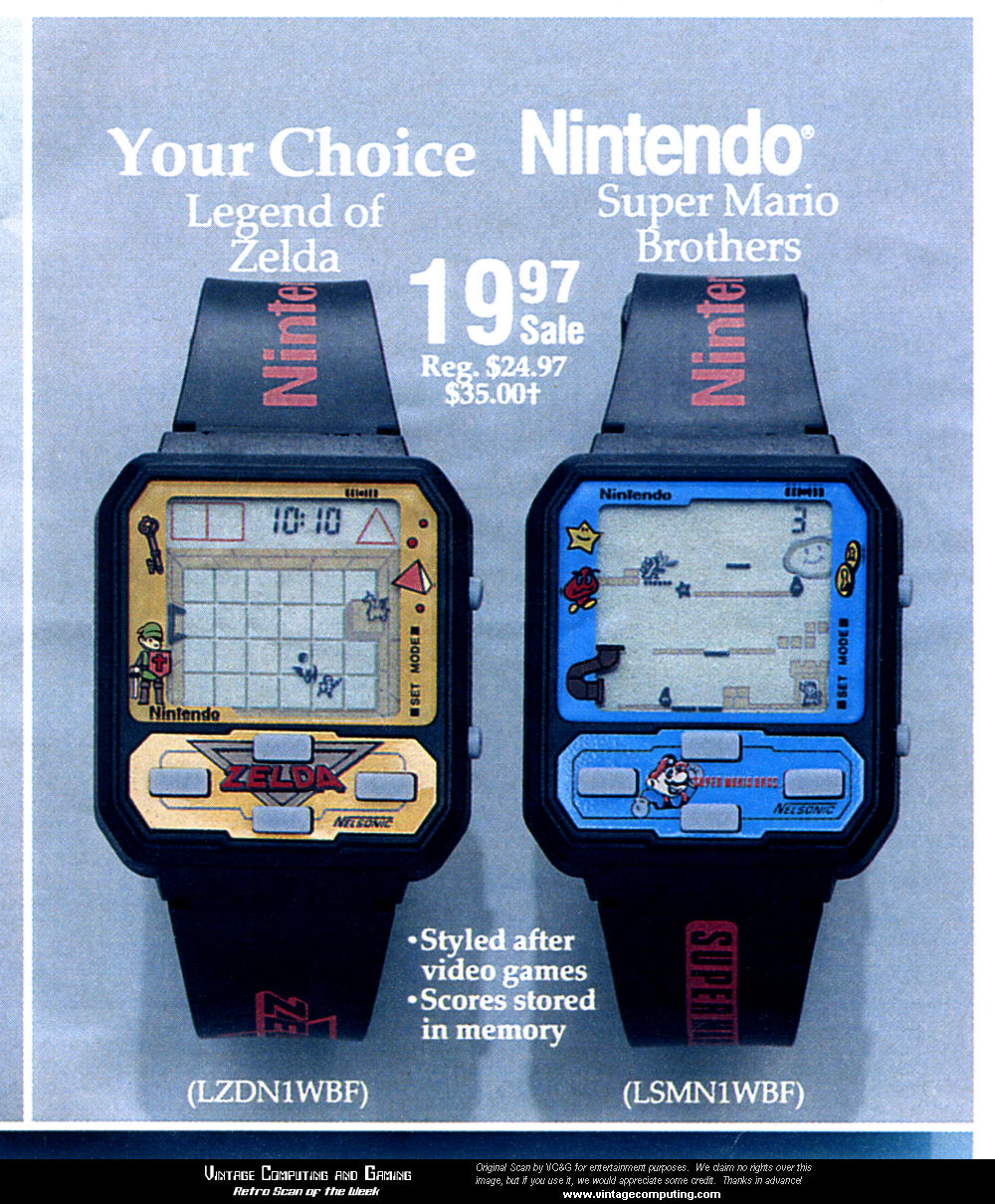 Why not put LZDN1WBF and LSMN1WBF on your Xmas wishlist?
As you probably know, Apple recently introduced the Apple Watch. That got me thinking about other nerdy watches of yore, and I remembered something I recently found in my mom’s attic.
Last month, my mother and I searched through boxes and boxes of my grandmother’s old dishes to see what might be of use to me now. The dishes had been sitting in my parents’ attic untouched for two decades. Many of them were padded with old newspaper from eastern Tennessee, which is where my grandmother lived until she died in 1992.
Among the usual black-ink-on-yellowing-paper fare, I found a handful of gloriously full-color advertisement circulars. A December 1989 mini-catalog for Service Merchandise caught my attention immediately because it featured a pair of Nelsonic Game Watches licensed by Nintendo. (That segment of the circular is what you see scanned above.)
Each of these two watches, which sold for ($19.97 a piece — or $38.37 today when adjusted for inflation) played a simplified prefab-LCD interpretation of its console namesake. If you remember Tiger’s LCD handheld games, you’re on the right track. In the Zelda watch game, you were forever trapped in a dungeon, and in Super Mario Bros. you forever hopped between platforms.
While these watch games were limited at the time, it was amazing to think you could fit a portable, battery-powered “video game” on your wrist and play it wherever you liked. I personally recall seeing more than one of these watches getting confiscated by teachers during my elementary school days.
That desire to carry functional video games with us has never abated. Heck, I bet that within days of the Apple Watch’s release next year, someone will hack it to play emulated versions of Super Mario Bros. and The Legend of Zelda — allowing us to finally have the full NES experience on our wrists. It may be 25 years too late, but it will be amusing to see how things have come full circle.
Discussion Topic of the Week: Have you ever owned a watch that played a game? Tell us about it.
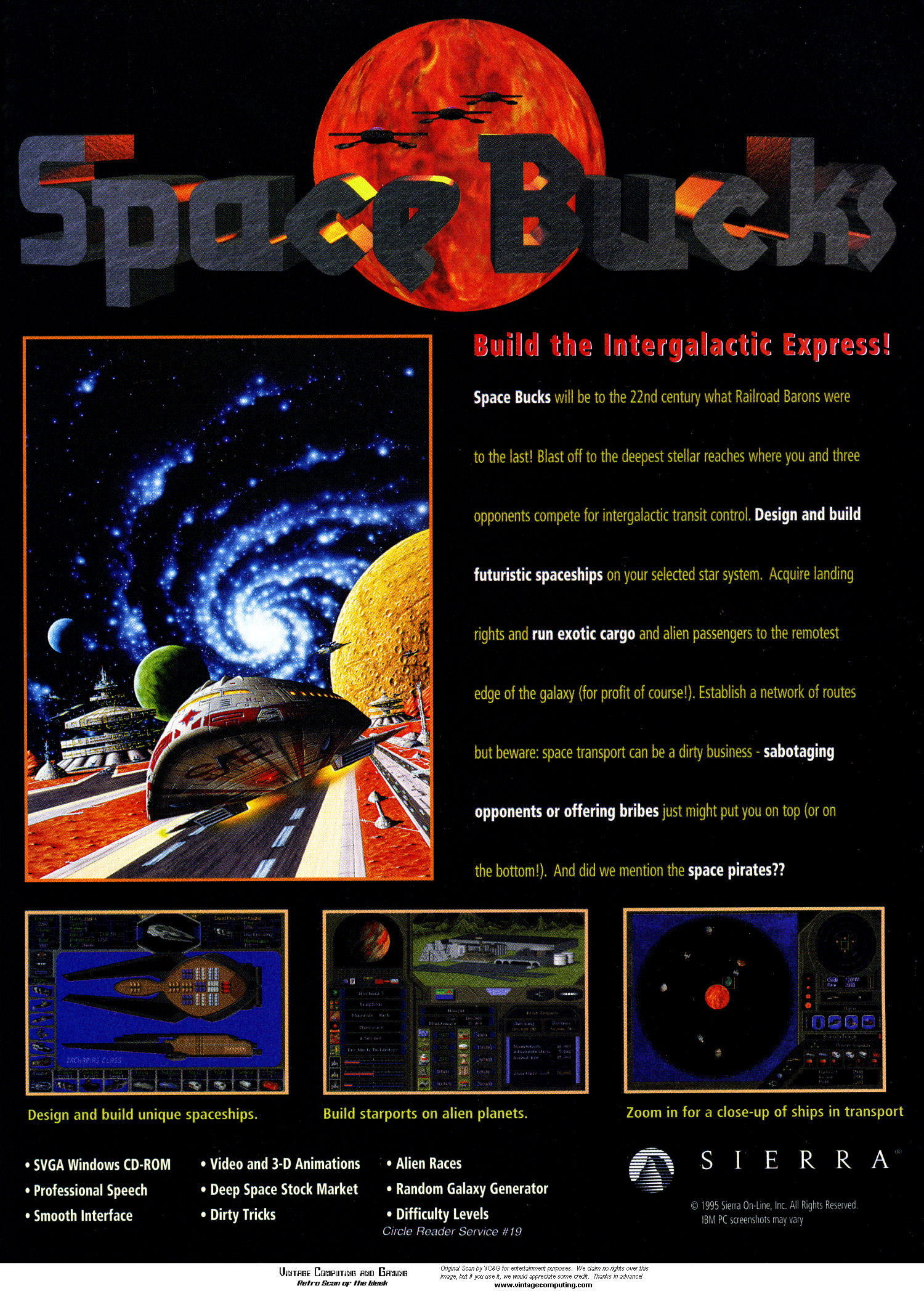 So now we’ve entered the 3D font era.
I’ve never played Sierra’s Space Bucks, but it looks like a fascinating strategy game. I was a big fan of SunDog: Frozen Legacy on the Atari ST, so I’m a sucker for any game that shows the inside of your spaceship from a top-down view (even if only in a non-functional splash screen). Has anyone out there played it?
(As an aside, when I started this blog in 2005, I could just say “I’ve never played this game, does anyone out there know anything about it?” And get away with it. That’s because very little game info was out there; Wikipedia had very few video and computer game entries — especially obscure ones — and MobyGames was incomplete. Now I have no excuse for not looking it up myself. And what do you know: here’s a Wikipedia entry on Space Bucks, first created in 2012.)
I have this feeling that most Windows games from the 1995 era slipped through the cracks and were mostly forgotten. It’s my impression that not many people played early games created for Windows 95 and late-period games made for Windows 3.11. Maybe it’s because the IBM PC world was in the middle of a big transition from MS-DOS / Win 3.11 to Windows 95. I remember still buying MS-DOS games well into 1997, for example.
Discussion Topic of the Week: What was the earliest game you bought that ran exclusively on Windows 95/98?
 Everything looks cheaper in black and white print.
The IBM PC wasn’t the only American microcomputer that got cloned in the 1980s. The Apple II also inspired its fair share of software-compatible copycats, such as the Aplus 3000 system seen here.
This appears to be a grey market VTech Laser 3000 computer with the name plate removed — possibly to avoid any trade import bans on Apple II clones that may have existed at the time.
Clones like this were popular in certain underground circles, and for good reason. Take a look at the price list in the ad. The Aplus 3000 retailed for US $499 (about $1,104 today when adjusted for inflation) verses $1745 for a bona fide Apple IIe (about $3,863 today). And on top of that, the Aplus 3000 contained integrated peripheral cards that would cost thousands of extra dollars if purchased separately for use in a real Apple IIe.
As I’ve mentioned before, peripheral integration was a great way to undercut official products. It happened quite a bit in the IBM PC universe.
Discussion Topic of the Week: If you could buy an unauthorized clone of an iPad or iPhone that ran iOS and had better specs for less price, would you do it?
—
See Also: Orange+Two Apple II Clone (RSOTW, 2010)
See Also: Apple II Box for C64 (RSOTW, 2013
See Also: How I Got My First Computer, and How I Got My First Computer Back
 If I were riding a flying ostrich, I’d probably be smiling too.
I don’t normally take scans out of context, but I made an exception for this amazing illustration. It comes from the instruction manual for Joust for the Atari 2600. I isolated the image years ago for possible use in one of my Halloween costume ideas posts, and I’ve been staring at it in my scans folder ever since.
Joust is one of my favorite arcade titles, and I’m particularly fond of the Atari 7800 home version.
I’d like to find out who created this glorious piece of video game art. I’ll do some digging in a bit, but if you know already, please leave a comment and I’ll update this post. (The illustrator may be referenced in the manual itself, but it’s packed where I can’t get to it.)
By the way, I think this illustration would look awesome on a t-shirt. Anybody want to make one?
Discussion Topic of the Week: Which is better: Joust or Balloon Fight?
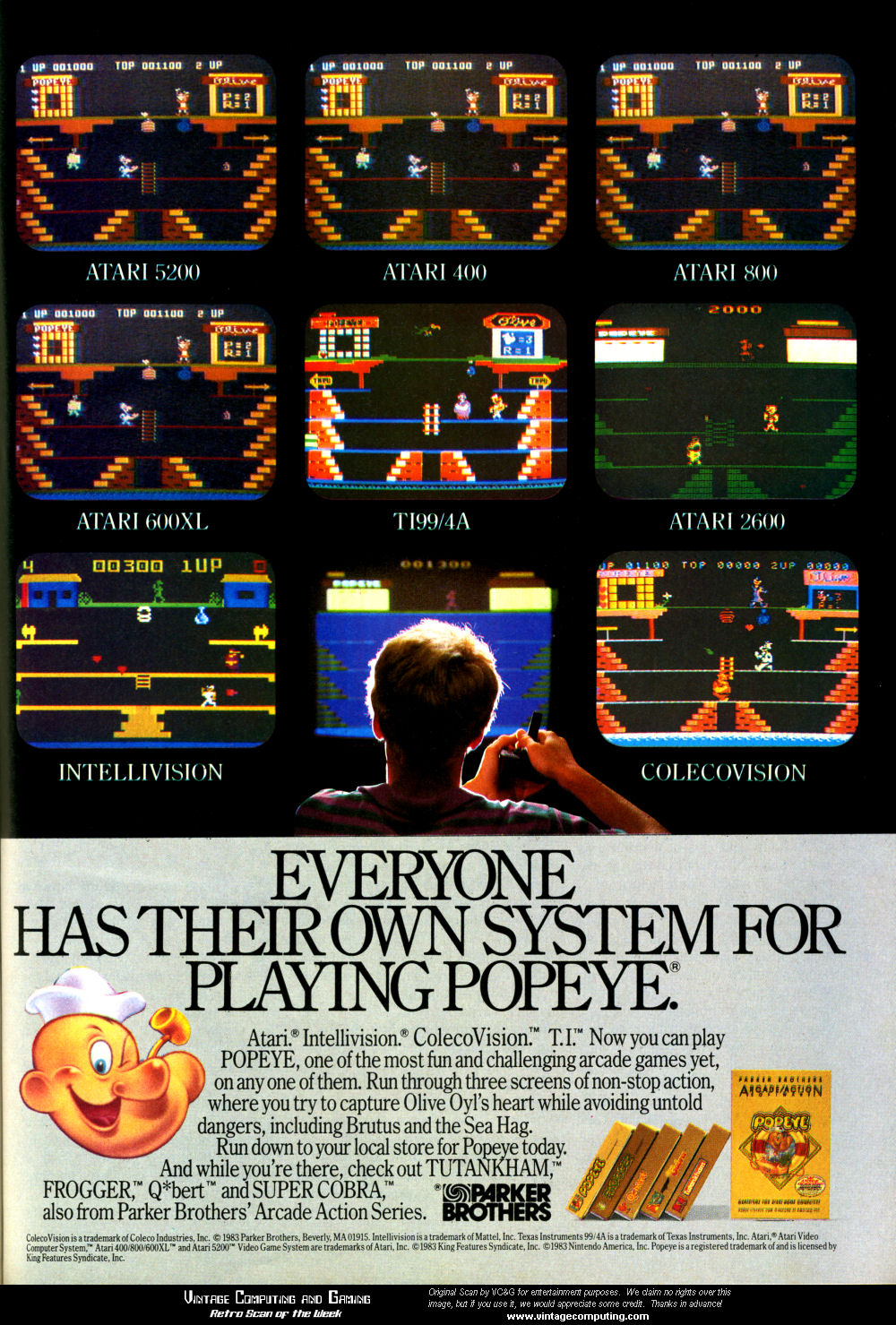 Well blow me down
Discussion Topic of the Week: Of the systems listed in the ad above, which is your favorite?
—
See Also: Eight Ways to Play Q*Bert (RSOTW, 2007)
See Also: Multi-Platform Mania (RSOTW, 2009)