Author Archive

Anatomy of a Young Collector’s Room

Wednesday, March 22nd, 2006
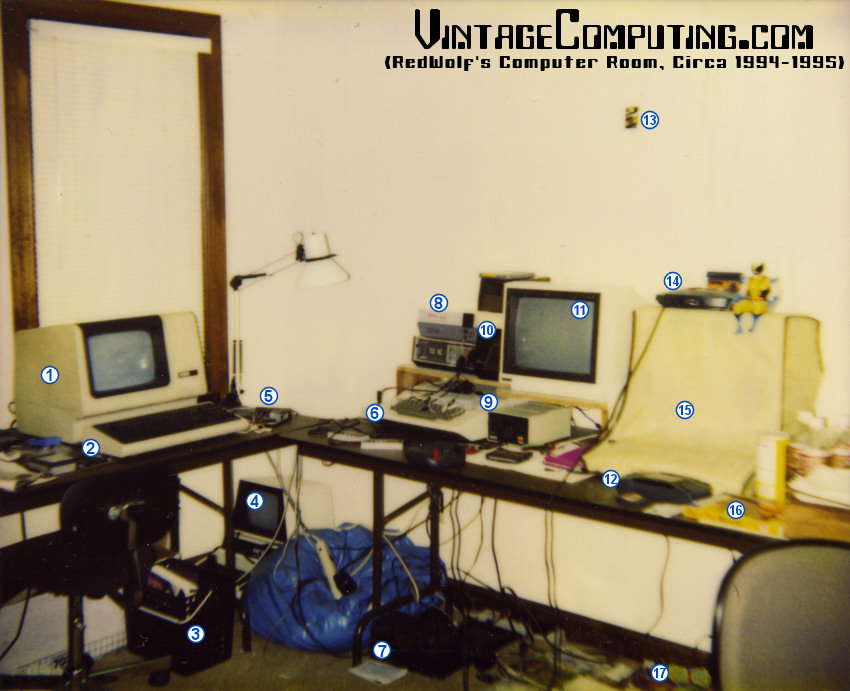
Late last year I found this classic (for me, anyway) picture lurking in my files and scanned it. It’s a Polaroid photograph of one corner of my then “computer room” taken by myself somewhere around late 1994 or early 1995 (yes, my family was lucky enough to have the space for another room dedicated mainly to my BBS computer, but filled with my other junk as well). I was 13 or 14 at the time. As you can see on the picture, I’ve labeled certain items in the room with numbers. Each number is associated with an item that I talk about below. With that out of the way, click on the image to open up the bigger version and let’s start the tour!

1. DEC VT-125 Terminal – A true classic in the terminal world, pulled from a dumpster. The neighbor of my father’s company serviced minicomputers and was always throwing neat stuff out. I got about 3-4 of these, took a few apart, eventually throwing them away for space concerns. But I think I still have one or two left.

2. Micromint Z8 Board – Part of the Micromint Z8 Basic Computer/Controller set. Inherited from my father’s old workplace. The Micromint Z8 system was a BASIC language-programmable microcontroller, essentially for early “embedded computer” applications. I have a bunch of cool expansion boards too, including one that lets you save/load your program to cassette tape, and another that lets you burn EPROMs of your BASIC programs! Cool stuff — I should play with it again.

3. NES Games – Back in 1994, my NES game collection could actually fit in one cubic foot of space. Crazy. A NES Game Genie code book can be seen here, awkwardly sticking out of the top of the plastic basket. Eventually my collection would spill out of the pictured basket and beyond…

4. Commodore CBM 2001-32 – This was had at a hamfest for $10, including the separate companion disk unit. It’s tucked away in the far back corner of the room, so I guess I didn’t use it very much.

5. Zoom 2400 BPS Modem – My first modem, given to my family by a friend. The top cover is off because I was playing around with hooking the speaker audio output to headphones — both for kicks, and for late-night modem sessions without waking the parents (I did this before I figured out the Hayes AT command to turn off the internal speaker) . This very modem is responsible for introducing me to the world of BBSes sometime in 1991. Of course, this being 1994-95, my main workhorse at the time is an Intel external 14400 modem across the room (not pictured).

6. Apple II+ – My dad bought this for me around 1990-91 (from a hamfest, big surprise) so I could learn BASIC on it. And I did, having loads of fun with it over the years. At the time of this picture I had the luxury of a color composite video monitor (#11). Up until then, I was stuck with a monochrome green-screen. But somehow it almost didn’t feel like an Apple II any more once it was in color.

7. Odyssey2 Games – Yes, this black blob is actually fifteen Odyssey2 games in interlockable cartridge racks, purchased for $10 along with an Odyssey2 console at a hamfest in the early 90s.

8. Nintendo Entertainment System – Back then, I took everything I owned apart, and the former “family NES” was not spared this treatment. Thinking myself clever, I switched the one and two player ports around, along with the “power” and “reset” buttons. How delightfully obnoxious. This unit, 11 years later, went on to become the NES DVD Player hack I did recently.

9. EPROM Eraser – It’s the gray rectangular box on top of the Apple II+ (#6). Never really used it very much. It was inherited along with the Micromint Z8 controller board stuff (#2) and was used to erase EPROMs programmed by the unit. It works by shining UV light through a tiny quartz window on the EPROM.

10. Apple II Disks – Stacked here are two boxes of Apple II disks. The lower one is mine, the upper one was given to me by a friend (with all his Apple II disks in it!). In fact, it was the same friend who gave my family the 2400 BPS modem (#5). It’s nice to have good friends.

11. Composite Video Monitor – What a grand day it was when I acquired my first color composite video monitor at a local hamfest! In this picture, the monitor is performing triple duty between the Apple II+ (#6), NES (#8), and Atari Jaguar (#14). I simply switched the AV connectors at the back depending on which one I wanted to use.

12. Atari Lynx – I bought this under-utilized portable wonder in used condition from a guy who regularly called my BBS (“Raven,” if you must know) in 1993 or 94. The transaction was done entirely by mail and we never met in person (imagine that!).

13. Mystery Sticker – I’m not sure what this is. It looks like a random peel-off trading card-sized sticker just stuck on the wall at an odd angle. Weird. This picture have been taken after my dad made me take down the 100-odd posters and other crap I had tacked and taped all over the walls, believing they were a fire hazard.

14. Atari Jaguar – I was a total Atari nut in the very early 90’s, believing strongly that Atari was the greatest company ever. “What’s this Nintendo business?” I said. “Atari was first!” I heard rumors of their Panther, then Jaguar, consoles and waited anxiously for their release. My birthday in 1994 was one of the happiest days of my life: I received an Atari Jaguar System and Super Metroid for the SNES. Here, Doom can be seen in the cartridge slot, a version of the seminal 3D FPS rivaled on consoles only by the PlayStation version.

15. Apple III – The prize of my collection at the time. When I first heard about the Apple III years before, it was like some magical, mythical beast. Would I ever catch sight of one, much less possess it? Naturally, I was extremely excited when my father and I came across this one later at a hamfest (again, big surprise). $10-20 later, I had my first Apple III, complete with dust cover (pictured on the unit). I only had the Apple II emulation disk for it, though, and to this day have never run any native Apple III software. Shortly after my Apple III was obtained (turned out they were not as rare as I thought), the Apple Lisa quickly became the next mythical beast to be had — a beast I’m still chasing in the wild to this day.

16. Plug ‘N’ Play Mosaic Book – This book is how I got my first copy of Mosaic, the first graphical web browser (it came on a floppy disk in the back). Shortly after, I began to develop my first home page, and boy did it suck. It’s funny reading lists of “cool” web sites from back then because, well…there were only about ten web sites back then. Ergo, all of them were cool (and listed in this book).

17. Handheld Video Games Magazine – I just found this particular issue (Spring 1991) again recently while working on my “Game Ads A-Go-Go” column for GameSetWatch. Good issue. I apparently didn’t value it very much at the time because it’s sitting on the floor right next to the spot where our cats would leave all the dead birds they’d caught that week. Yum.

Well that’s the tour, hope you enjoyed it. Thanks for accompanying me on a nice walk down memory lane.

Introducing the VC&G Discussion Forum

Tuesday, March 21st, 2006

VC&G ForumYou are about to witness a new experiment for Vintage Computing and Gaming…a full-fledged discussion board. It’s now up and running, so check it out!

I hope our forum can have a loose, friendly, all-inclusive atmosphere. I’m tired of forums that are filled with an elite, exclusive “old boys’ club” attitude that shuns new members who don’t know every esoteric detail about some computer / game system / whatever. As a result, as our forum grows and we get more established, I hope you can be as tolerant as possible to new members and those who might come looking for help on a situation that might seem “dumb” or “obvious” to you. Just remember that we were all in the same shoes once, knowing nothing at all about the world, much less computers and video games. Some of us were lucky enough to learn through the kindness and generosity of mentors and teachers who freely shared knowledge with us without feeling threatened. If you were graced with such fortune, think back and remember how it felt to be treated with equality and respect, despite your youth and inexperience. Now it’s your turn to pass on that knowledge, and that gift, to a new generation. Now you are the mentor.

All forums will be moderated by myself (or trusted persons I choose in the future), so please try to stay on topic. We have a wonderful place to talk about miscellaneous stuff called the “Off-Topic Forum” as well, so if your post is not about computers or video gaming in some way, post it there. Blatant personal attacks by members to other forum members will not be tolerated. Disagreeing with each other (or me) is perfectly fine, but please be civil. Once you hurl an insult — no matter how subtle a dig — or assign someone a negative label (i.e. call them a name), the flame wars are sure to begin. Keep these things in mind so we can douse the fires before they spread out of control.

Any suggestions about the forum are welcome at any time. I stocked the forum with some interesting VC&G-related avatars to get us started, and I’ll be starting more message topics in the days to come. I know the forum is really empty now, so any help you can provide in getting our new forum rolling will be incredibly, gratefully appreciated. Thanks a ton in advance, and have fun talking!

Retro Scan of the Week: “Video Game Saver (Never Die) with Unlimited Fun”

Monday, March 20th, 2006
Super Game Boy Flier

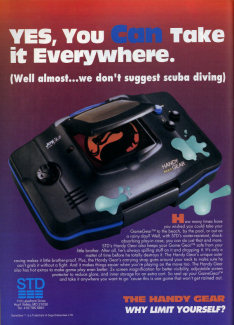
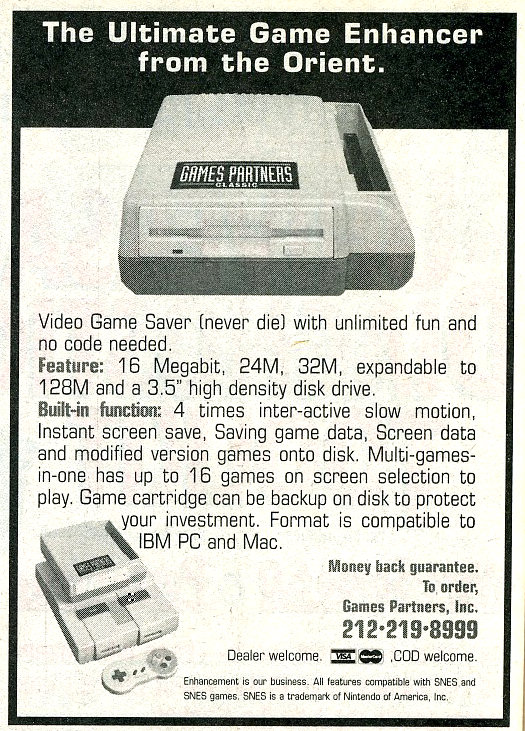
This advertisement appeared in the September 1995 issue of “Electronics Now.” I found it lurking in the back of the magazine — you know the place, the cheap black and white section where all the “shady” ads are (for porn BBSes, diet pills, pirated games, etc.). This particular ad is for what appears to be a re-branded version of the “Game Doctor III” game copier for the Super Nintendo / Super Famicom. I happen to have a Game Doctor III, but could never get it to work properly (I prefer my Super WildCard DX2 instead, which vastly outclasses it anyway). “Backup devices” such as this are/were illegal, of course, so it’s interesting seeing how this particular distributor skirted the issue with their entertaining “Engrish” description of the product. For Great Justice!

This Week’s Game Ads A-Go-Go: “Strange and Devious Perhipherals”

Thursday, March 16th, 2006
GSW Ad

Now up at GameSetWatch is my second “Game Ads A-Go-Go” column about classic game-related ads. This week’s piece is about “Strange and Devious Peripherals.” Check it out.

Retro Scan of the Week: “Play it Loud!” Super Game Boy Flier

Monday, March 13th, 2006
Super Game Boy Flier

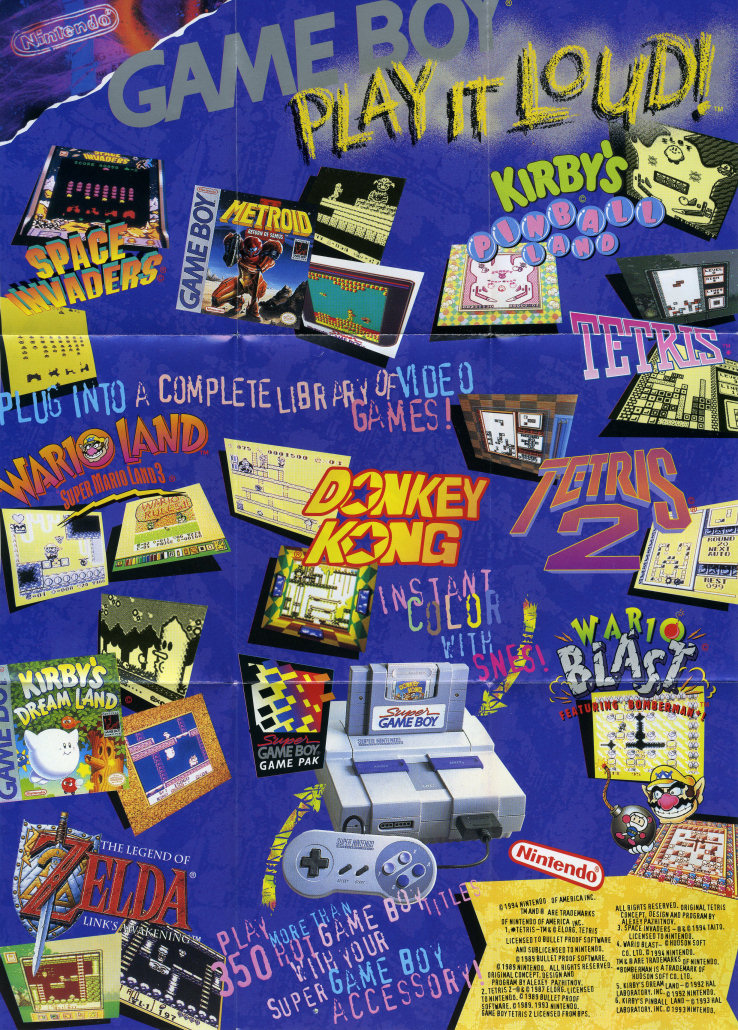
Remember the “Play it Loud!” days? I almost wish I didn’t. Even then I would cringe every time I heard or read Nintendo’s ads. Nonetheless, this flier sets off all the relevant nostalgia alarms in my brain, with specific regard to the Super Game Boy. The Super Game Boy (SGB), for me, was one of the most exciting Nintendo products launched in the 1990s. You could play all your current Game Boy titles in four whole colors. But of course, I usually ended up using just a greyscale-like palette and simply enjoying the fact that you could actually see the games you were playing for once. Then there were the SGB-enhanced games that had more colors when you played them on the SGB. The SGB I bought had the first SGB-enhanced game Donkey Kong as a pack-in. It was one hell of a winning combination.

Japanese Castlevania III: The Music is Worth it

Friday, March 10th, 2006

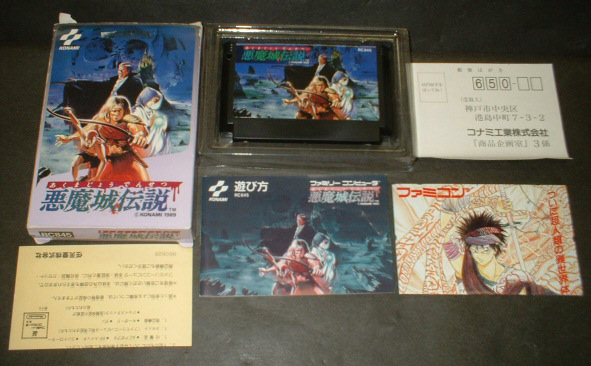
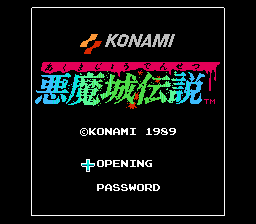
C3 JapanWelcome back to RedWolf’s New Adventures in Famicom Land. Our latest trip takes us to an exciting island called “Akumajou Densetsu,” which promises to shower us with interesting music unlike any we’ve ever heard before on the Famicom or NES. That’s because Akumajou Densetsu, or the Japanese version of Castlevania III: Dracula’s Curse, uses the VRC6 chip, which provides for three extra sound channels (in addition to the Famicom’s original five). And Akumajou Densetsu utilizes those three extra channels brilliantly. Unfortunately, due to some hardware setup in the NES that I don’t understand, the US games could not utilize these extra sound channels. As a result, the music for Castlevania III had to be rewritten and simplified for the US release.

C3 JapanI had heard tales of how cool the music is, but I always wanted to hear for myself. So I bought a copy of Akumajou Densetsu recently and plugged it into my new AV Famicom. I was confronted with a flurry of new low bass notes and more complicated percussion. Sure, the music is nowhere near up to SNES snuff, but it’s an incredible experience nonetheless — Castlevania III’s music is some of the best on the NES. The rest of the game is the same as far as I can tell (except that, for some reason, the jumping “Igors” in the US version were changed from jumping demonic frog-like things in the Famicom one), so if you’re serious about Castlevania III, then it’s worth it to pick up this cart and a real Famicom to experience the music as originally intended. FCEU seems to emulate the music pretty well, but I highly recommend getting the real thing.
Jake, if you don’t have a copy of this, you should definitely get it. 🙂

RedWolf’s Classic Video Game Ads Column on GameSetWatch Premiers Today

Thursday, March 9th, 2006

Ad from GameSetWatchStarting today, I’ll be doing a weekly column called “Game Ads A-Go-Go” (the title was the GSW editor’s idea) over on the blog GameSetWatch that showcases good, bad, strange, funny, and interesting classic video game-related advertisements. My first column is on “Dumb Ads of the 90s” and is up now. Check it out!
Most of the ads featured in the column will be scanned from my massive early 1990s game magazine collection that I recently unearthed from deep-earth storage (my parents’ basement). The column itself is a partnership between GSW and VC&G, actually more of an extension of VC&G-style content exclusively on GSW. Why? I guess it’s because we love each other so much (read: “I’ve been bribed with a lifetime supply of chili hot dogs”). But never you mind, and don’t you worry — the fresh content from VC&G will continue to flow just as readily as before.

How to Tell if You Have a Video Game Collecting Problem

Thursday, March 9th, 2006
A Slight Collecting Problem

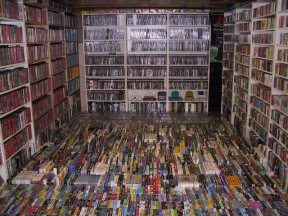
How do you know if you have a video game collecting problem? How about this: when you can’t even walk on your own floor because every square inch is covered with games. Talk about painting yourself in a corner…with video games. And my fiance thought I had a problem. The next time your wife complains about your collection, show her these pictures.

All kidding aside, this is looks like an important library of video games. I wonder: if this room were discovered like some long-lost vault or tomb in the year 120,402 A.D. by our descendants after World War 15, what would they think of us?

Update: Read an interview with the owner of this collection and see more photos here.

Captain Hamfest and the Tale of the Infamous Nail-to-Ground Commodore 64 Hack

Tuesday, March 7th, 2006

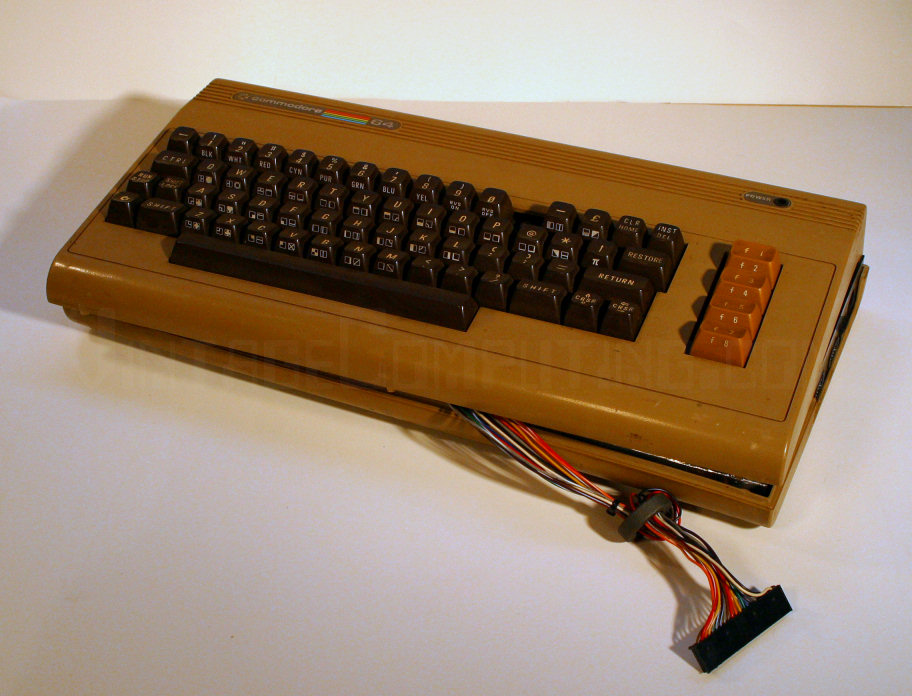
C64 Nail-To-Ground HackI have a box of about eight musty, “doorstop quality” Commodore 64’s (C64) and VIC-20’s sitting up in my attic. They came from a local hamfest a few years ago. It was getting late in the show that day and the vendors were tired and wanted to go home. At the end of any hamfest, vendors have tons of near-worthless, unsold, bulky junk that they’d usually rather throw away than drag back to their car. I have been stuck in a situation at least four or five times where I was interested in buying one item, but would only be allowed to purchase the item if I agreed to haul off all kinds of other crap for the seller. In this case, I just wanted to buy a single box of C64 disks that I noticed sitting on a table, but the guy would only sell it to me if I agreed to take six C64s, five Vic-20s, a few disk drives, lots more accessories and carts, and…well, there wasn’t just one box of disks, after all, but more like ten. It was like some Vaudeville routine: as soon as I thought the seller had pulled the last box of Commodore-spew from under the table and turned to leave, he’d say “oh wait!” and pull out another one. At this point my father, who was saddled with the unenviable task of helping me carry all these musty artifacts to our car, had a severe grimace on his face. That day I inherited some guy’s entire Commodore collection for $10, including his massive anthology of pirated C64 game disks (complete with a thick three-ring-bound index to the disks!), and I think my dad inherited some permanent “Commodore grimace” lines in his forehead.

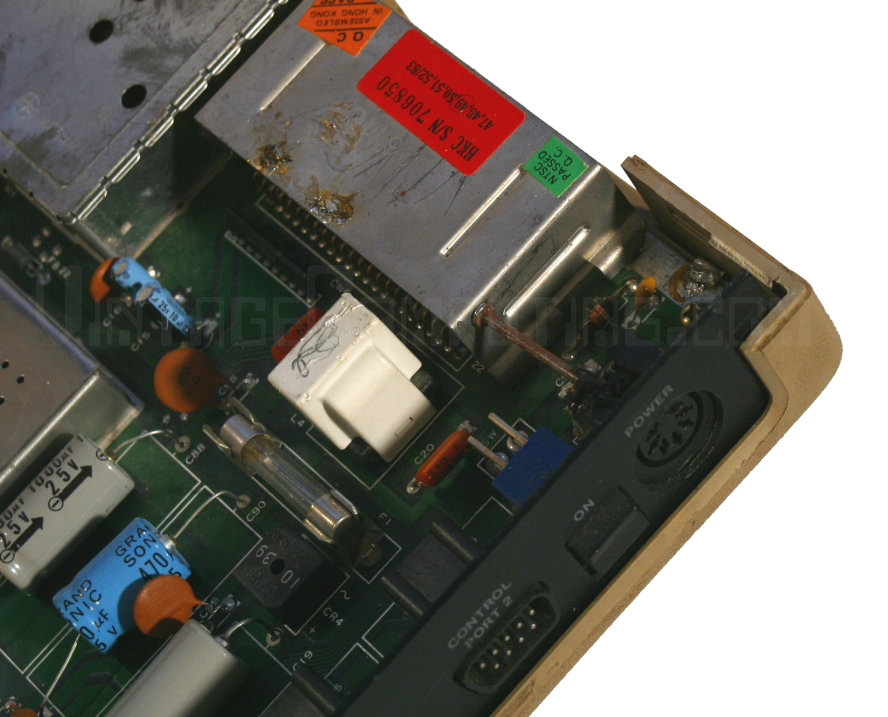
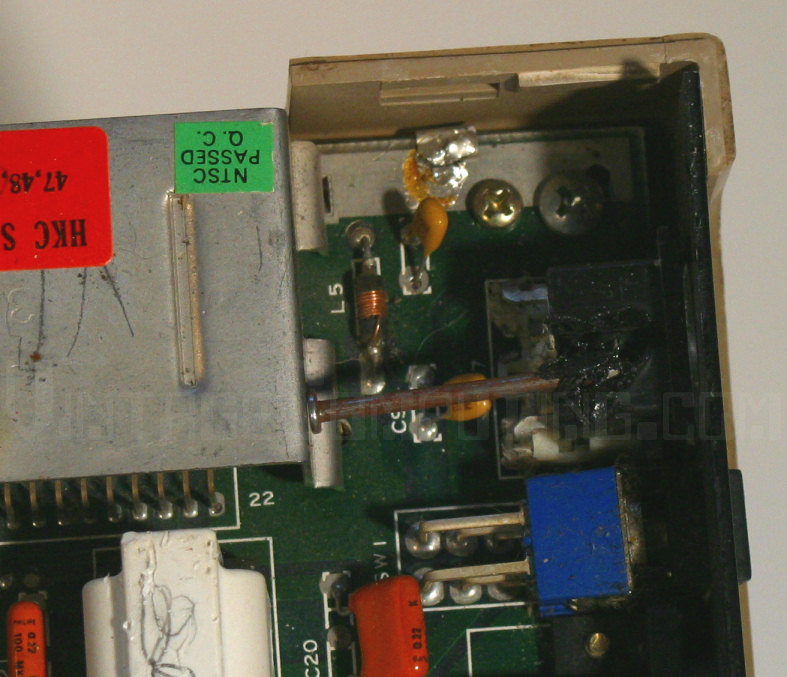
C64 Nail-To-Ground HackI climbed up into my fiberglass dust-ridden attic the other day, looking for an ideal donor of a 6510 processor to add to my CPU collection. Temptingly, in my Commodore box there was a C64 already apart and in pretty bad shape — an ideal sacrificial Commie to dissect. Upon bringing it down and looking inside the case, I found something pretty amusing: some guy — presumably the previous owner — was fiddling with the power connector in the unit and somehow broke the ground contact and corresponding pin off the connector. It looks to me like he was in the middle of laboring to remove the connector when he was abruptly struck with Sudden Onset Lack-Of-Patience Disorder (or SOLOPD, a common affliction amongst electronics tinkerers). Soon after, his strategy for connector removal became “rip it off any way you can.” Unsurprisingly, he broke his machine in the process. Through the magic of literary time travel, we can infer what obviously happened afterwards as he attempted a repair:

There he was, cradling the lifeless body of a broken C64 in his arms, crying and cursing himself for his impatience and uneven temperament. He broke down on his knees and swore to the heavens to never harm another 64 again if only the Commodore Gods would ease his suffering and forgive him for his mistake. But alas — his cries of desperation fell only on deaf ears (the 22 year-old family cat). And like any man whose most desperate call goes unheard, something turned inside him. For a brief moment, all that was dark and cruel welled up within him, twisting his soul in queer ways as a streak of fiery evil flashed over his hollow eyes. He raised his arms, clutching the helpless computer over his head, and nearly bashed the faulty unit into the darkest form of oblivion. But at the last moment, something stopped him: a key from the unit fell to the floor beneath him. It was the “plus” key — the very first key he pressed on the greatest day of his life. Vivid images of his 15th birthday flooded his head, filling him with a deep sense of regret over what he almost did. It was on that day that he received the very machine he was clutching from his late grandfather. How could he forsake old Roy — always happy, smiling, and helpful — and the desire for a better life that he handed down to his only grandson in the form of a $300 personal computer? It was then that the man decided that he should spare the machine; he would fix it. But how would he achieve such an impossible task? He didn’t have any spare C64 power connectors, and, after all, replacing the connector required removing the old one — the very problem that got him into this mess to begin with! Frantically searching for a solution, he scratched through his junk box until his fingers nearly bled. In the dustiest, farthest back corner of his tattered box, he found it: a nail. Yes! He thought back to his summer job as a carpenter with his grandfather’s construction business — lesson number one in his carpentry training taught him that a common picture frame-hanging wall nail, when used properly, was the perfect solution to any troubling situation. He quickly put his MacGyver-like improvisation skills to work, firing up his soldering iron to melt the broken connector’s mangled plastic and fuse the nail in place. After an intense four-hour operation with many close-calls and stressful moments, he was finished. He plugged the proper power supply into the machine and, with great tension, flipped it on. Tears of joy streamed from his reddened, tired eyes as he saw the bright, vibrant power LED light up. “If only Papa Roy were here to see this,” he thought, as he ran his hand across the smooth back of his favorite machine. “May this heavy light that shines upon me forever serve as a beacon, steering and guiding me through the foggiest, darkest, and stormiest nights of my life.” The ordeal was finally over, and he knew he would never be the same man again.

Yes, he used a nail to act as a ground contact, bridging the outer ground ring of the C64’s DIN power connector and the RF shielding of the cartridge port. Does it really work? I don’t know; I don’t care to try. Personal revelations for the man aside, this has to be the messiest improvised hack I’ve ever seen in my life. At least we got a good story out of it.

C64 Nail-To-Ground Hack

Hacks like these should make us all stop and think more deeply about ourselves.

Retro Scan of the Week: “Call Inmac for those hard-to-find drive filters!”

Monday, March 6th, 2006
Inmac Drive Filters

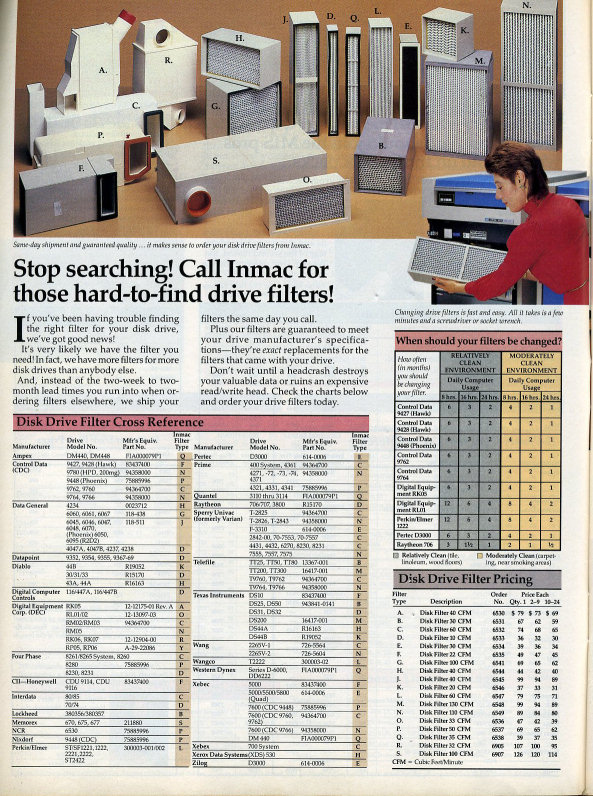
It happens every week: I lose another disk drive to dust and dirt because I can’t find the drive filters I need to operate my high capacity hard disk drives. Well no more headcrashes for me, because I found Inmac! They have more drive filters for more disk drives than anybody else, all without the two month lead times you normally run into when ordering drive filters elsewhere. If you ever need drive filters for your hard disk drives, give Inmac a call.

Somebody pinch me.