[ Retro Scan of the Week ] HI-RES ADVENTURE #4: Ulysses and the Golden Fleece
Monday, March 23rd, 2015
Discussion Topic of the Week: What’s your favorite static-screen graphical adventure game of all time?
Discussion Topic of the Week: What’s your favorite static-screen graphical adventure game of all time?
 “Web storage needs getting a little out of hand?”
Discussion Topic of the Week: Total up all your personal computer storage you have in use, right now, in gigabytes (local site only, not cloud). How much data storage do you currently use at home?
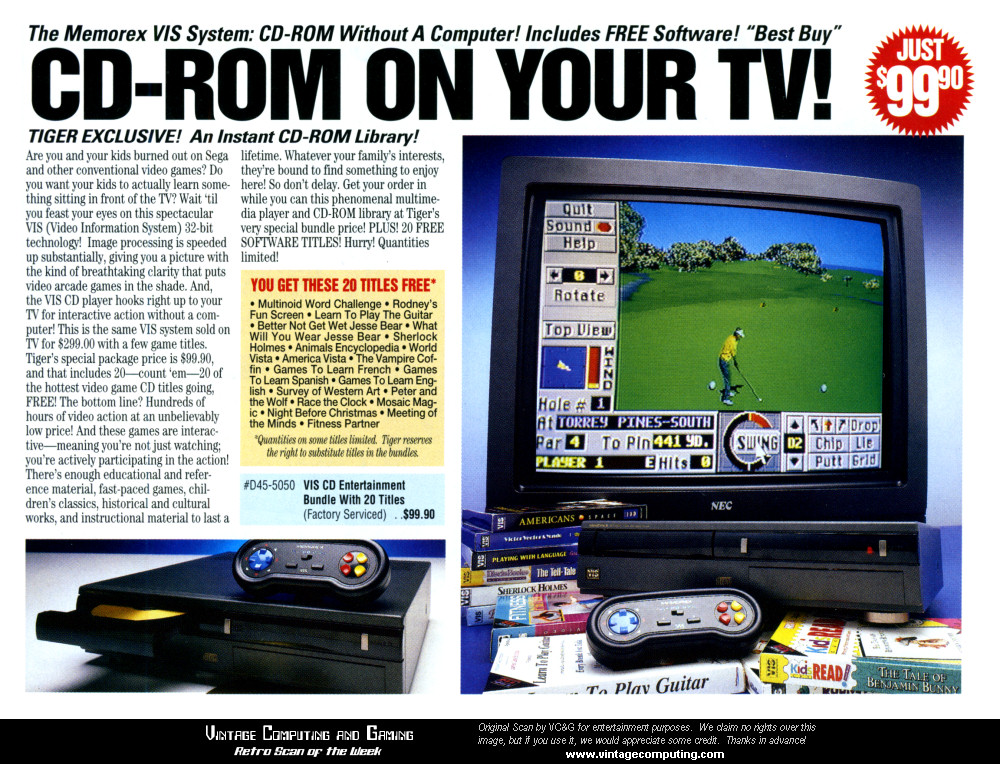 CD-ROM ON YOUR MOTHER LOVIN’ TV!!
Back in 2009, I made a list of the worst video game systems of all time for PC World, and the Tandy Memorex Video Information System (1992) was #2 on the list.
Six years later, I am not fond of dishing out bad vibes toward any game console. But the VIS was indeed an underwhelming commercial product.
And honestly, calling the VIS a video game console is a stretch. As more of a multimedia appliance than a straight up “video game system,” its lineage lay half-way between game machine and general purpose PC. Its designers intended it to run educational software as frequently as games.
For fans of odd an interesting systems, the VIS definitely stands out. Under the hood, it sported a modified PC architecture based on an Intel 286 CPU and a custom embedded version of Windows called “Modular Windows.” In addition, the VIS allowed storing data on removable memory cards that plugged into the front of the console (a feature that, in game consoles, arrived second only to the Neo Geo, I believe).
Of course, ever since I saw this section of a 1995 Tiger Software catalog (Tiger had apparently bought up a clearance stock of the machines — see also this scan of the Jaguar CD in a Tiger catalog), I wanted a VIS regardless of its faults. While I have used them before — including some in-store demos at Radio Shack — I still do not have one in my collection.
Discussion Topic of the Week: Did you own any CD-based game consoles from the multimedia console era? (i.e. CD-i, VIS, 3DO, CDTV, Jaguar CD)
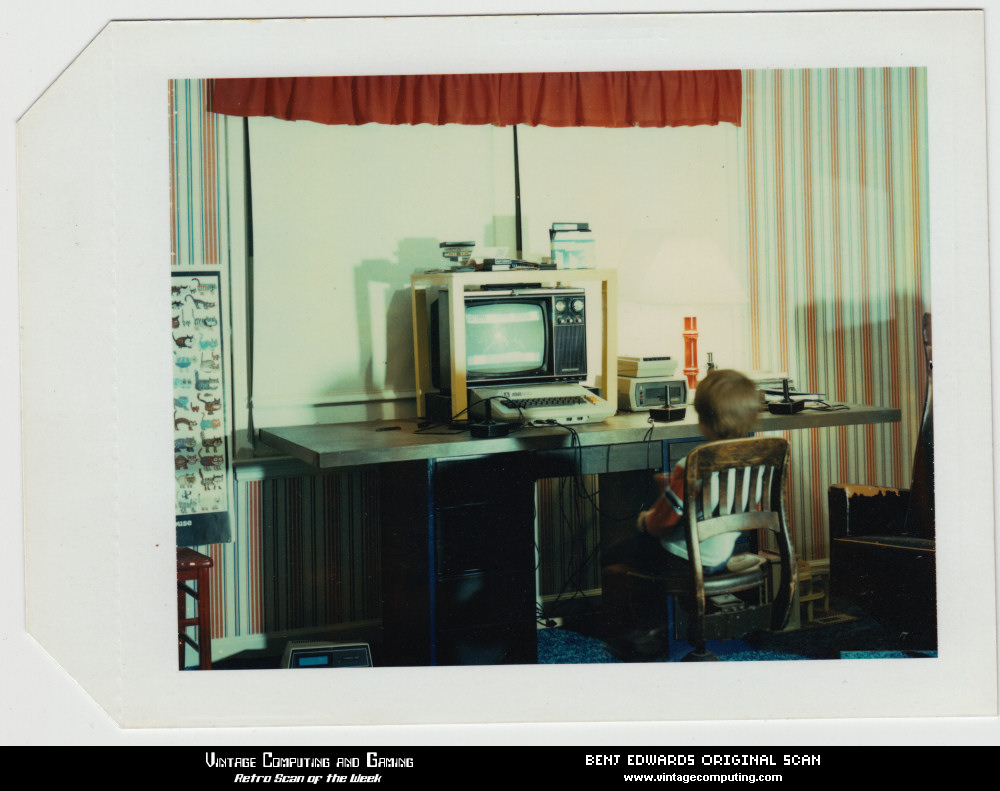 My brother Jeremy playing Slime on the Atari 800 in his room, Jan 14 1983
Discussion Topic of the Week: When you were a kid, did your parents let you have a computer in your bedroom?
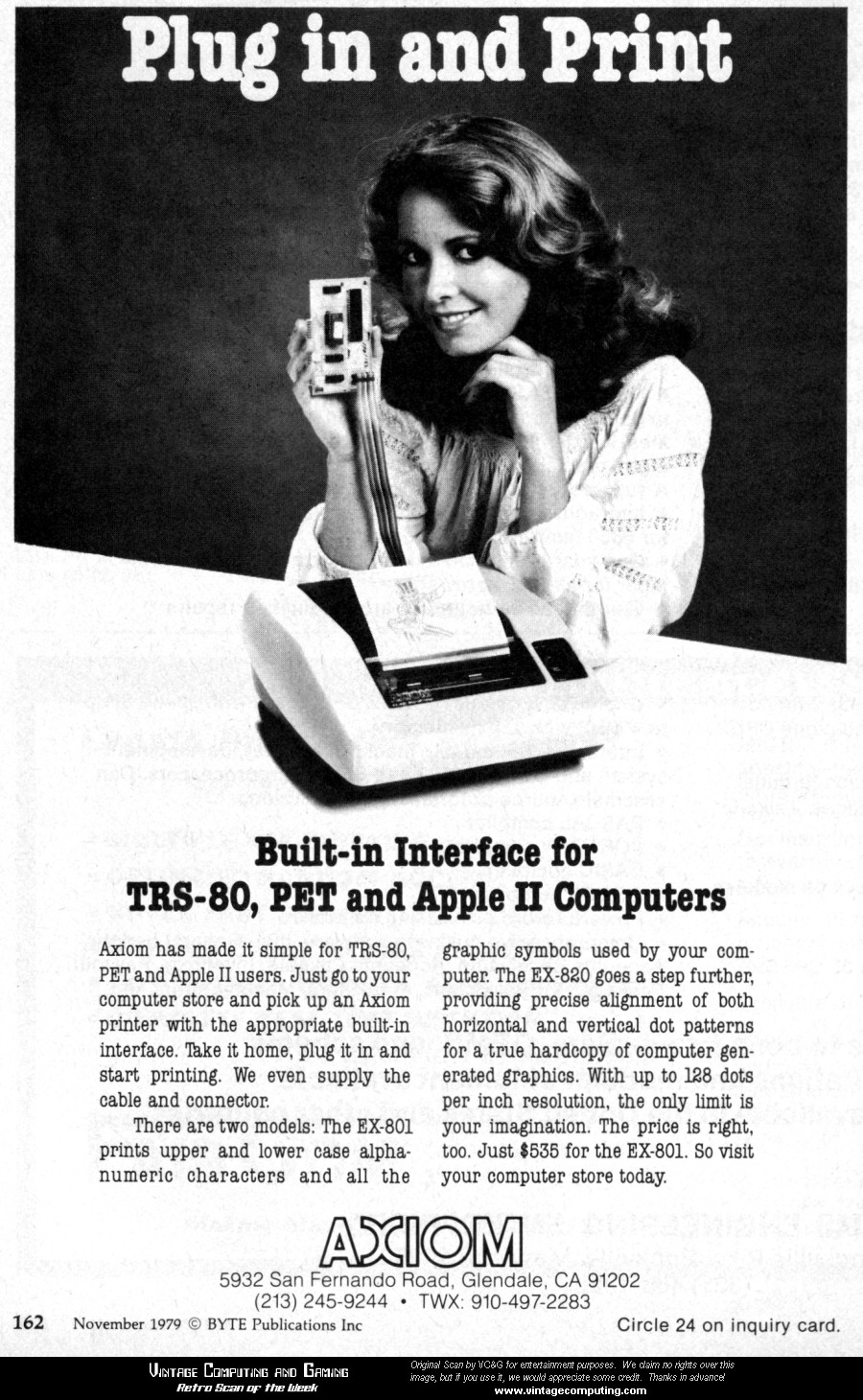 * Feathered hair not included
Ah, the good ole days when you had to pay $535 (that’s $1,744 in today’s dollars) for the privilege of merely being able to hook a printer to your home computer. What can I say — it was a useful feature.
My first computer, an Apple II+, came equipped with a Grappler+ printer card (from the previous owner), although I can’t recall ever using it. Instead, I printed school reports by that time from whichever family MS-DOS machines we had at the time, each of which included a built-in parallel port for printer use.
What a great day it was when I switched from a noisy dot matrix printer to the that awesome Canon Bubblejet we had. Silent printing! And the day we got our first full-color photo capable HP inkjet printer around 1996. It was pretty low resolution, but still amazing.
Today, I don’t print much. I have a color laser copier in service to reproduce scanned documents (in lieu of a copy machine) in case I need a hard copy of something — usually a form or contract — to mail.
Discussion Topic of the Week: Do you regularly print anything from your computer these days? What do you print?
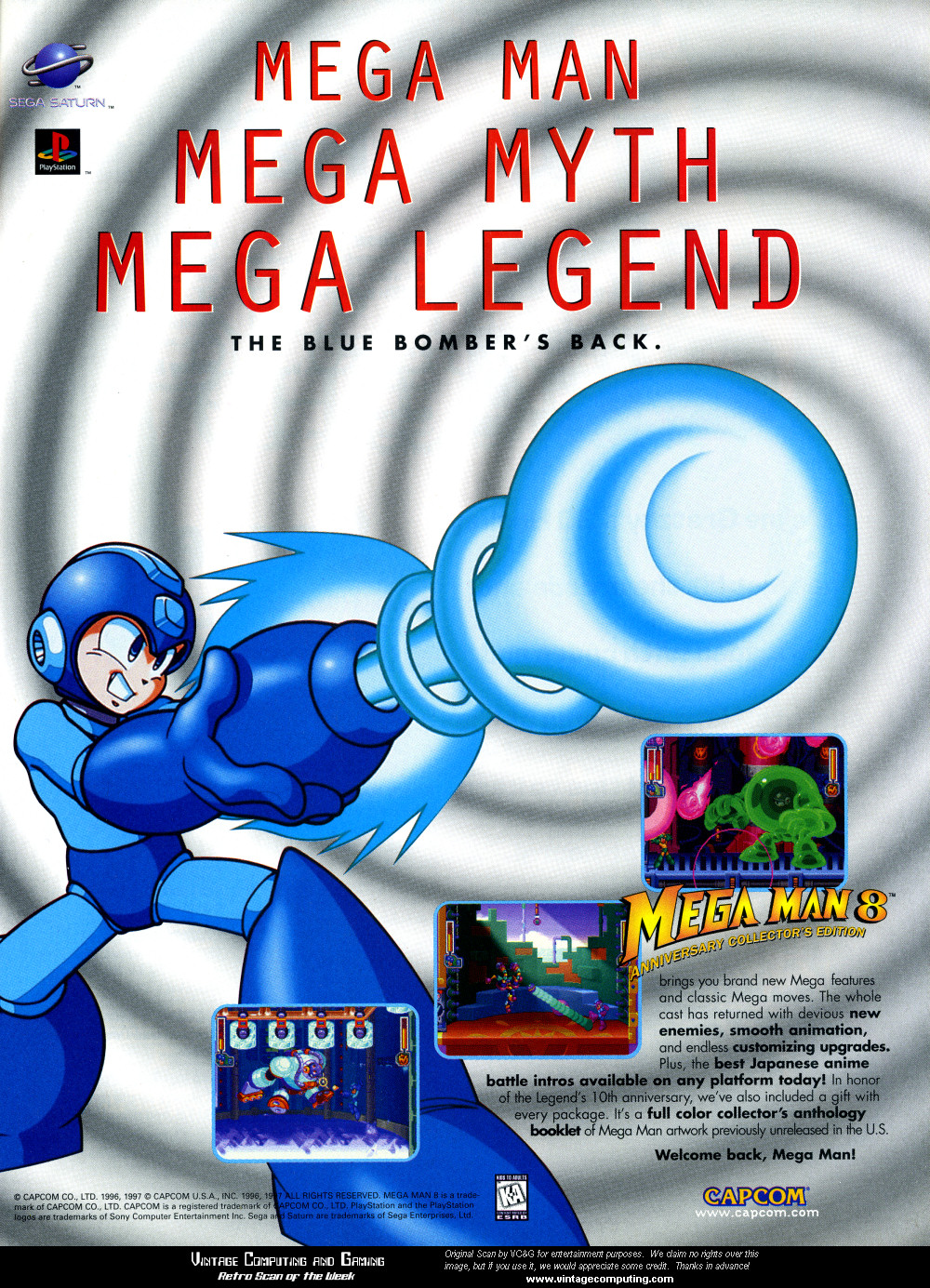 You are getting sleeeeepy
Mega Man 8 remains notable in my mind for its resistance to polygonal 3D graphics at a time when the media perceived that as a requirement for sales success (in the PlayStation-dominated console era). I remember renting it and being impressed by its fluidity and gameplay, although it was too difficult and frustrating for me to play for more than ten minutes in a sitting.
But then again, all the side-scrolling Mega Man games have been that way for me. I’m still partial to Mega Man 2, 3, and X, though.
Discussion Topic of the Week: What’s your favorite entry in the main-line Mega Man (1-10) series?
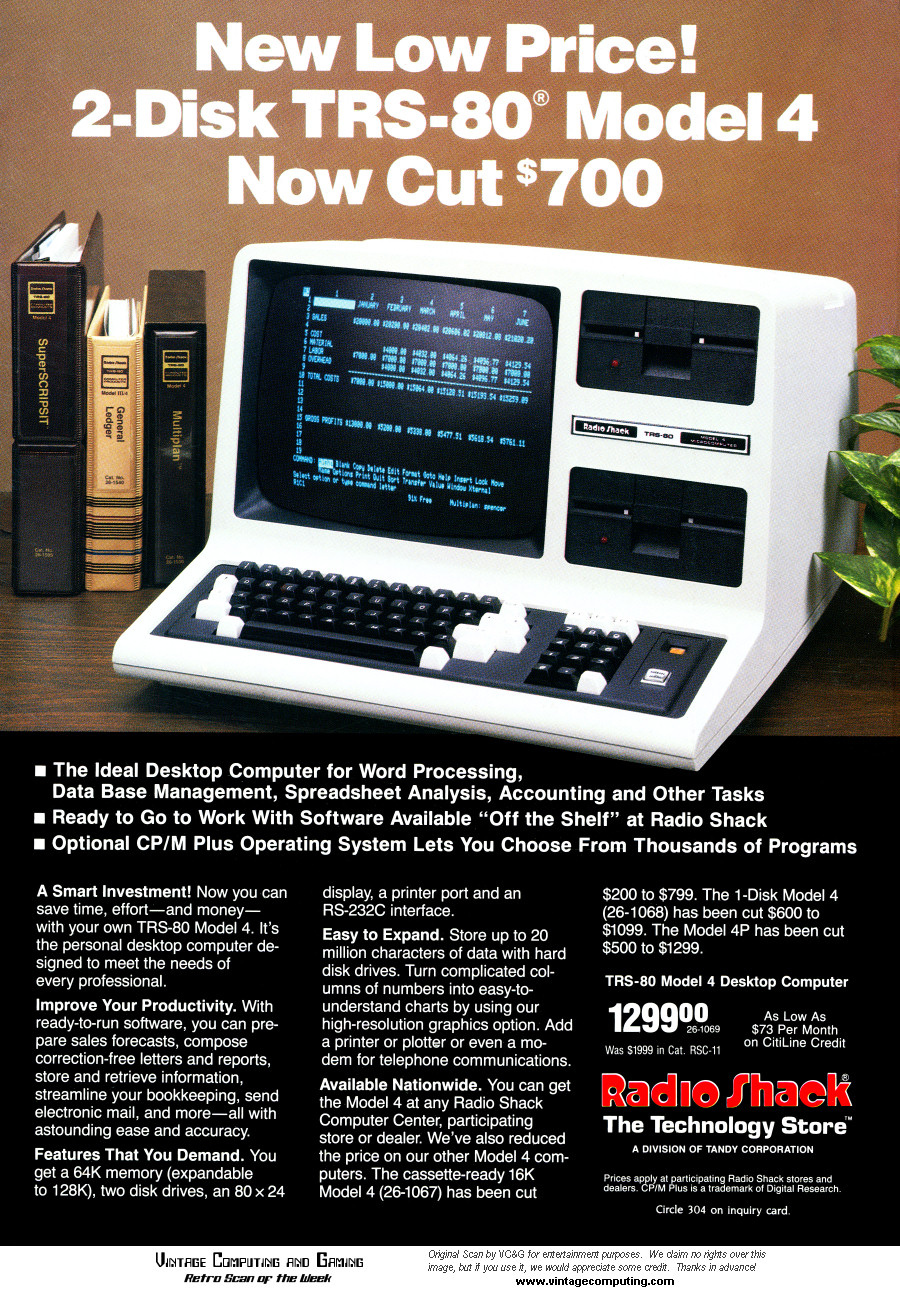 Philodendron not included.
Discussion Topic of the Week: Did you use a TRS-80 or Tandy computer of any kind back in the day? Tell us about it.
 After 94 years in business, it is likely that Radio Shack will soon be no more. And sadly, it has taken the impending death of Radio Shack for me to realize how absolutely ingrained its products have been in my life.
As the son of an electronics engineer living in the US, our home growing up held at least five Radio Shack products per room (or those of its related brands: Tandy, Realistic, Optimus, Archer, or Micronta).
I am not joking or exaggerating. I could go through my parents’ house today and fill a moving van with that stuff: speakers, tapes, radios, hi-fi receivers, turntables, headphones, microphones, clocks, intercoms, outlet timers, telephones, cables, wires, adapters and more.
It’s almost absurd. My first IBM compatible PC was a Tandy 1800HD laptop. My first cassette recorder, microphone, telephone, cordless telephone all came from Radio Shack. My first kiss…well, a Radio Shack robot, of course.
And who can forget the batteries. The batteries!
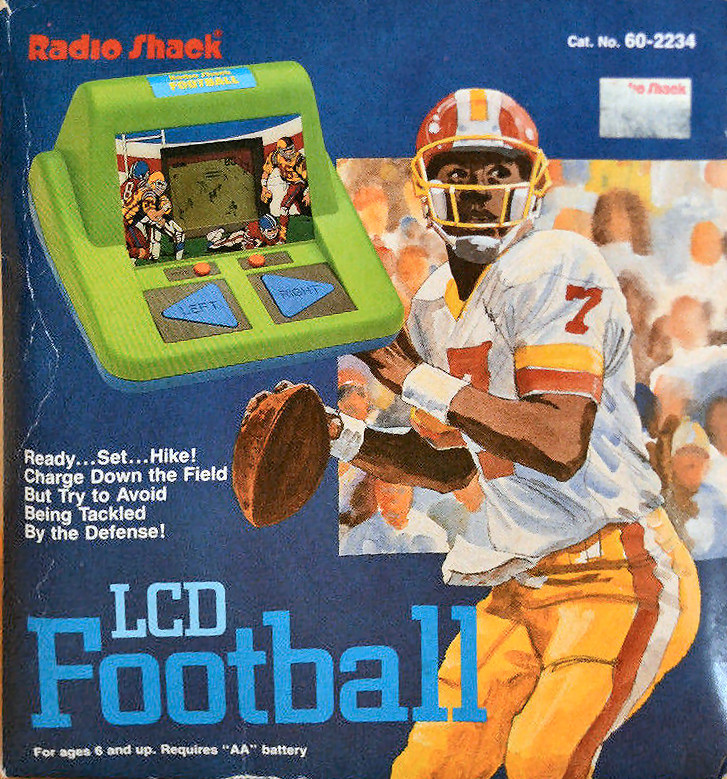 Above and beyond all that were the games, the toys, the amusements. The Armatrons and Cosmic Fire Away 1000s. Pocket Blackjack, electronic chess, Pocket Repeat, RC cars, tiny kid DJ stations, microphone FM transmitters, electronic coin banks, joysticks, talking alarm clocks (Dare I add the Tandy 1000 series and the TRS-80 Color Computer). The list is endless, I tell you.
In honor of the foundering electronics retailer, I pulled together a slightly massive collection of Radio Shack toy and game box art from the late 1960s up to the early 2000s. For good measure, I threw in a handful of non-toy product boxes as well (such as one for a Zack Morris-sized cell phone and a pocket TV set).
As you look through them below, I have but one question to ask:
How many of these have you owned or played?
[ Continue reading The Glorious, Colorful World of Radio Shack Toy and Game Box Art » ]
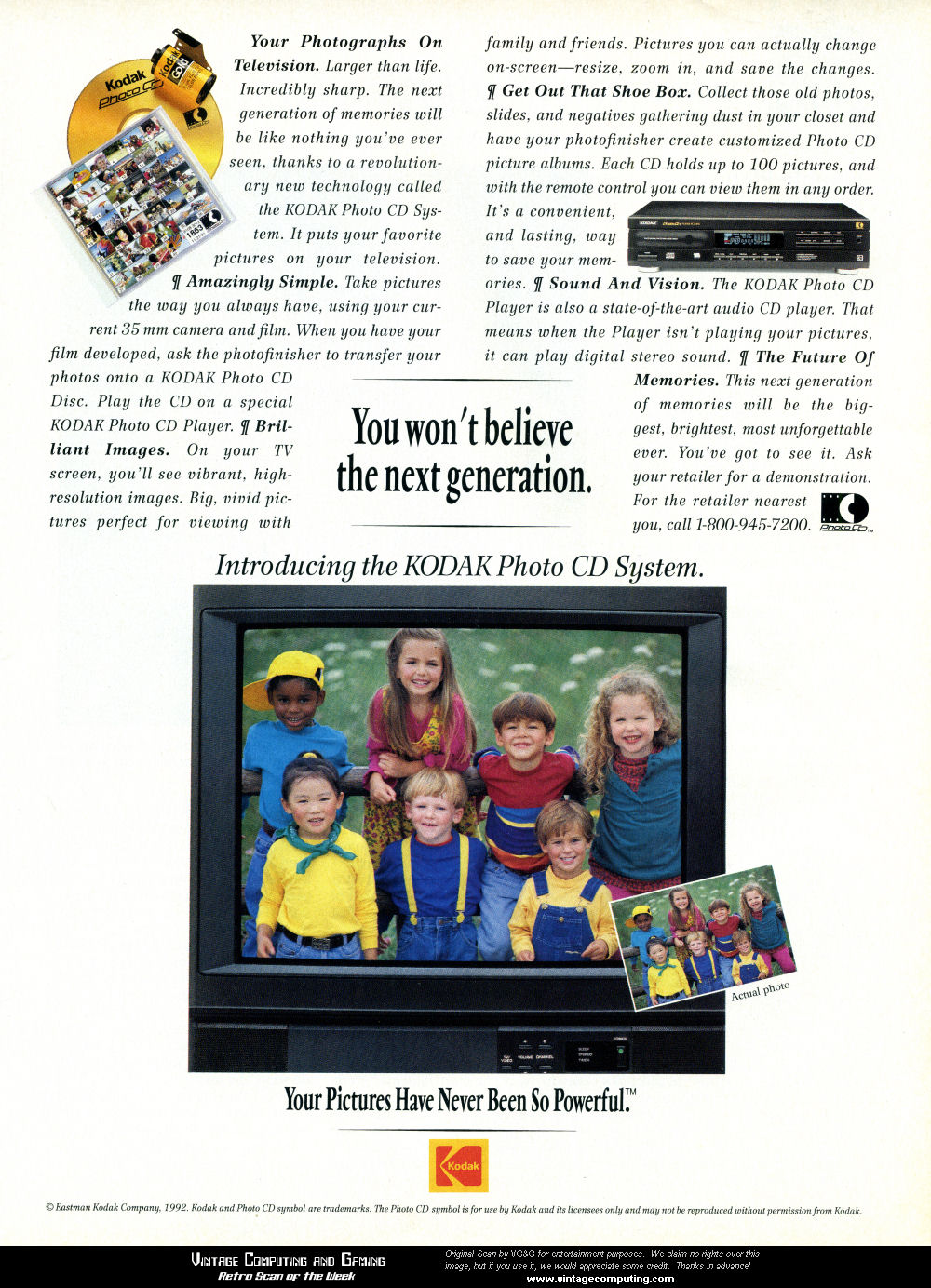 Because the best place to look at photos has always been your TV set
In September 1990, Kodak announced a brand new system for storing and viewing photographs: Photo CD. At a time when Compact Discs represented the vanguard of consumer electronics technology, Kodak capitalized on the excitement by blending digitized photos with a custom CD format.
Kodak designed that format for viewing through special a Kodak CD Player device (think DVD player for still photos) that hooked to a standard TV set. Using such a player, one could view the digitized photos via a virtual slideshow.
It would not be until August 1992 until Kodak finally launched the system, releasing its first Photo CD player and beginning production of Photo CD discs for customers.
With a base image resolution of 512 x 768, Photo CD was far from an archival medium. It tried to offer convenience, but instead ended up adding needless cost and encumbrance to the photo viewing process. In an era before most people were equipped to view, edit, or print digital photos from a PC, the fact that the photos came in an electronic format did not add anything notable to the experience. Predictably, adoption of the Photo CD system never gained much steam. (Wikipedia’s article on Photo CD has some pretty good additional analysis of why Photo CD never took off.)
I personally remember encountering a Kodak Photo CD player in either a photography store or a Radio Shack as a kid. I thought it was amazing — your own photos on a TV set! But my dad, an experienced photographer, never bought into the system.
P.S. For more CD history, check out my Compact Disc 30th Anniversary article that I wrote back in 2012.
Discussion Topic of the Week: Did you ever use the Kodak Photo CD service or own a Photo CD player?
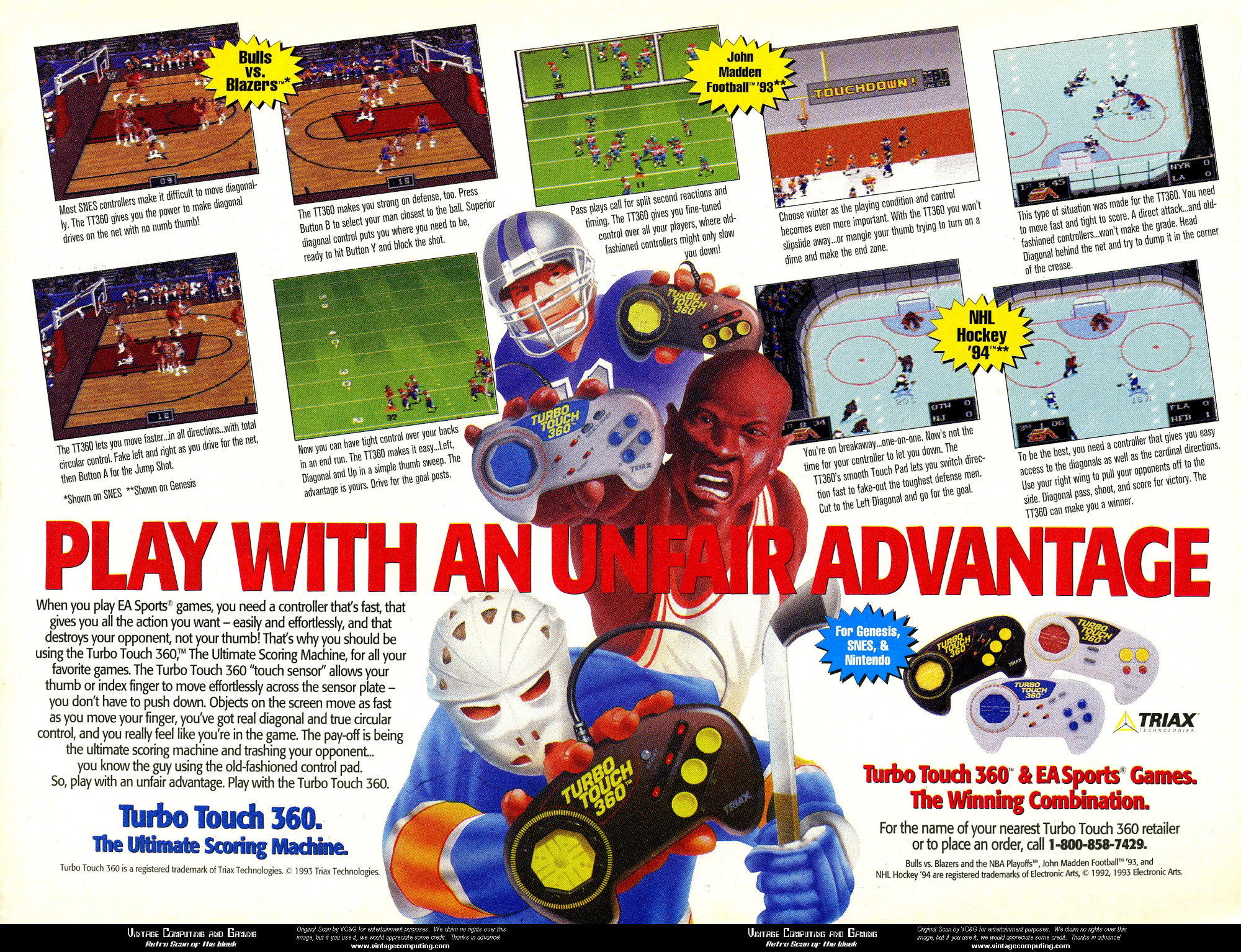 Man, that basketball player is pissed.
The Super NES / Genesis era coincided with a second golden age of third-party video game controllers and peripherals (the first golden age being the Atari 2600 era). If you browse through the Retro Scan archives, I’m sure you’ll see quite a few.
One of the stand-out gimmicks of this era arrived courtesy of Triax Technologies: the Turbo Touch 360. Representing a series of controllers for various platforms (SNES, Genesis, and NES with IBM planned, but I’m uncertain if it launched), the Turbo Touch line relied on a touch-sensitive pad in lieu of a traditional D-pad.
Using the touch pad, you didn’t have to physically push down on the D-pad to register movements; instead, you lightly slid your finger over the cross-shaped touch pad, sort of like a laptop touch pad. Ideally, this should result in quicker movements, but it could also result in more errors.
There was another supposed benefit to the touch pad technology as well. This 1993 Chicago Tribune article positions the Turbo Touch as a cure for game-induced thumb blisters (at the suggestion of Triax’s marketing staff, as the article suggests).
I’ve heard a lot about people getting thumb blisters over the years while playing video games, but I’ve never actually seen it happen. That’s because I’ve only heard about it through game peripheral advertisements. Such blisters are plausible, of course, but you’d have to push down on the D-pad very hard and rub it around over a long period of time. Maybe my thumb skin is just tough or something, but it’s never been a problem for me.
(Full disclosure: I did get a blister in the middle palm of my hand by rapidly rotating a Suncom Slik Stick over and over for about an hour while playing Decathlon for the Atari 2600 in the early 1990s)
I’m not saying that no one ever got a thumb blister from playing a video game, of course (do a Google search) — just that it wasn’t the epidemic that companies like Triax have led us to believe.
Call me skeptical, but I wouldn’t be surprised if the the video game thumb blister meme originated as a marketing angle in an era that aimed to be loud, raw, and edgy (think “Play it Loud“, Sega scream, etc.). What could be edgier than actually getting physically injured while playing video games? That’s intense!
I actually own a Turbo Touch 360 pad for the Genesis that I never got around to trying for some reason (I bought it at a thrift store when my Genesis was packed away). Right now I have no idea where it is. Perhaps I should dig it out and put the promise of touch-fueled gameplay to the test.
Discussion Topic of the Week: Have you ever gotten a blister from playing video games? Tell us how it happened.