VC&G Interview: Robert Tinney, BYTE Cover Artist and Microcomputer Illustration Pioneer
Tuesday, September 26th, 2006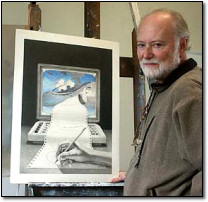 If someone wrote a book on the history of personal computer art, chapter one could only bear the name of one man: Robert Tinney. As cover artist for over eighty issues of BYTE magazine — microcomputing’s first and finest major publication — and as one of the first men to illustrate topics related to the fledgling field of personal computers, he near single-handedly shaped the popular visual idiom of what computers were, could be, and would be for the for a whole generation of microcomputer enthusiasts.
That proud generation has long since grown up and moved on to a myriad of different fields and disciplines, spreading its knowledge, love, and expertise of all things technological around the world. Collectively, they have arguably become the world’s most influential, yet sometimes underrated, segment of the modern populace. So imagine if you could go back in time and visit that same generation in 1978. What would you see? A lot more pimples, no doubt, and a lot more hair. And most likely, you’d find a copy of BYTE in their hands — with a Robert Tinney illustration on the cover.
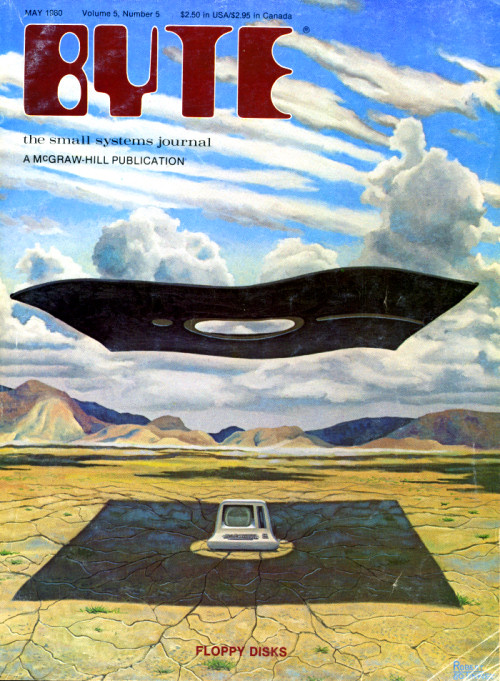 Tinney’s BYTE artwork is amazing. It displays unparallelled creativity in the use of visual metaphors to convey typically intangible, abstract, and sometimes abstruse technical concepts. His illustrations penetrate all pretense and cut straight to the heart of the main idea of the topic at hand, laying it out in an appropriately minimalistic fashion that, while sometimes visually spartan, richly sparks the imagination and places the viewer firmly in the scene. His work communicates, and it does so in ways that words never could. For most commercial artists, the idea of illustrating for a completely new field without artistic precedent would probably be daunting, if not completely nervewracking — and who’s to say it wasn’t for Tinney — but despite that immense challenge, he pulled off the assignment not only handily, but with the kind of proficency and mastery that made the genre, in this writer’s humble opinion, firmly his own.
It was with all these superlatives in mind (and a stack of 1987 BYTEs as my bedside reading material) that I recently requested an email interview with Robert Tinney. I am delighted to say that he accepted the offer, and you can read the result below.
 Ah…it’s Friday again; time to have some fun. In our inaugural match of the recently formed (some 5-10 minutes ago) VC&G Wrestling League (or VWL, if you will), we’re pitting two of personal computing’s most auspicious luminaries against each other in a no-holds-barred “battle of the grizzled.” Who will come out on top? Let’s take a look at our contenders: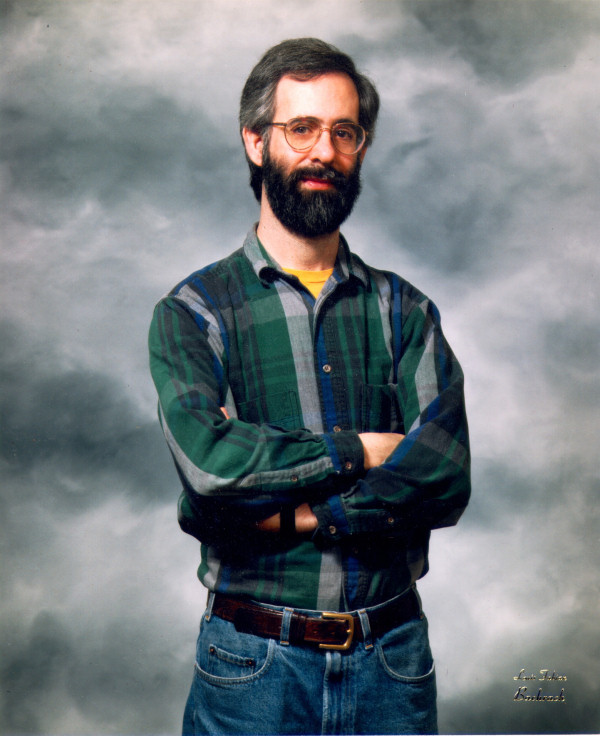

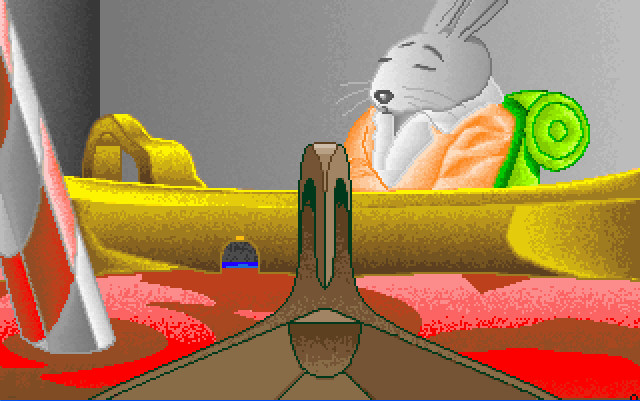
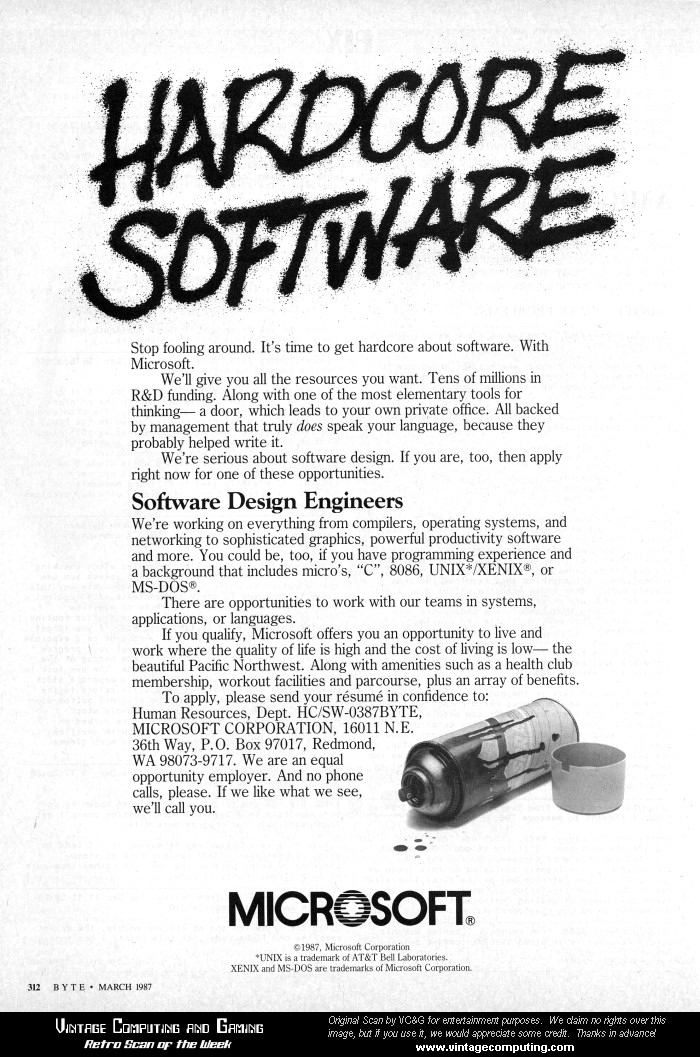
 But seriously — once you sign up to work at Microsoft, they’re so hardcore that, on your first day on the job, they lock you stark naked in a ten-foot-square, windowless, blank white room with two cans of spray paint. Your next move will determine your position in the company. This Kobayashi Maru-like “no-win scenario” originates from an incident in 1981 when Microsoft co-founder Paul Allen was painting their new office space over the weekend and somehow locked himself inside a closet. Thinking quickly, he fashioned a makeshift air horn out of a spray paint can and some cardboard. Of course, no one ever heard him, and that’s probably why we’ve not seen Paul Allen since.
 What was the first computer you ever used? Was it a mainframe? A hobby kit? An early consumer PC? An IBM clone? I’ve heard numerous neat stories of people’s first experiences with computers since starting Vintage Computing and Gaming, but here’s your turn to share one of your own. Tell us about your “first time” with a computer. What kind of computer was it? Where were you when it happened? Was it the first computer you ever owned? Post a comment telling your story, and let us know. I’d love to read them.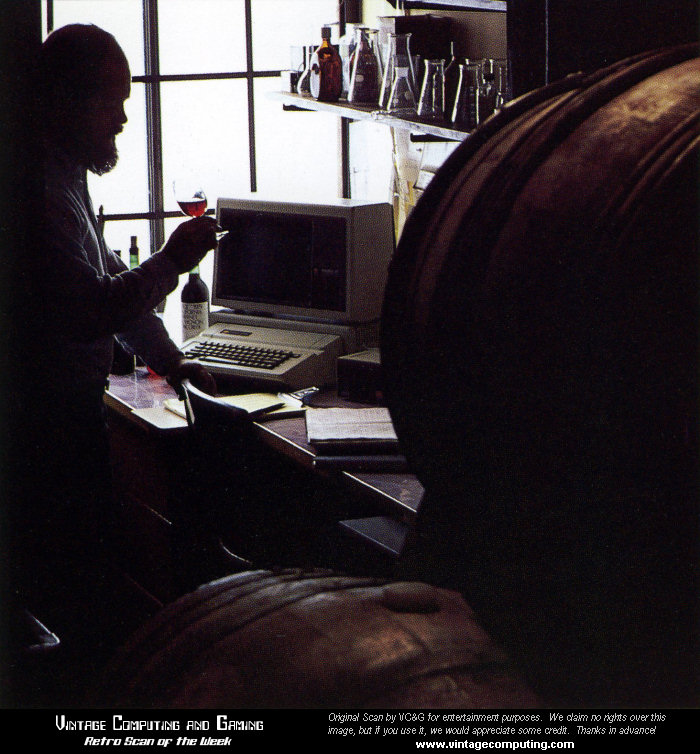
 [ In this article, I’m testing a new image preview method. You can see a larger version of most images by hovering your mouse cursor over an image. Please let me know if you encounter any problems with this. — The Editor ]