Author Archive

[ Retro Scan of the Week ] African American Apple Fans

Monday, February 4th, 2013
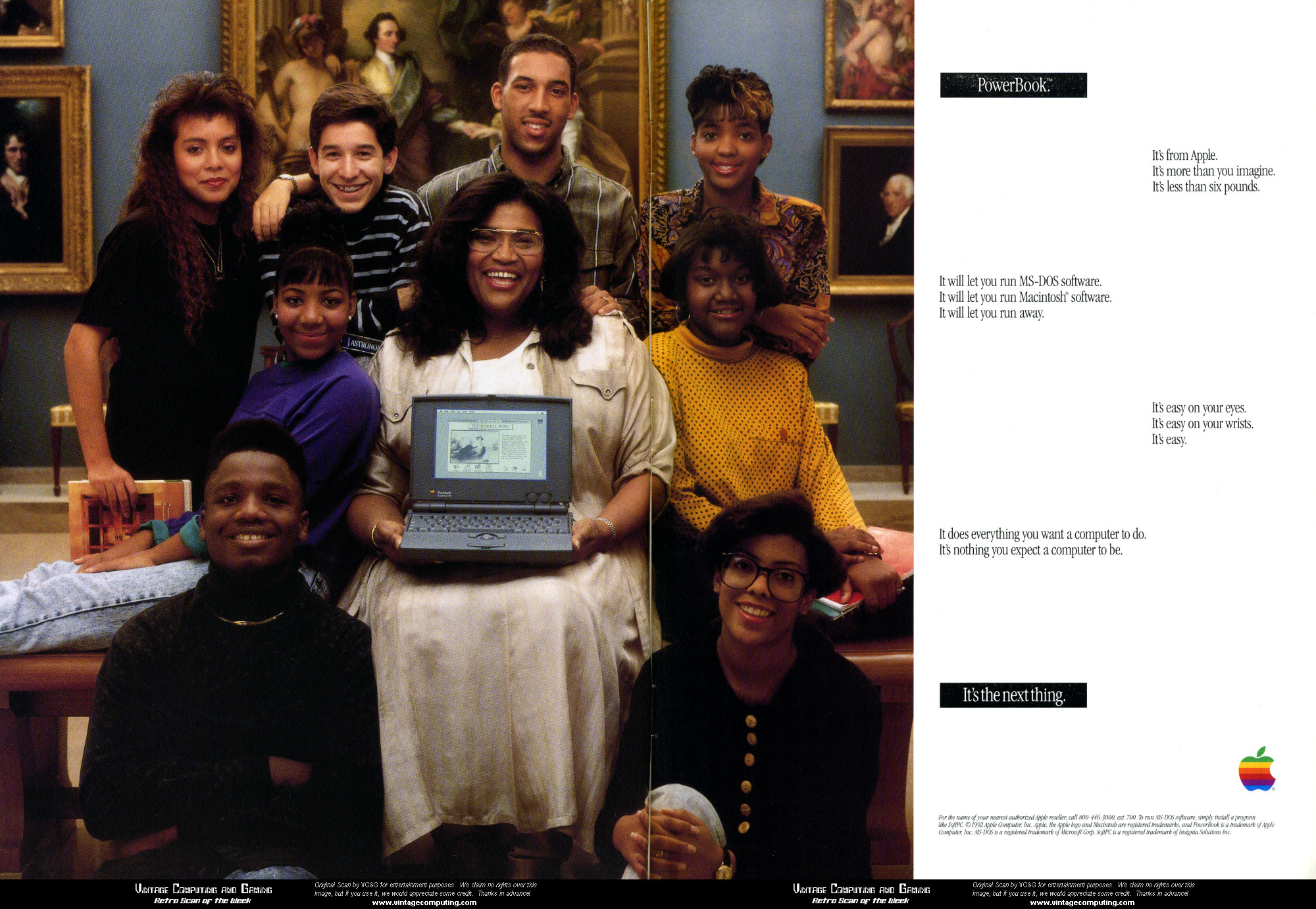
Multiracial Black African American Apple Fans Apple PowerBook Advertisement 1992One big happy family — and a PowerBook (click to see entire ad)

It’s Black History Month once again in the US, so I thought it would be timely to share this Apple PowerBook advertisement from 1992.

The ad appeared in the February issue of Smithsonian Magazine; I don’t think it is a coincidence that it prominently featured people of African descent. It also prominently featured the PowerBook 100, which had just been introduced a few months prior in October 1991.

The obvious racial focus of this ad brings to my mind a couple of interesting, if racially-charged questions: What percentage of black Americans, historically, have used Apple products versus other computer brands? Do African Americans, like other demographic groups, have their computer or tech brands of choice?

Today, Apple is such a mainstream company that the answer to the first question is most certainly larger than it likely was in the pre-iPod era. It would be interesting from a cultural standpoint to peek back into private demographic customer studies that Apple no doubt commissioned at various points in its history.

As for an answer to the second question, I have no idea. But I would love to hear from African American computer users to find out.

[ From Smithsonian Magazine, February 1992, p.10-11 ]

Discussion Topic of the Week: What’s your favorite PowerBook model?

[ Retro GIF of the Week ] Twin Chinese Dragons

Friday, February 1st, 2013

Apple I Smithsonian 1992 Retro GIFClick to see other views of this image: [ Original Size ] [ 2X Zoom ]

This week we’re taking a look at another image that made the rounds in the BBS days, DRAGON6.GIF. In it, we see two digitally illustrated Chinese dragons who appear to be springing forth from a magical stone. Iridescent waves crash around them, and smoke curls throughout an ethereal void. The color palette is rich and bold, underscoring the image’s Eastern art influence.

At the moment, the artist behind this amazing work of digital art remains unknown. Still, we can narrow down when the image was made and how by taking a look at its resolution, color depth, and file date.

[ Continue reading [ Retro GIF of the Week ] Twin Chinese Dragons » ]

Virtual Console Makes Nintendo Look Incompetent

Tuesday, January 29th, 2013

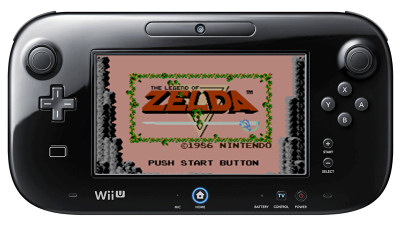
Wii U Virual Console

In light of the news that Virtual Console games on the Wii U won’t be able to use save files from the Wii’s Virtual Console, I would like to point something out.

Just today, I found a NES save file for The Legend of Zelda dated May 28th, 1998 (created by legendary NES emulator Nesticle) and continued that saved game in Nestopia in the year 2013.

I did it to spite Nintendo, because this is ridiculous.

That emulator save file originated on a PC I owned 15 years ago, and it resided on a long-since-decommissioned hard drive. Now it’s saved to a SSD in a computer a bajillion times more powerful, with a different emulator, and it still works.

[ Continue reading Virtual Console Makes Nintendo Look Incompetent » ]

[ Retro Scan of the Week ] Final Fantasy Tactics is 15

Monday, January 28th, 2013

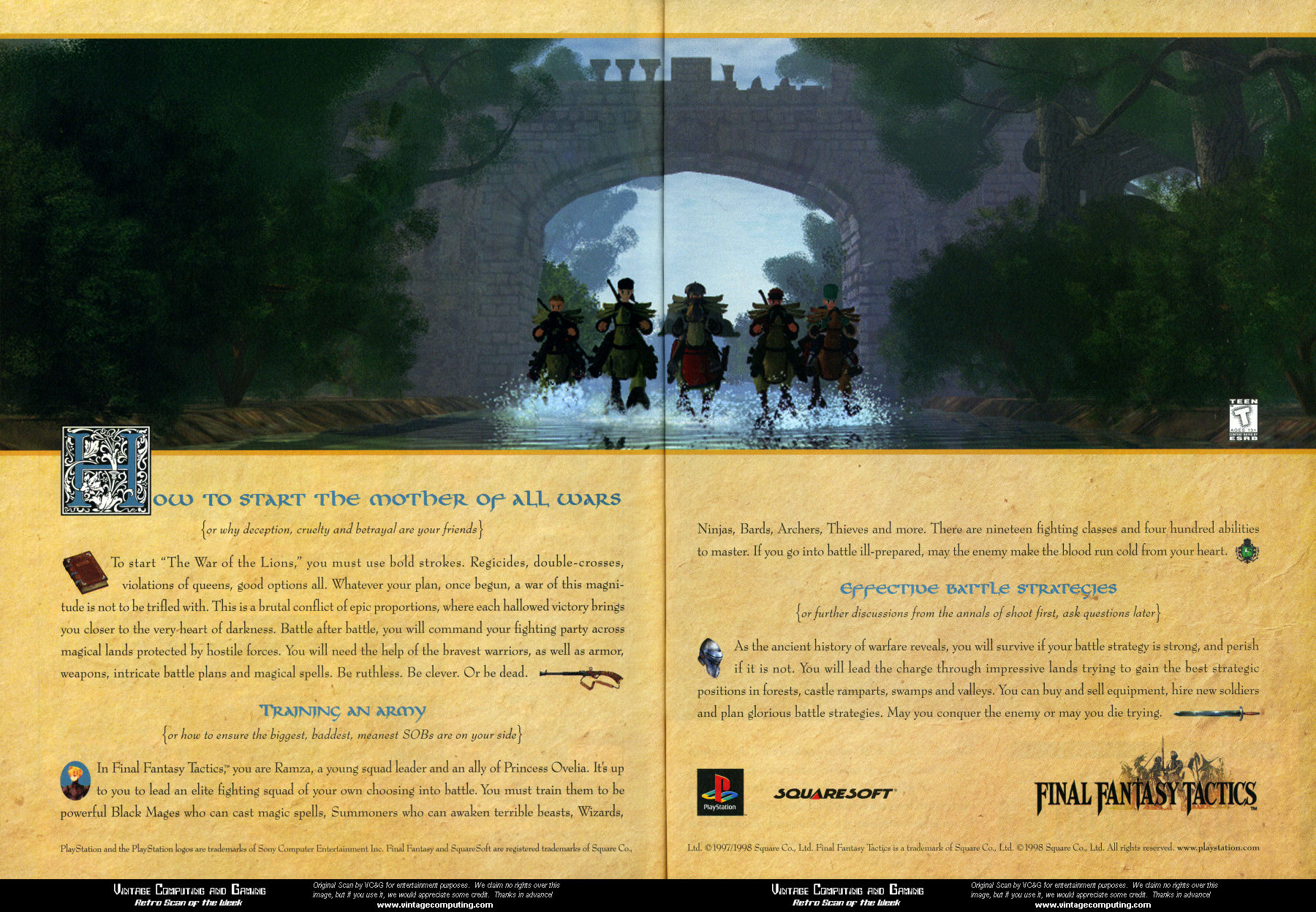
Final Fantasy Tactics Playstation PS1 PSX Magazine advertisement GamePro May 1998“How to Start the Mother of All Wars”

Fifteen years ago today, Square released Final Fantasy Tactics in North America for the Sony PlayStation. (It’s kinda crazy, because I was going to use this scan today anyway, just by chance.)

I remember being excited when this game came out. I’m sure I read a glowing review of it in EGM and recommended it to my brother, who promptly bought it and played it on and off for the next two years. I still have Final Fantasy Tactics’ music stuck in my head just from hearing him play the game so much.

The game is a strategic masterpiece, and though I have not played it to completion myself, I appreciate its depth, its music, and I absolutely love its sprite-based graphics and spell effects. The sprite-based nature of FFT alone was something to cheer at a time when most new PSX games were plagued with choppy, low-res polygonal 3D graphics.

[ From GamePro, May 1998, p.70-71 ]

Discussion Topic of the Week: In your words, what’s so great about Final Fantasy Tactics?

[ Retro GIF of the Week ] Cheryl Tiegs: Queen of the GIF

Friday, January 25th, 2013

Apple I Smithsonian 1992 Retro GIFClick to see other views of this image: [ Original Size ] [ 2X Zoom ] [ 4:3 Ratio ]

I’ve always thought of VC&G as sort of a family friendly blog, so I don’t plan on delving into adult GIFs any time soon. But we might as well talk about bikini photos, because they were some of the most heavily traded GIF images in the BBS days. They provided culturally acceptable PG- or PG-13-level titillation, and male teenagers (arguably the primary users of BBS systems in many areas) flocked to them.

Just recently, I searched my GIF archives for the oldest GIF format bikini photo I could find. I came up with this image of Cheryl Tiegs in a file dated October 29th, 1987, which is only four months after the June 15, 1987 publication date of the first GIF specification (GIF87a, for those keeping track).

The image itself is derived from a photo taken by Walter Iooss Jr. for the 1978 Sports Illustrated Swimsuit Issue. The sharpness of the image suggests to me that it was scanned (vs. video captured), either with a flatbed or handheld color scanner, and likely from that issue itself.

I don’t know who scanned it. It could have been Jim Maxey, who originated many GIF files in the format’s early days, but since the image isn’t tagged with his BBS information, I doubt it. Maxey also tended to work with video capture boards verses scanners at that time.

Regardless of who created this image, it’s a nice, relatively tame example of 16-color EGA bikini art. Upon viewing it, you can almost feel its 1970s girl-next-door wholesomeness flowing out of your computer screen. And that’s despite her see-through fishnet bathing suit, which was scandalous in 1978.

(Note that Tiegs’ name is misspelled in the file name as “TEIGS”)

[ Wondering what a GIF is? Read the introduction to this column. ]

Retro GIF of the Week Fact Box
Source File Name: TEIGS.GIF
Source File Date: October 29, 1987
Source File Format: GIF – 87a (non-interlaced)
Dimensions: 640 x 350 pixels (EGA)
Color Depth: 4-bit (16 color)
Origin Platform: IBM PC
Derived From: Scanned photograph taken by Walter Iooss Jr.
Creation Date: 1987
Artist: Unknown
If you know more about the origin of this image, please leave a comment.

The World’s Earliest Known Figurative Computer Art

Friday, January 25th, 2013

SAGE Pin-Up First Computer Art First Computer Porn

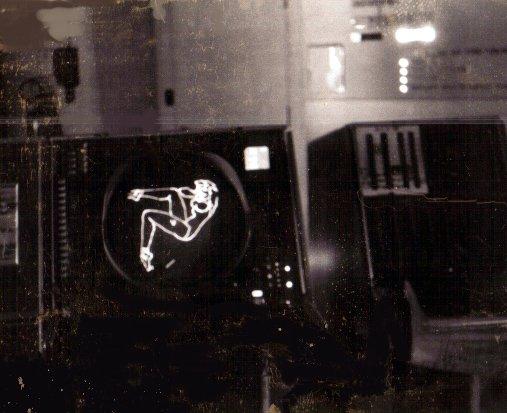
Thirty-five thousand years ago, when massive beasts still roamed the earth, an early modern human carved the figure of a sexually robust woman into a piece of woolly mammoth tusk, creating the earliest known figurative artwork. During a time of almost certain hardship and scarcity, when acquiring that tusk involved slaying an animal 100 times one’s weight, the artist devoted countless hours to create a sculpture that idolized nothing less than sex itself.

35 millennia later, during a time when computing power was so scarce that it required a government defense budget to finance it, a late modern human utilized a $238 million military computer, the largest such machine ever built, to render an image of a sexually robust woman on a glowing cathode ray tube screen. The year was 1956, and its creation was a landmark moment in computer graphics and cultural history that has gone unnoticed until now.

You can read the full story I wrote about this landmark piece of digital art over at The Atlantic. I’d like to personally thank Lawrence Tipton, Robert Martina, and all of the SAGE veterans who helped me research this piece.

More Macworld Mania

Friday, January 25th, 2013

Macworld Logo

Since my last update on the articles I’ve written for Macworld in November, I’ve written at least a handful more vintage-related stories for the publication that I haven’t mentioned on this blog. To remedy that, I thought I’d share them below in convenient digest form.

The Mac Plus Clock piece is particularly fun, and I think VC&G fans will really enjoy it.

[ Retro Scan of the Week ] Apple Lisa and Apple IIe

Monday, January 21st, 2013

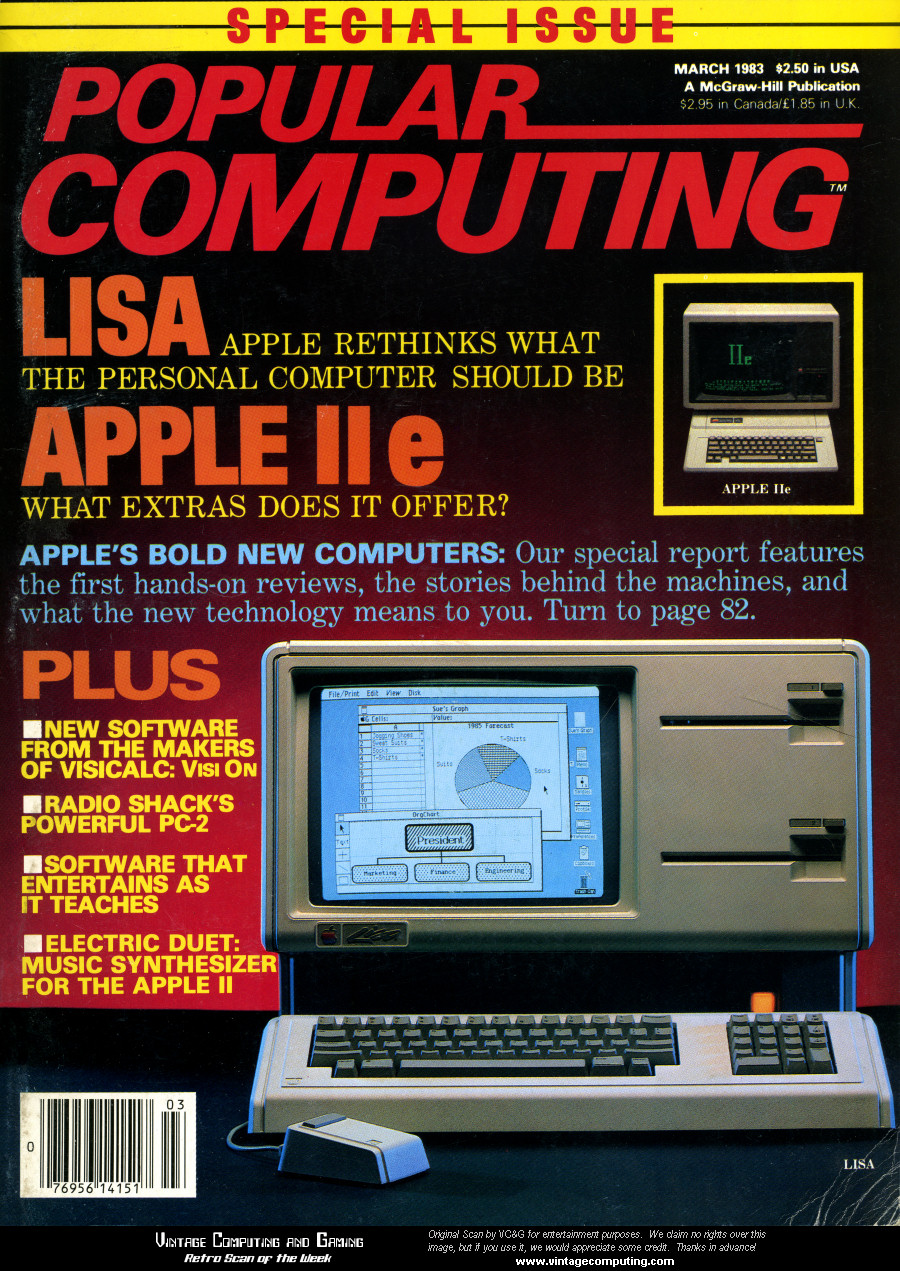
Apple Lisa and Apple IIe on the cover of Popular Computing - March 1983APPLE’S BOLD NEW COMPUTERS IN ALL-CAPS

Thirty years ago last Saturday (January 19th, 1983), Apple announced two new computers: the Apple Lisa and the Apple IIe.

Ultimately, the Apple Lisa met an early end, leaving behind technology that shaped the entire industry. The Apple IIe remained a reliable breadwinner during uncertain times in the early life of the Macintosh and remained the flagship member of Apple’s popular 8-bit computer line until it ended in 1993.

Here’s the cover of the March 1983 issue of Popular Computing which featured Apple’s two new machines. It has always been one of my favorite vintage computer magazine covers.

By the way, I recently wrote an article about this anniversary for Macworld in case you’re interested.

[ From Popular Computing, March 1983, cover ]

Discussion Topic of the Week: Have you ever used an Apple Lisa? What did you think about it?

[ Retro GIF of the Week ] The Smithsonian’s Apple I

Friday, January 18th, 2013

Apple I Smithsonian 1992 Retro GIFClick to see other views of this image: [ Original Size ] [ 2X Zoom ]

You’re looking at a photograph of an Apple I computer that currently resides in the collection of the Smithsonian Institute in Washington, D.C. It was on display at one point, but I believe it is not being displayed at the moment (feel free to correct me on that).

I downloaded this 256-color GIF image from CompuServe back in 1994 (judging by the file date). I think it came from the Archive Photos forum, but I am not 100% sure about that. Either way, it’s a nice photo, and if you see it floating around the Internet, it’s likely because I first posted it on VC&G in 2006.

As you may know the Apple I (which was officially titled “Apple Computer 1” on the circuit board and “Apple-1” in its manual) did not ship with a case. The wooden enclosure you see here was created by early Apple employee Randy Wigginton’s father. It’s interesting how it presages the design of the Apple II enclosure to some extent.

[ Wondering what a GIF is? Read the introduction to this column. ]

Retro GIF of the Week Fact Box
Source File Name: APPLEI.GIF
Source File Date: August 20, 1994
Source File Format: GIF – 89a (non-interlaced)
Dimensions: 640 x 480 pixels
Color Depth
(bits per pixel):
8-bit (256 color)
Origin Platform: Unknown
Derived From: Scanned photograph
Creation Date: 1992
Artist: Smithsonian Institute
If you know more about the origin of this image, please leave a comment.

[ Retro Scan of the Week ] MacCharlie’s FrankenMac

Monday, January 14th, 2013

Dayna Communications MacCharlie IBM PC accessory for Macintosh ad - 1985I’d like to have heard Steve Jobs’ reaction when he first saw this.

Long before Boot Camp and Parallels, if you wanted to run IBM PC compatible software on your Mac, you had to strap on this unholy contraption — the Dayna Communications MacCharlie.

If I recall correctly, the MacCharlie was essentially an IBM PC clone in a beige box that hooked to the Mac’s serial port. As a result, the Mac merely served as a serial terminal for the MacCharlie via custom terminal software running on the Mac. That’s not a particularly efficient setup, but the lack of expansion ports on the original Macintosh meant that there was no other reasonable point of entry.

Since it worked through the serial port, the MacCharlie could only run text-based MS-DOS applications. Conveniently, the MacCharlie shipped with a keyboard extender that added the IBM PC’s special function keys and a numeric keypad to the Macintosh keyboard.

[ From Byte Magazine, April 1985, p.71-73 ]

Discussion Topic of the Week: Have you ever used a hardware system adapter (something that lets you use software from one platform on another through hardware, not software emulation) for any computer system?