[ Retro Scan of the Week ] Crystalis
Monday, May 4th, 2009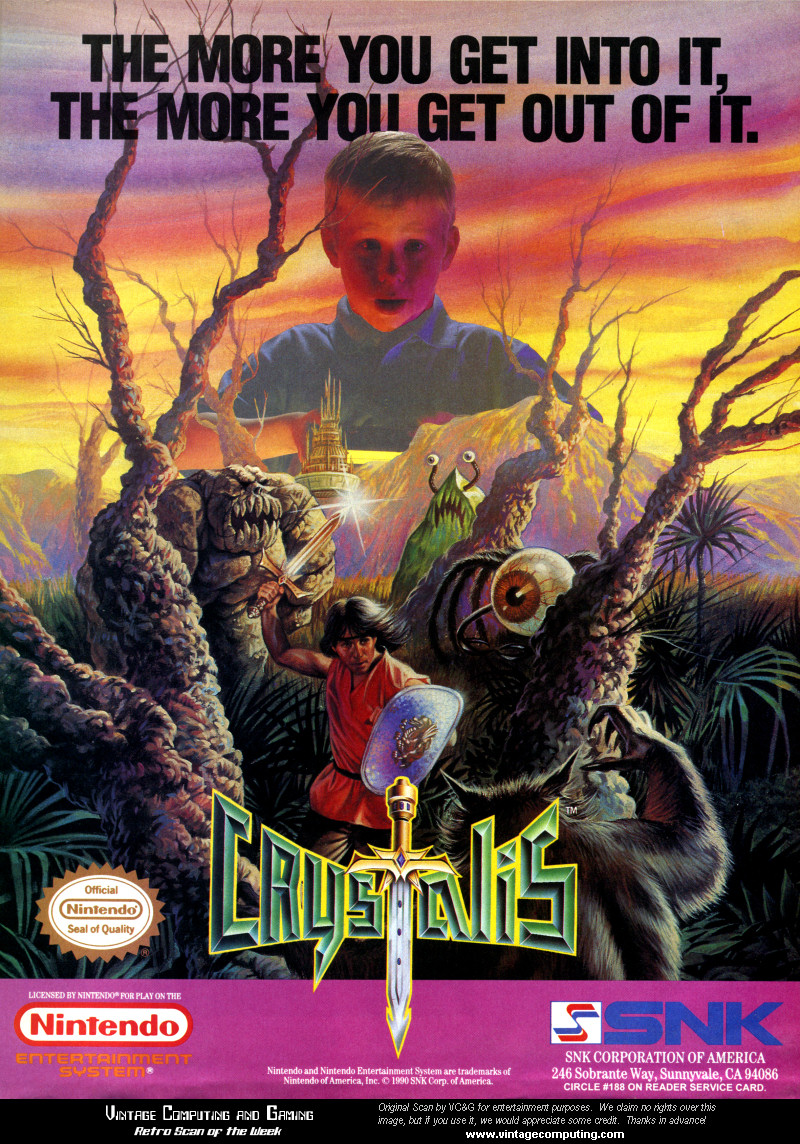 That kid is one heck of an evil overlord.
Discussion topic of the week: In your opinion, what’s the best Zelda clone out there?
That kid is one heck of an evil overlord.
Discussion topic of the week: In your opinion, what’s the best Zelda clone out there?
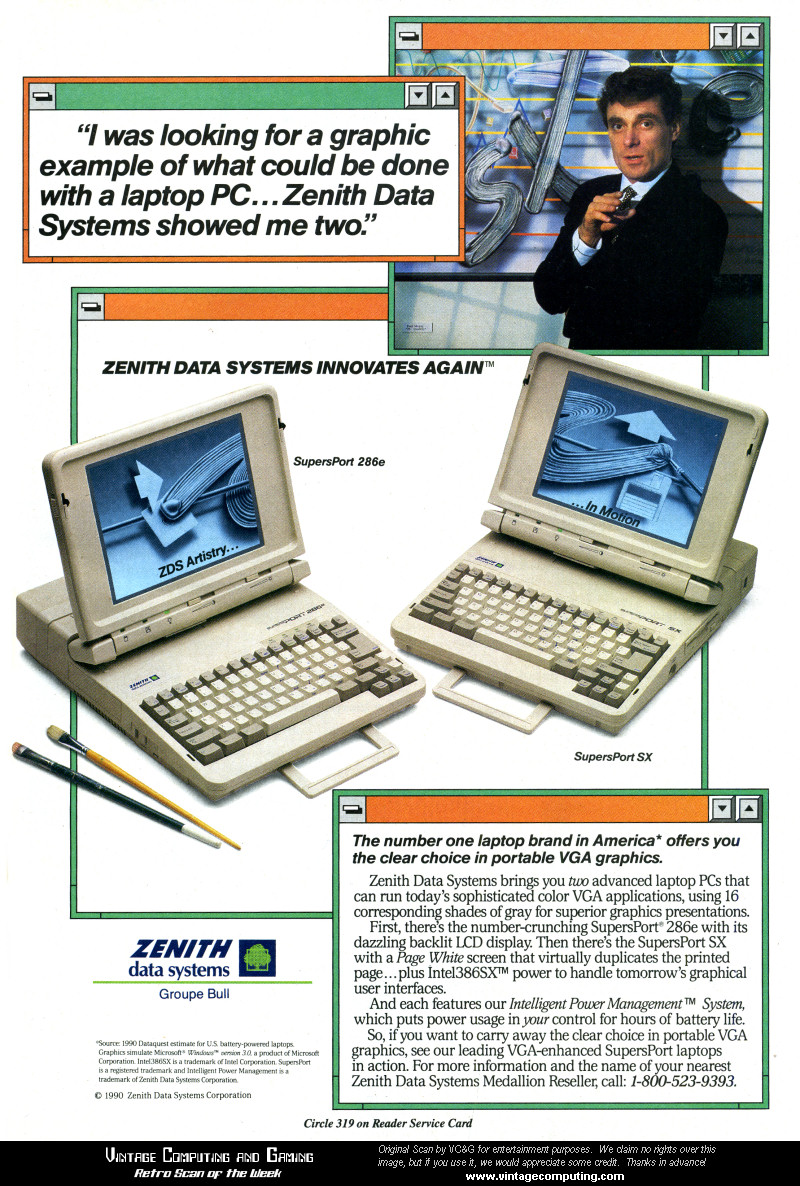 “Zenith Data Systems Innovates Again”
I’ve used my fair share of hefty laptops like the Zenith Supersport SX and 286e seen above. Their relatively large size by modern standards made them no less miraculous for their time.
Even in 1990, we’d come a long way from foot-breaking luggables like the Osborne 1, the Kaypro II, and the Compaq Portable. Gone were the bulky CRT displays; in their place sat thin LCD panels that would vastly expand in capability over the next 19 years. The LCDs in most early laptops started off monochrome with no backlighting, low contrast, poor viewing angles, and slow refresh rates, but that was worth suffering through if it meant you could have a full-powered PC on the go.
Interestingly enough, computers like those seen above — even with their display limitations — are not completely obsolete: I still use old monochrome laptops for writing outside because you can easily see the displays in full sunlight. If you try that with most modern laptops, you’ll see nothing but a dark blur.
Discussion topic of the week: What’s the largest portable computer you’ve ever used?
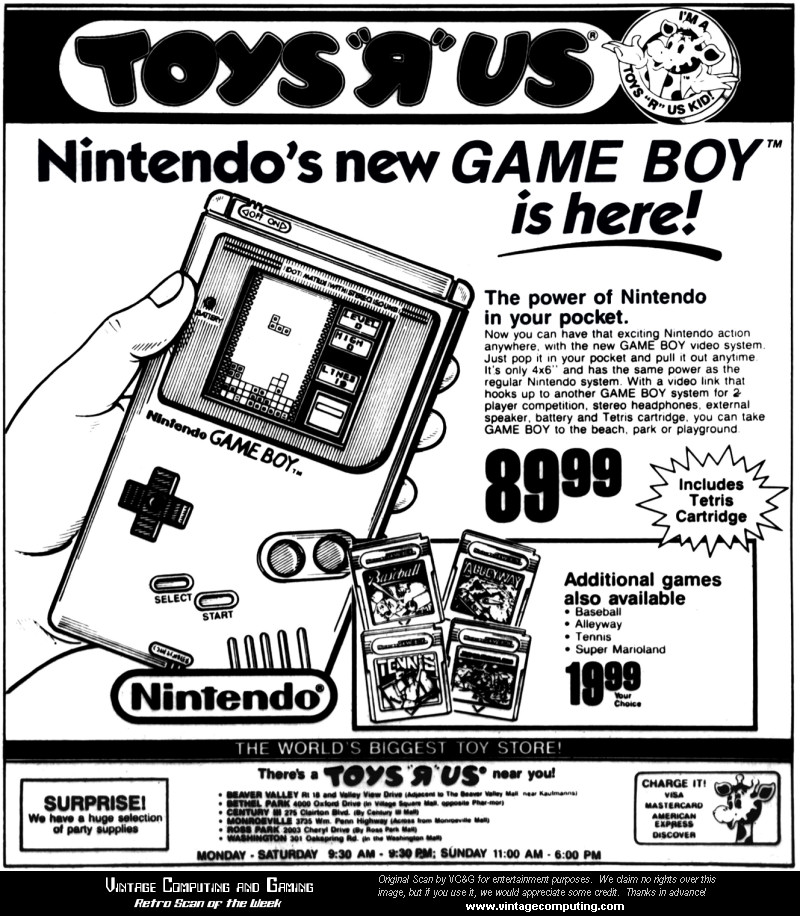 “Just pop it in your pocket and pull it out any time.”
Twenty years ago tomorrow, the Game Boy went on sale for the first time in Japan. It retailed for Â¥12,500 (about $94 US at 1989 rates), and Nintendo offered four games at Game Boy’s initial launch: Super Mario Land, Baseball, Alleyway, and Yakuman (a Mahjong game). Four months later, Game Boy reached American shores with a retail price of $89.99 and a powerful pack-in game — Tetris.
Nintendo’s inclusion of Tetris as the US pack-in was a stroke of absolute genius. The handheld version of Alexey Pajitnov’s addictive puzzler made such waves in US that its release will long be remembered not just as a defining moment in video game history, but as a major cultural event for an entire generation.
As we now know, Game Boy’s long and successful run created an immense legacy, far beyond just Tetris. Overall, publishers released 1246 licensed games for the Game Boy in Japan and 952 in the US. To date, Nintendo has sold 118.69 million units of the original Game Boy line (including Game Boy Color) worldwide.
Above, we see an original Toys ‘R’ Us newspaper advertisement announcing the arrival of the Game Boy and its launch games in the United States. (Gotta love that line art.) It really brings back memories of my excitement regarding Nintendo’s first handheld system.
In your opinion, what factors made the Game Boy so successful?
On the other hand, what mistakes, if any, did Nintendo make with the Game Boy over its twenty year run?

If you use this week’s image, please support “Retro Scan of the Week” by giving us obvious credit for the original scan. Thanks.
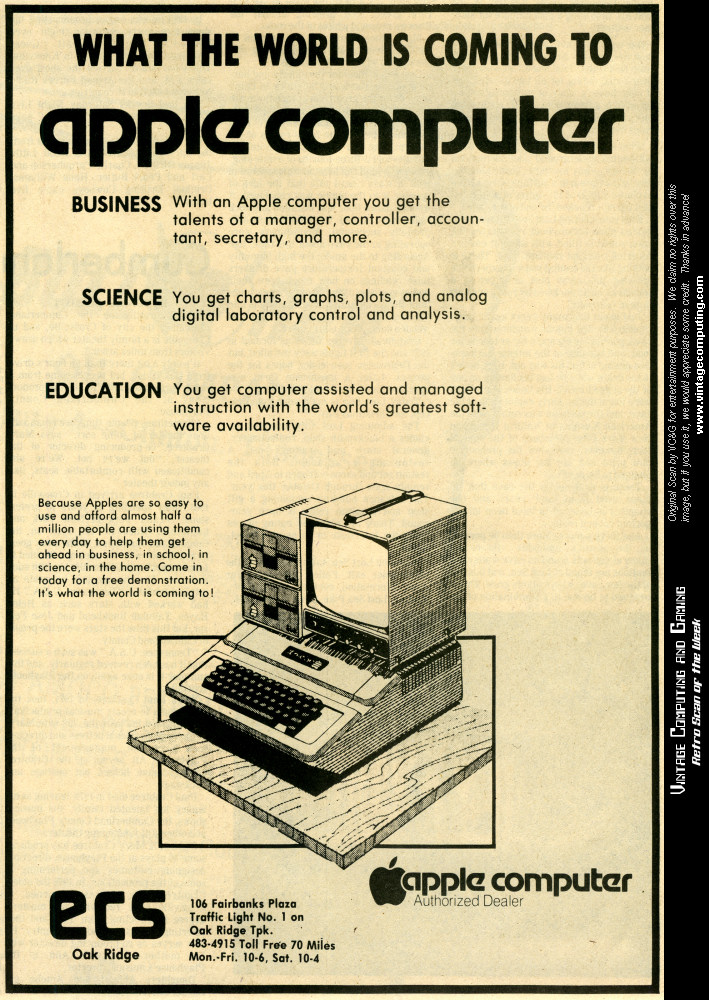 Computers? What is the world coming to?
Here’s another item from my grandmother’s cedar chest — I love these old newspaper line-art illustrations. ECS was Oak Ridge, Tennessee’s first retail computer store, if I recall correctly from an old article I read. They advertised quite a lot in the local newspaper, including the ad for the Apple II you see above.
The Apple II’s configuration with two Disk II drives and a small monitor on top is interesting. I believe I’ve seen Apple promotional photos from the early Apple II days with the same setup. The relatively tiny display seems somewhat silly from a modern perspective, but computer monitors were very expensive back then. A large one that would have covered the entire top of the Apple II would have cost $400 or more in 1980-ish dollars.
In fact, just perusing some ads in the back of a 1981 BYTE magazine, I don’t see any monitors offered larger than a 13″ color Zenith for $399.95 ($933 in 2009 dollars). 9-inch to 12-inch monochrome monitors cost anywhere from $150 to $260, which is equivalent to $350 to $606 in 2009 dollars. You get the point — even entry-level displays back then cost an arm and a leg. Even if you paid two arms and two legs, the monitors were still relatively small.
Discussion topic of the week: Tell us about your first Apple II experience. Where and when was it, and why were you using it?
If you use this image on your site, please support “Retro Scan of the Week” by giving us obvious credit for the original scan and entry. Thanks.
 A classic case of fist-cheek syndrome.
Now here’s something you don’t see every day: a print ad for an Atari 7800 game. Moreover, a print ad for an Atari 7800 game in 1990. Moreover, a print ad for an original Atari 7800 game in 1990.
An advertisement like this seems odd because Atari’s marketing budget for the underwhelming 7800 was very modest. My guess is that the release of the Atari Lynx in the year prior injected renewed vigor into Atari’s marketing efforts. The same vigor likely prompted Atari to publish a handful of new 7800 titles around 1990-91, of which Alien Brigade was one. From what I’ve read, modern Atari fans enjoy this rare light gun game, but I’ve never played it.
Discussion topic of the week: Do you think that the Atari 7800 could have better taken on Nintendo if Atari had marketed it better? Also, feel free to share your favorite Atari 7800 games.
If you use this image on your site, please support “Retro Scan of the Week” by giving us obvious credit for the original scan and entry. Thanks.
[Editor’s Note: This was part of an April Fools gag. Ulaf is still not amused.]
 HELLO AGAIN VINTAGE SUPERFANS. RECENTLY, THE BENJ DECIDES TO HAND ULAF THE RAINS OF THESE BLOG POST. SO ULAF CONVERT SITE TO THE FAVORITES OF ALL THE WORLD’S KRELZ, GARDENSING. AND HENCE: VINTAGE COMPUTING AND GARDENSING.
TO STARTS US OFF, MY MIND WILL SHARE WITH YOU EASY THREE TIPS TO THE BETTER GARDENSING.
NUMBERS 1:
DO NOT EAT THE VEGTABLES BEFORE THE GROWING.
NUMBERS 2:
THE DIRT IS NOT FOR THE EATING, BUT FOR THE GROWING.
NUMBERS 3:
THE WORMS ARE FOR THE GROWING, AND THE EATING IF YOUR MIND LACK EXCELLENT NUTRIMENT.
THAT IS ALL FOR NOW. STAY TUNES FOR MORE GARDENSING TIPS AND TRICKSTERS FROM THE WHIRL OF ULAF.
FOR COMPUING AND GAMINGS TIPS, CONSULT HOW TO BEAT THE VIDEO GAMES, THE ULAF CLASSIC. SOON ULAF WRITES “HOW TO BEAT THE VEGETABLES” FOR YOUR MIND TO CONSUME. UNTIL NEXT TIME THIS IS ULAF SAYING BE THE MASTER.
ULAF FANS UNITE! READS ULAF ON THE TWEETER: @ulafsilchov
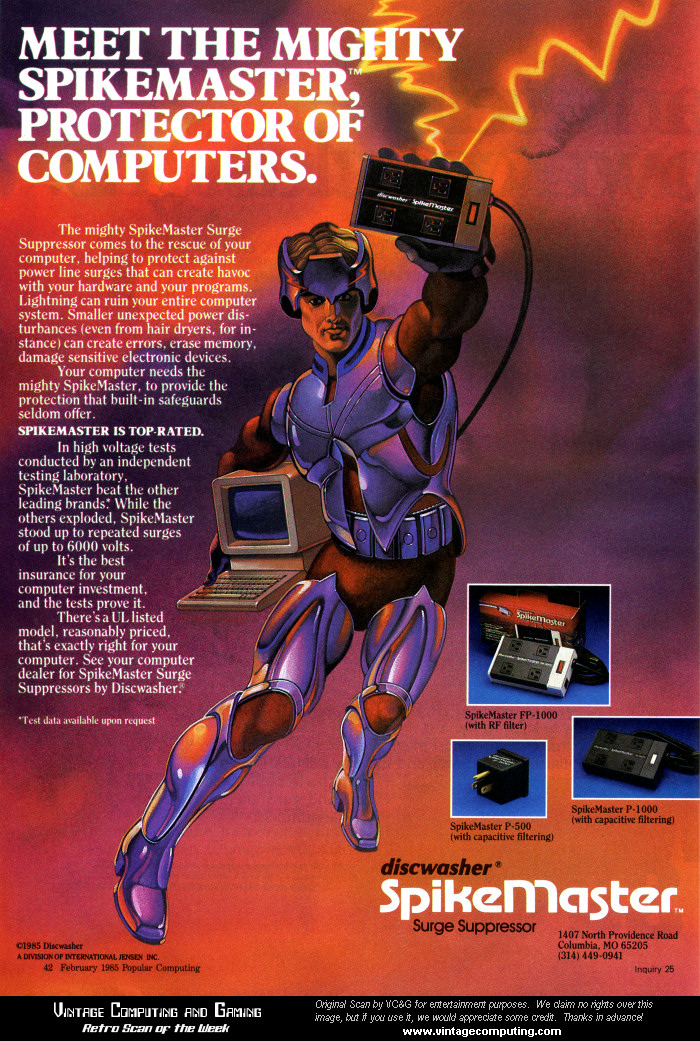 I smell a potential children’s cartoon franchise.
I don’t know what’s more ridiculous: the fact that the Spikemaster surge suppressor has a humanoid superhero mascot with powers of unknown capacity, or the fact that the company producing the suppressor is named “Discwasher.”
Either way, I know what I’m dressing up as this Halloween.
Discussion topic of the week: What do you think Spikemaster’s superhero powers should be?
If you use this image on your site, please support “Retro Scan of the Week” by giving us obvious credit for the original scan and entry. Thanks.
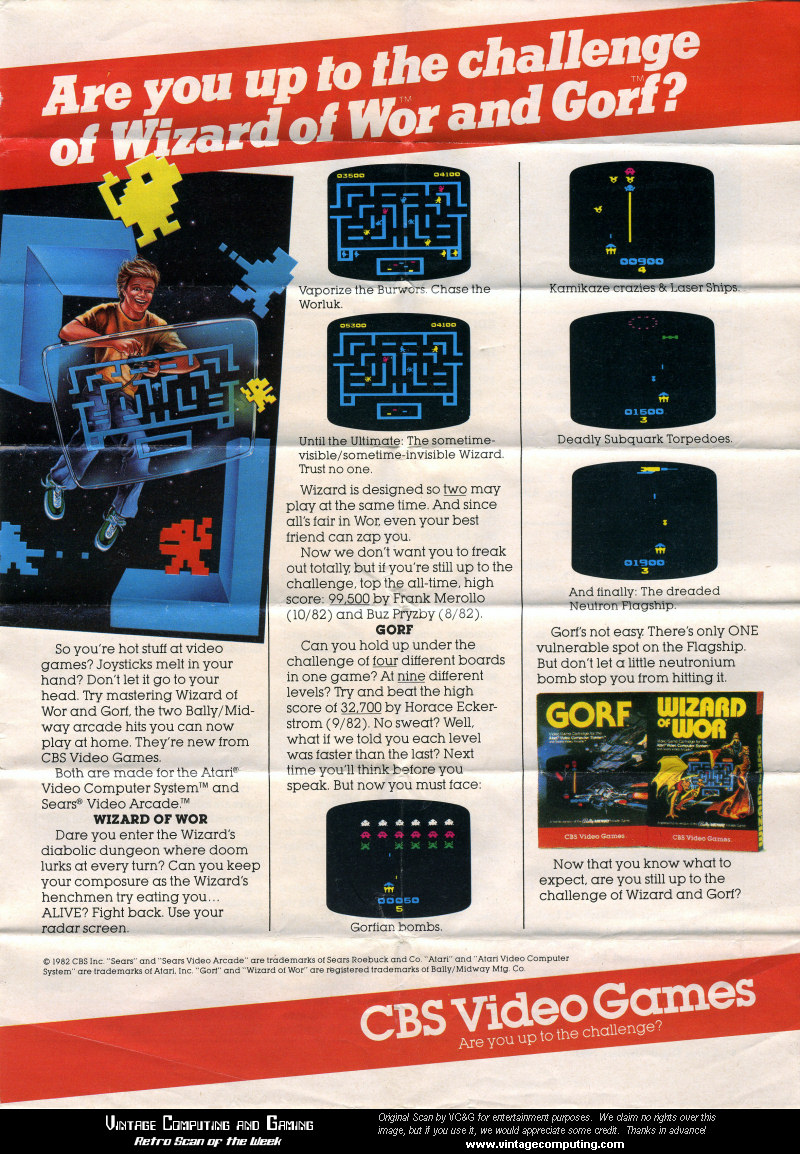 From my pocket to you.
My mother was born in Texas, and my immediate family usually visited her parents every summer when I was a kid. During one of these visits as a teenager, my grandmother invited me to look through her Time Magazine collection. She led me to the back of the family’s wash house, a detached building on their rural Texas property where she did the laundry. Through a side door, we entered my grandfather’s generally dark and cluttered workshop. In the far corner — beyond the tools, beekeeping equipment, and motorcycle parts — I spotted three or four large cardboard barrels overflowing with old magazines. The mouse-chewn issues spilled over the edges of the containers where they had been piled haphazardly for decades.
 I spent the rest of the day thumbing through musty old magazine issues from the 1970s and 80s. While reading a copy of Science Digest from 1983, I ran across the ad for Wizard of Wor and Gorf you see above. I was amazed. In my youthful zest to discover and collect all things vintage, I felt like I had uncovered a lost Egyptian tomb. I’d never before seen a vintage video game print ad — and prior to that, I didn’t know that CBS had published a version of Wizard of Wor (a game I love) for the Atari 2600.
I eagerly tore out the ad page, folded it up, and stuck it in my pocket. Why I didn’t take the whole magazine is unknown to me; I guess I just didn’t want the rest.
Until now, the page you see above has been sitting, still folded, in my collection of vintage print materials. It’s been waiting for a day like this when it can finally end its long journey from my mid-1990s pocket in Texas to you, on the Internet, today.
A year or two later, I revisited the Texas magazine pile and found even more material, especially in Time Magazine. There were issues with cover stories on personal computers, video games, and computer viruses. That time, I took the whole issues themselves. Among them, I found a few ads for IBM systems (like this and this). I probably still have more from that collection that I can scan in the future.
Discussion topic of the week: Tell us about your ancient computing or video game discoveries. When have you felt most thrilled at uncovering old video game or computer history?
If you use this image on your site, please support “Retro Scan of the Week” by giving us obvious credit for the original scan and entry. Thanks.
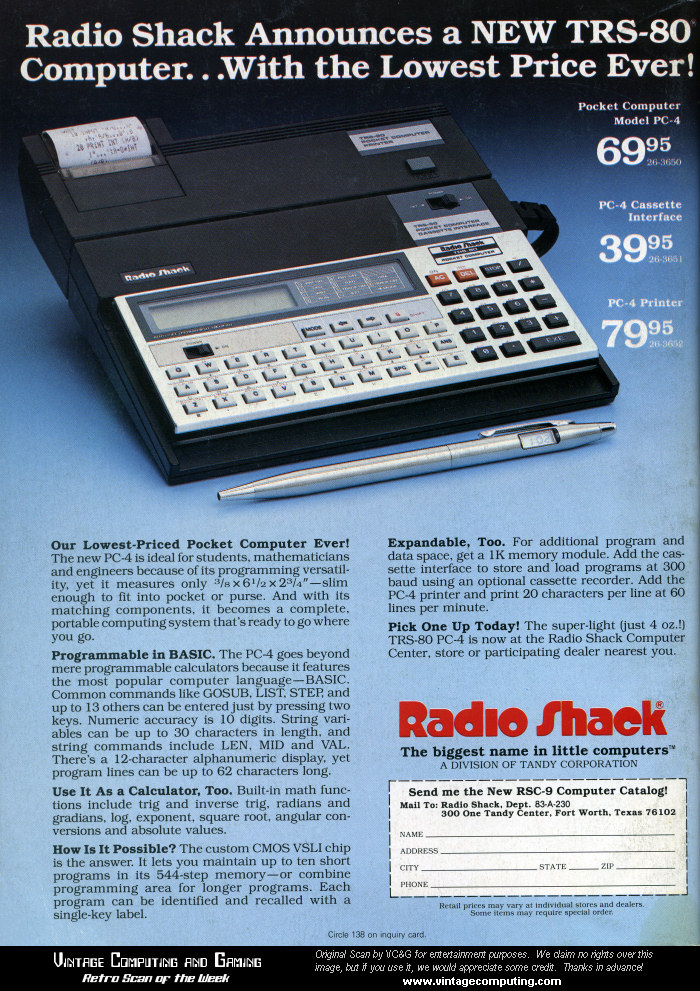 The iPhone has nothing on this. (Click for full advertisement.)
Here we see the state-of-the-art in 1983 pocket computer technology, the TRS-80 PC-4. I have the PC-1 in this series, and it still seems advanced. How many other pocket calculators allow you to program in full BASIC?
I remember taking my PC-1 to high school in the mid-1990s and programming on the sly in my ELP class. It felt so high tech — and my model was made in 1980! Ah, those were the days.
Discussion topic of the week: What was the first PDA or pocket computer you ever used?
If you use this image on your site, please support “Retro Scan of the Week” by giving us obvious credit for the original scan and entry. Thanks.
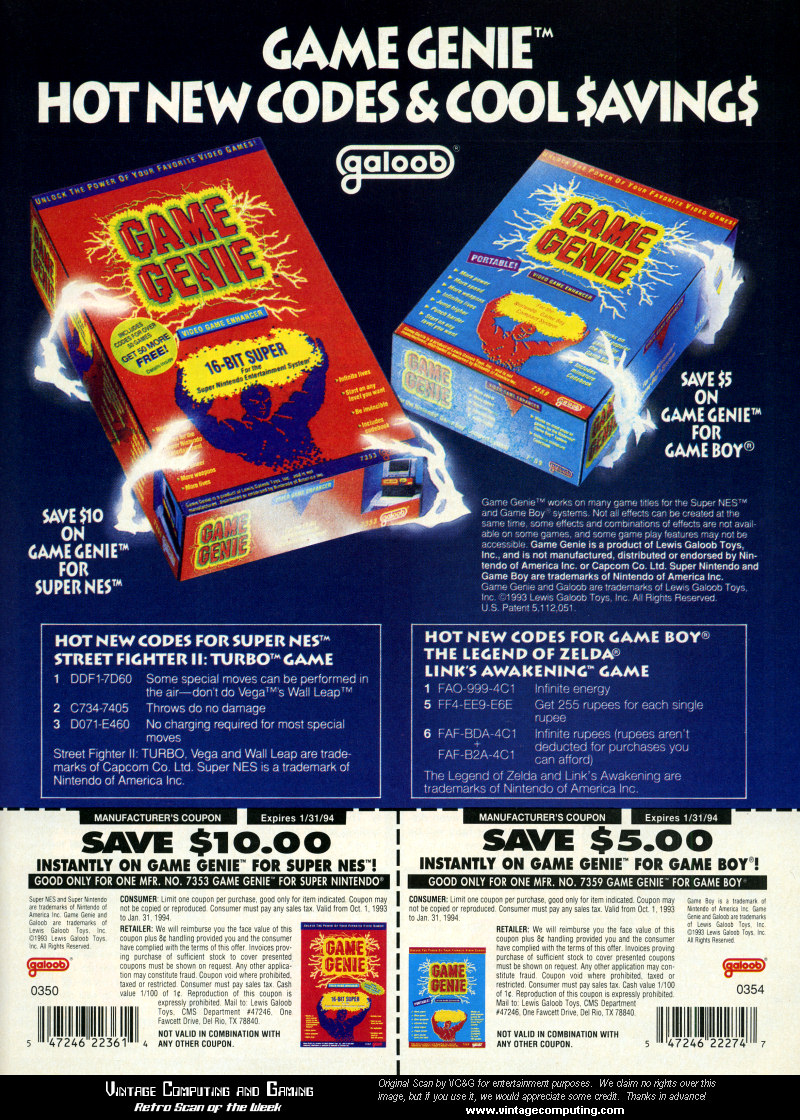 Your wish is my command.
If my previous posts on the Game Genie are any indication (wow, they’re from 2005 — that’s vintage), then I’m a huge fan of the game-manipulating device — assuming, of course, that my 2005 self wasn’t lying just to throw off the accuracy of a future Retro Scan post.
But heck; I shouldn’t have to read my old blog posts to know that. In the early 1990s, I spent untold numbers of hours developing my own Game Genie codes for games like Super Mario Bros. and Super Mario Bros. 3 on the NES, and also for Super Mario Land for the Game Boy (I need to make a homebrew gallery about that). I loved the Game Boy Game Genie so much that I took a hacksaw to its extraneous plastic parts so it would fit on the Super Game Boy. It was a weird kind of love, but it worked.
From there, I moved on to the Super NES Game Genie (I don’t recall developing my own codes for that), and I eventually bought a used Game Genie for the Sega Genesis. The only one I never acquired was the Sega Game Gear version. But I didn’t have a Game Gear back then, so that would have just been silly.
Discussion topic of the week: The Game Genie: reality-bending peripheral or wussy crutch for bad players?
If you use this image on your site, please support “Retro Scan of the Week” by giving us obvious credit for the original scan and entry. Thanks.